In Rocky Mount, N.C., Corey Odom is a dad to a fifth-grader. Forty-miles up I-95, he’s a special-ed facilitator, football and basketball coach at Weldon Middle School in neighboring Halifax County.
You could compare and contrast Weldon and Rocky Mount by any number of demographic measures. But as a parent and a teacher, watching and working as schools adjust to distance-learning during the COVID-19 crisis, the difference is obvious.
“All their classes are on Zoom,” Odom said of Nash-Rocky Mount Public Schools. “We may have one or two classes that are doing Google Classroom or Zoom, but not all of them can do Zoom.”
That’s because if you live in the Weldon City School District, you’re almost 30% less likely to have broadband Internet service than in Rocky Mount. In Weldon, just over half of residents have access to high-speed data, one of the lowest rates in the state of North Carolina. Its surrounding counties, Halifax and Northampton, aren’t much better, according to the American Community Survey. By contrast, nearly 80% of North Carolina households are subscribed to broadband, and in the bigger cities it’s 85 to 90%.
“There are 115 school districts in the state with varying degrees of capacity,” said Todd Silberman, a spokesman for the state Department of Public Instruction. “It’s sort of something that DPI doesn’t control. It can vary even within a district.”

“It’s a story that varies across the state by wealth and by location,” said Michael Priddy, interim director of the education think-tank Public School Forum of North Carolina. Priddy began his four-decade career as an educator in Northampton County and eventually served as superintendent in districts across the state.
He said the academic achievement gap, built on inequitable resources from school to school and district to district, is mirrored in access to high-speed Internet, or lack thereof.
“What you hear are stories of students going to school at night to sit outside the building to do their homework,” Priddy said. “What this pandemic has done is revealed the true nature of the struggle that’s been going on for decades.”
‘This Is Not About Political Debates’
With North Carolina schools shuttered until at least mid-May, the COVID-19 pandemic has touched off a long-roiling debate about the lack of broadband infrastructure in some parts of the state and, more broadly speaking, educational equality between urban and rural districts, rich and poor districts.
In 2018, the state budgeted $35 million in new grant funding for “Growing Rural Economies with Access to Technology” (GREAT), an initiative targeting North Carolina’s 40 most impoverished counties. Last year, these grants totaled almost $10 million to support small telecommunications cooperatives bringing new broadband to 9,800 households and almost 600 businesses in 19 counties, six of them contiguous to one another across northeastern N.C. The General Assembly also passed a law last year allowing rural electric cooperatives to lease the use of their fiber-optic network to Internet providers.
“What this pandemic has done is revealed the true nature of the struggle that’s been going on for decades.”
Michael Priddy, interim director of the Public School Forum of NC
The GREAT grant application deadline for 2020 passed in mid-March, not long before Gov. Roy Cooper closed the state’s schools. The Senate Democratic Caucus is now moving to increase this year’s GREAT grants from $15 million to $25 million to match the number of applications
“I have been advocating for access to broadband in unserved and underserved areas for eight years,” said state Sen. Valerie Foushee, who is chairing the caucus’ COVID-19 work group on local government needs. “It’s being revealed that there are needs that existed prior to the pandemic.”
Foushee lives in Hillsborough and represents Orange County, where Internet connectivity is greater than the state average. She also represents Chatham County, where a quarter of households aren’t connected.
“This is not about political debates,” she said. “This is about what is needed for our citizenry right now to be able to do the people’s business.”

In Robeson County along the South Carolina border, where just over half of households have a broadband connection, Dee Grissett, president of the local chapter of the N.C. Association of Educators, estimates an even smaller percentage of students, about one-third, actually have access to online learning.
“Our county is very rural,” said Grissett. “The Internet infrastructure … is spotty in some remote areas and inaccessible in others.”
“It doesn’t go down every road,” said her Robeson colleague Kendall Hamilton, principal at Littlefield Middle School in Lumberton. “We’ve got some places that just don’t have Internet. It’s not available. It’s uncharted territory. Everybody’s giving their biggest effort.”
Through evidence-based research and consensus-building, Priddy’s organization has been supporting counties like Halifax and Robeson as they’ve fought for more resources to level the playing field in the ongoing “Leandro” case, named for the original Hoke County family who sued the state.
The five counties in the original case — Robeson, Vance, Hoke, Halifax and Cumberland — said they didn’t have the funds to provide access to an equal education, despite taxing their residents at a higher rate. Since the original case was filed in 1994, courts have repeatedly ordered the state to provide more support for underperforming schools.
“We’ve got some places that just don’t have Internet. It’s not available. It’s uncharted territory.”
Kendall Hamilton, principal at Littlefield Middle School in Robeson County
Last year, a court-ordered consultant presented a lengthy report with recommendations on resolving the longstanding equality issues.
“Leandro focuses on these same kinds of issues,” Priddy said. “We call them equity.”
Priddy said access to the Internet and up-to-date technology is going to be more important as schools move away from printed textbooks and toward digital materials. But as long as these resources are distributed based on communities’ ability to pay, poorer students won’t have the same opportunities.
“Right now access to the Internet is a private good, and you purchase it,” Priddy said. “The private providers look at it from a cost-benefit perspective. They have chosen to lay cable in the places where they’re going to get the earliest return on their investment.”
Priddy’s organization is currently studying Internet access for the state’s education system, and he said about 1,000 out of N.C.’s 100,000 teachers live in a neighborhood without broadband access.
“This is an oxymoron,” he said. “Teachers can afford the Internet, but they can’t afford it if it’s not there.”
He compared the Internet to roads and the postal service, which required public investment over decades to make them accessible to everybody.
“We cannot ignore the fact that something needs to be done. This will not be the last disaster.”
NC Sen. Valerie Foushee
“These are public goods, and they’re paid for by everyone through taxes,” he said. “To imagine universal access in every home would require a change in the laws.”
Along with increasing the GREAT grant funding, the Senate Democratic Caucus also wants to push through the Republican-sponsored House Bill 431, the N.C. FIBER Act, giving municipalities the power to invest tax dollars in broadband infrastructure where it might not yet be commercially profitable and then lease it to private Internet companies. That bill has been stuck in the House Finance Committee since August.
Meanwhile, teachers across North Carolina are working with what they’ve got.
‘I Think It’s Above Our Heads’
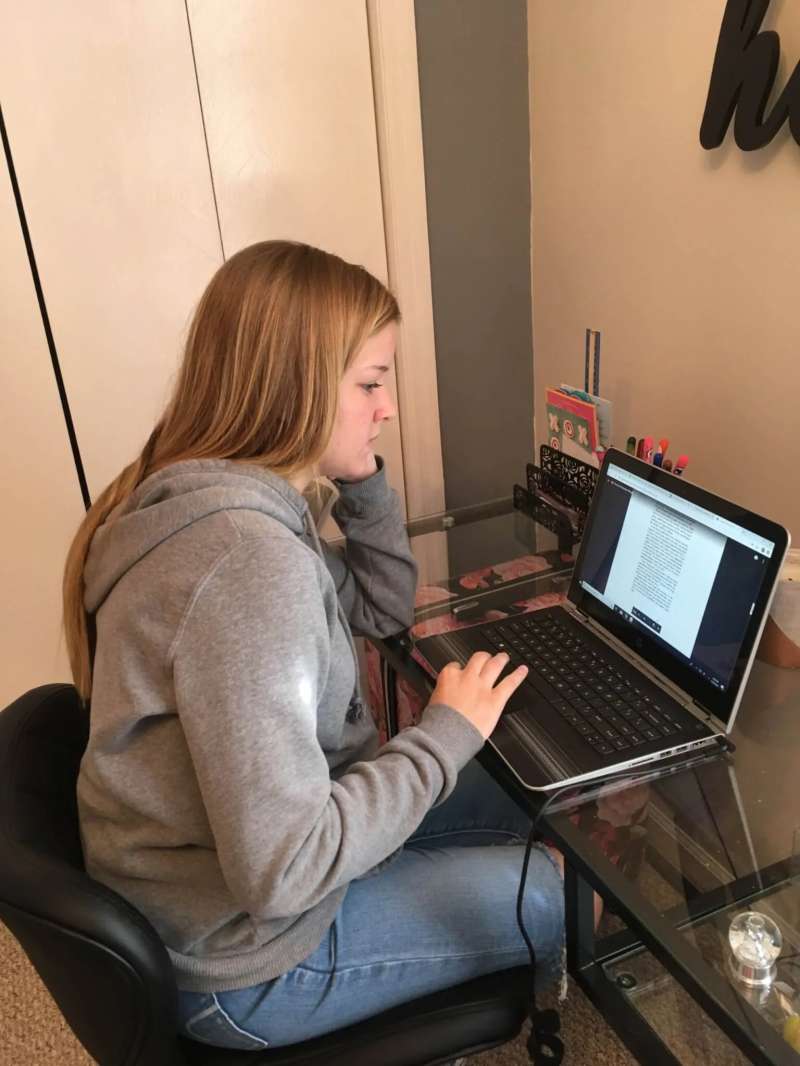
In rural counties, students might go to library parking lots, school campuses or a local McDonald’s to connect to free public WiFi, something they had to do even before COVID-19. Many families signed-up for Spectrum’s free Internet service or are using their cell phones as wireless hotspots. Principals are lending out laptops they bought for other purposes.
All of these strategies are helping teachers and students stay in contact, even if they don’t provide the bandwidth for live streaming lessons or class discussions. Still, reliable Internet service isn’t available in every neighborhood, and not every family has a cellphone with robust data plans or convenient transportation to public WiFi.
“We just don’t have enough towers in rural areas,” Odom said. “It’s a problem with the network. I don’t think it’s a school issue. I think it’s above our heads.”
That’s why educators across the state are assigning schoolwork on paper for families to pick up at their schools, even as they’ve scrambled to master online teaching platforms.
“It’s a little bit new to everybody,” said Hamilton. “Even though we’ve been practicing with it, it’s not like you’ve gone full scale. I know the teachers are working hard.”
“Our county is rocking it out,” said Marylaura McKoon, principal of E.O. Young Elementary School in Henderson, Vance County, north of Raleigh near the Virginia state line. “I’m so proud of what we’re doing.”
McKoon spoke by phone while handing out homework packets and Google Chromebooks in front of her school earlier this week. E.O. Young has more than 100 of the laptops, most of which the principal ordered through a federal Title I grant, arriving just before the coronavirus crisis. E.O Young receives additional federal funding because all of its students come from low-income households and qualify for free or reduced-cost lunches.
“I’ve been able to deploy all of (the Chromebooks) but two,” McKoon said. “They’re moving out quickly, and then you just pray about them. You pray about them because they’re not cheap.”
In a county where one in five households don’t have a computer, it costs about $20,000 to disperse the devices in a single elementary. For McKoon, delivering free lunches and homework packs is part of the struggle for Leandro districts like Vance.
“There are just so many different platforms that are free right now so that teachers can communicate with their children and their children can communicate back with them,” she said. “But not all children have access to the online classes, so we have to be able to prepare for everybody so that it’s equitable.”
Remote education shifts much of the responsibility from teachers to students and their families, changing the expectations educators can have.
“Some kids function great,” said Hamilton, the Lumberton principal. “They prefer that method of learning. I think a lot of it depends on the individual. It’s like college students. Some may respond better to this.
“Even when we’re in school, the subject that they like the most, they’ll do it a lot more than they do the others,” Hamilton added. “If I’m really interested and if I want to, every kid in America, if they really want to learn something, they can get on their phone and they can Google it.”
McKoon said at least one student at E.O. Young in Henderson was so frustrated with online learning the principal told his mother to let him work with the paper packets.
“We don’t want to stress out the mamas,” she said. “It’s just about making sure that they’re connected to us. It’s made them feel that they’re not alone.”
Hamilton agreed. “What kids miss most is being in a routine and getting to see their friends. That’s the biggie. As you get off your regular daily schedule, it would be difficult to do eight hours of school at home, or even seven for that matter. We try to encourage a good amount of time every day.
“The teachers can plan back and forth and throw ideas around online, but the relationships are important,” said Hamilton. “People are just social. They’re just social. I think people just need each other.”
McKoon said students are only reviewing material they’ve already learned, because it’s not fair to expect the kids working with paper packets to learn on their own without being able to ask questions in the moment.
“It’s all review. This is intervention and expansion,” she said. “We can’t introduce new standards until everybody’s online, and that’s going to be a challenge.”
But that challenge, says Sen. Foushee, predates the COVID-19 crisis. These needs were here all along.
“We cannot ignore the fact that something needs to be done,” said Foushee. “This will not be the last disaster.”