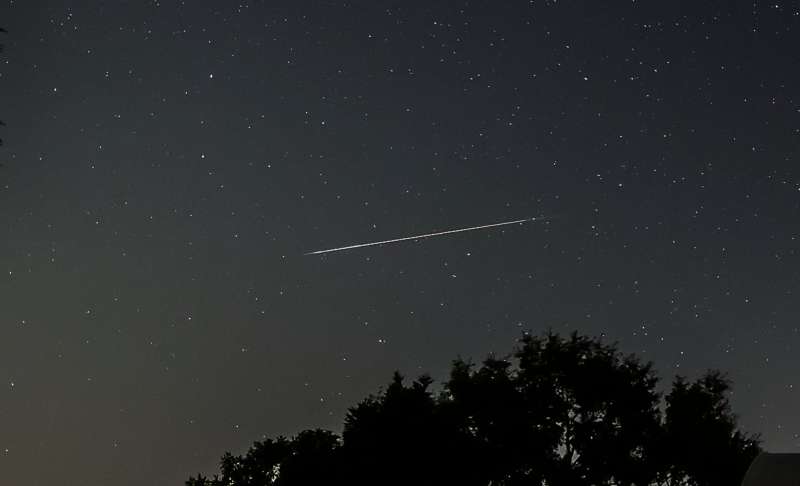
The Perseid meteor shower is at its peak, but if the weather doesn’t cooperate with viewing now, there is still plenty of time to see it.
Considered one of the world’s favorite meteor showers, the Perseid meteor shower is considered one of the most spectacular yearly showers observable from the U.S. NASA says that 50-100 meteors can be observed hourly during much of the Perseids’ duration.
Read More: 6 stunning celestial events in NC this summer
While the chance of storms may obstruct some people’s views in Western North Carolina, a new moon during the Perseids meteor shower peak times should make for good viewing otherwise.
If you’re hoping to make a wish, or simply observe yet another incredible cosmic display, here’s what to know about viewing the Perseids in North Carolina.
When is the Perseid meteor shower? When do the Perseids peak?
According to EarthSky.org, the Perseids will be visible July 14-Sept. 1, and are expected to peak at 9:53 a.m. on Aug. 13. The website notes that the early morning hours of Aug. 12-13 will likely be best for viewing, but notes that the Perseids “tend to fall off rapidly after their peak.”
What will the moon phase be during the Perseids peak?
Another plus for the Perseids this year ― a new moon falls Aug. 12, just before the shower’s peak, meaning that if the weather holds up, viewers will likely be able to see even more meteors than usual with particularly dark skies.
What is the best time to see the Perseids?
Pre-dawn hours, particularly on peak viewing days, are generally the time at which the Perseids are most spectacular, though they may be visible earlier in the night. NASA says they can be visible as early as 10 p.m.
What are Perseids?
According to Space.com, the Perseid meteor shower is an effect of the comet Swift-Tuttle, discovered in 1862. Swift-Tuttle is the largest object known to repeatedly pass Earth, with a nucleus of about 16 miles wide.
Read More: 9 ways to get into microvolunteering in North Carolina
In short, the observable “shooting stars” provided by the Perseid meteor shower are actually pieces of Swift-Tuttle comet debris heating as they enter Earth’s atmosphere and burning in bright bursts of light. The meteors can travel at 37 miles per second, according to NASA.
How to watch the Perseids shower
As usual, the darker the skies, the better the stargazing. Apart from observing as late at night ― or early in the morning ― as you can stand, avoiding light pollution will provide for a better viewing experience. Find clear, open spaces for the best views of the sky.
Space.com advises stargazers to look up and to the north for the best views of the meteors. In southern latitudes, viewers look toward the northeast.
One special option in the Western N.C. area is North Carolina’s only certified Dark Sky Park. Pisgah Astronomical Research Institute, or PARI, holds regular viewing events for significant astronomical events ― including the Perseid shower. Visit for the evening or book a campsite or cabin on Aug. 9, near the shower’s peak.
Reporting by Iris Seaton, Asheville Citizen Times / Asheville Citizen Times
USA TODAY Network via Reuters Connect