Reporting by Cory Vaillancourt, Asheville Citizen Times
The face in the painting is split down the center. On one side is the seal of the Eastern Band of Cherokee Indians. On the other side, the Stars and Stripes. The man in the painting is not torn between them. He is whole.
As the United States prepares to mark 250 years since the Declaration of Independence — a document that espoused universal ideals while excluding women, enslaved people and Indigenous nations from their full meaning — the anniversary lands in a more complicated place for Cherokee people.
The American Revolution helped create a country that did not see Cherokee people clearly. The centuries that followed brought treaty violations, removal via the Trail of Tears, forced assimilation, discrimination and attempts to dissolve Indigenous identity into something more manageable for the nascent United States.
Still, Cherokee people remain. They remain in art. They remain in language. They remain in the names of mothers and grandmothers. They remain in tribal government, town government and state government. They remain in the difficult patriotism of people who can love a country without letting it lie about what it has done.
That is the uneasy power inside “Unrelenting: Cherokee People and the American Revolution,” an exhibit on display at the Museum of the Cherokee People — one of the oldest tribal museums in the country — through Dec. 30.
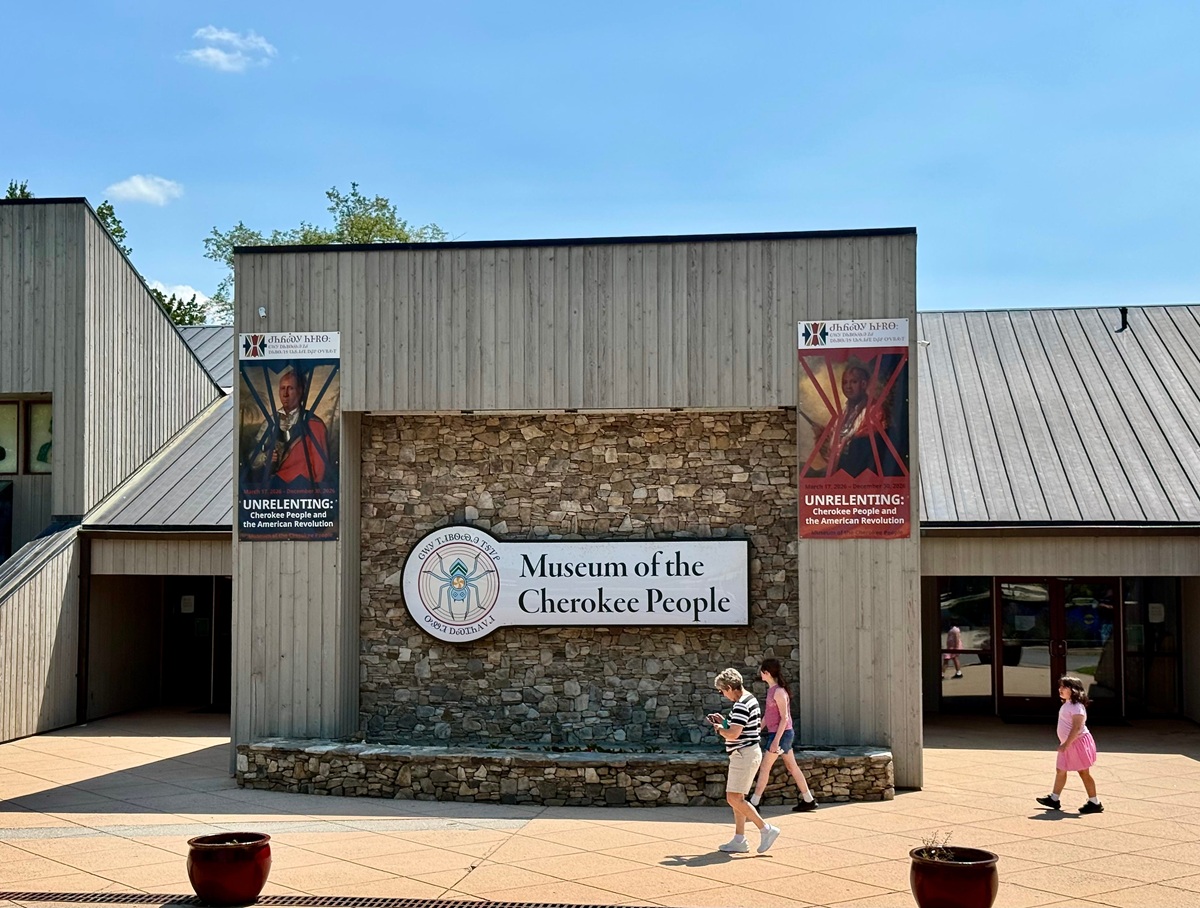
Established in 1948, MotCP is located on the 57,000-acre Qualla Boundary, the ancestral home of the Cherokee people. It is governed by the Eastern Band, a separate entity from other tribal governments in other states.
The exhibit, really a juxtaposition of contemporary and traditional elements, is not a birthday card. It is not a grievance. It is a mirror in which questions loom ominously. Who counts as American? Who decides? Who remembers? Who gets remembered?
“I think American memory wants to make it black and white,” said Shana Bushyhead Condill, 49, executive director of the Museum of the Cherokee People told the Citizen Times June 26. “This is all about making that more complex.”
Condill said the museum began hearing from state and federal America 250 officials in 2022 about a possible commemoration. The museum could have folded its work into that wider mission, but instead self-funded the exhibit so Cherokee people could tell a Cherokee story from a Cherokee perspective — without outside strings.
That independence shapes the room. Visitors do not move through the exhibit in a structured march from past to present. They can start anywhere, go anywhere. Condill said that matters because Cherokee storytelling is not usually linear. It moves by theme, by memory, by relation.
A complicated patriotism for the Cherokee people
One wall tells visitors that 1776 was not simply the birth of a nation. For Cherokee people, it marked the start of the Cherokee-American Wars, the destruction of towns, the dispossession of homelands and the shaping of later federal Indian law. Andrew Jackson spent much of his presidency advancing Indian removal, using federal power to force Southeastern tribes from their homelands, setting the table for the Trail of Tears in 1838 and clearing the way for white settlement.
Another panel in the exhibit carries the story forward. Cherokee people remembered the violence of the 1770s when opposing treaty violations in the 1800s. They endured forced relocation and forced assimilation. They continued fighting for homes, cultures, identities and sovereignty.
The panel also holds the other half of the truth — Indigenous people serve in the U.S. Armed Forces at the five times the national average, per the National Council on Aging.
Patriotism is complicated, the exhibit says. Each person has a unique relationship with tribal and national government.
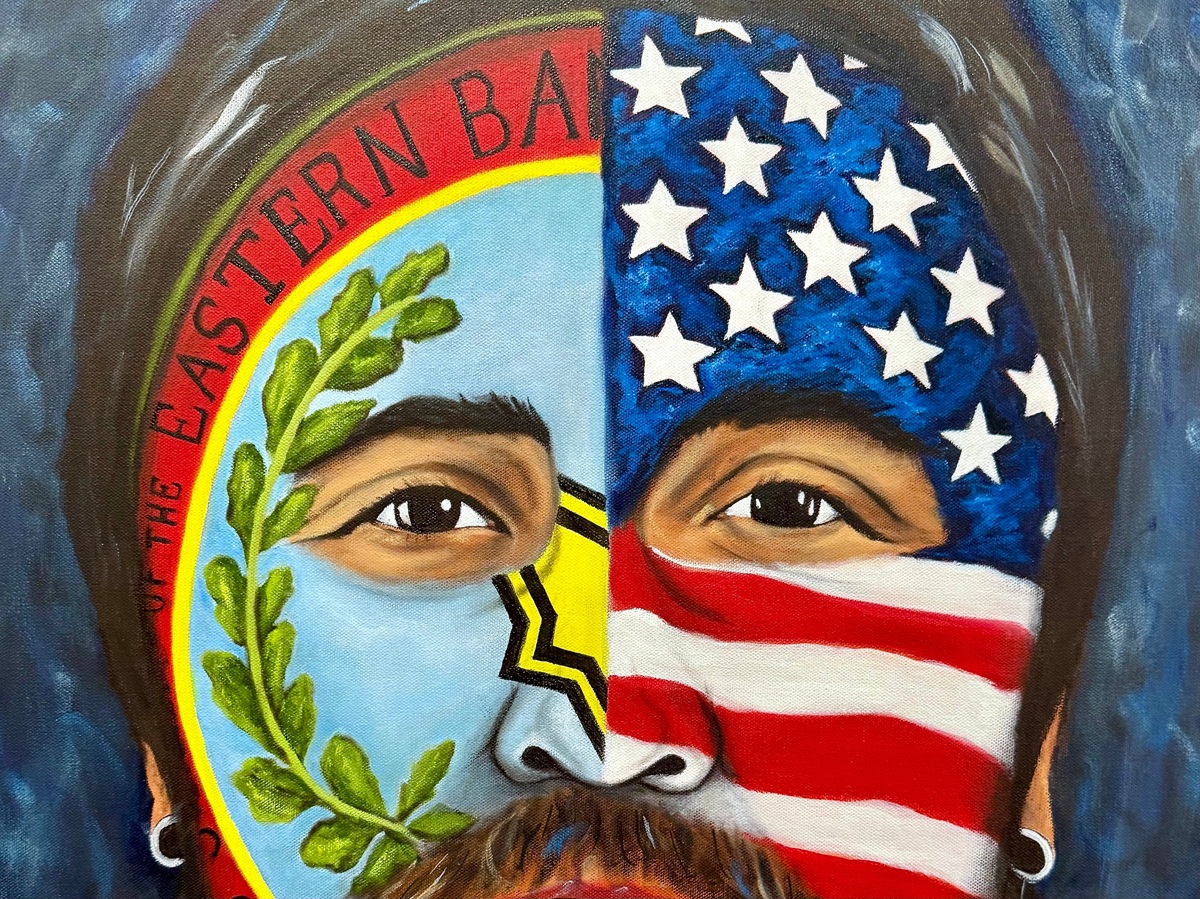
That theme is the whole story, right there in Aaron Lambert’s “American Indian,” the split-face self-portrait that serves as the emotional center of the exhibit’s argument.
Lambert’s artist statement says one side honors his Cherokee heritage, rooted in the Qualla Boundary, while the other honors his life as a U.S. citizen navigating the promises and complexities of American identity. The split is not a division, but a fusion.
Governing by consensus
The idea also runs through a red wall titled “Rematriating our History and our Nations.” America 250 is filled with founding fathers. The museum insists there were mothers, too.
Cherokee society has traditionally been matrilineal and egalitarian. Women were clan mothers, decision-makers, leaders, life-givers. Colonial powers failed to recognize such authority because they rarely had to look for power outside male forms.
That failure still echoes in secondary scholarship, Condill said. Cherokee women were not merely helpful. They were powerful.
“What we know as Cherokee people is that governance was much different than European governance,” she said. “Decisions were made by consensus and everybody’s voice mattered.”
Pride, pain and public service
Perry Matthews can hold that contradiction without sweetening the bitter bits.
Matthews, 41, is not an enrolled member of the Eastern Band, but has Cherokee ancestry and is the descendant of people taught by force that America’s promises could arrive with a beating, a school uniform and a command to stop speaking their own language.
“I’m proud to be an American. I think we do live in a great country, regardless of how crazy things get, or are. But I’m also very proud to be from the sovereign nation that I am from,” he told the Citizen Times June 25. “I’m proud of where my people have come to and I think any Indigenous person should be proud that, you know, we’re still here.”
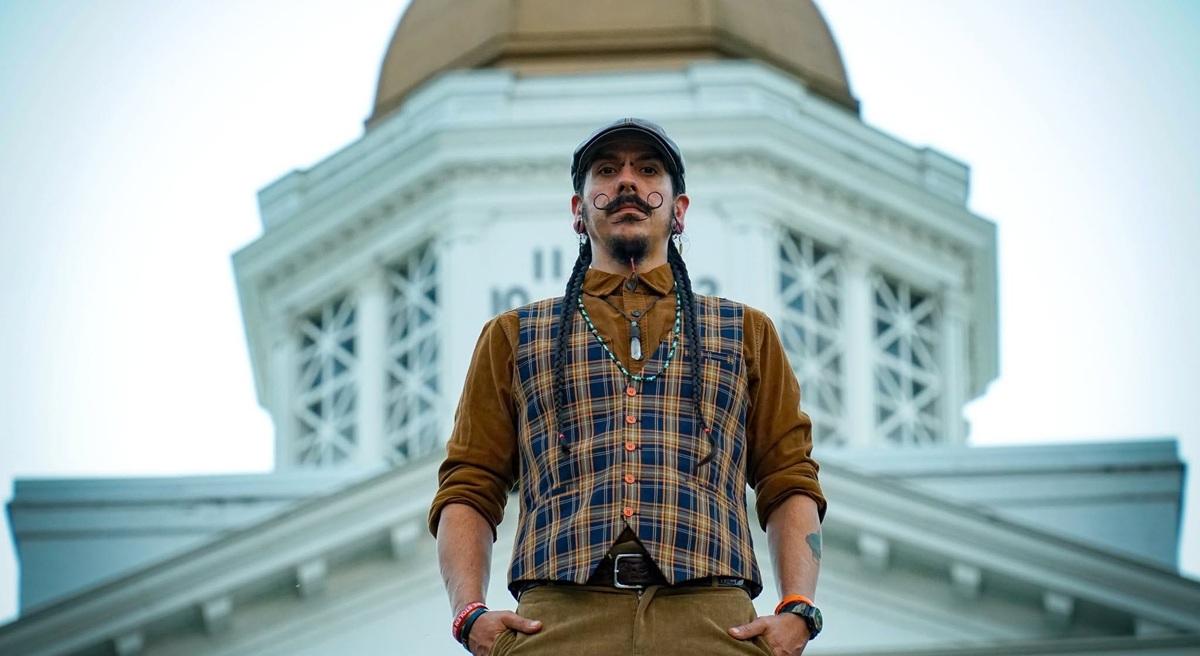
Matthews does not offer his experience as the universal Cherokee answer. He offers it as one man’s attempt to carry pride and pain in the same body.
For him, that duality is not merely academic. His grandparents and great-grandparents, of Qualla’s Wolftown community, were sent to boarding schools. Some were punished for not knowing English. History, Matthews said, can sow distrust of the government and of the world beyond the Qualla Boundary.
Growing up in Western North Carolina, Matthews said he often felt accepted but sometimes only within limits. He had white friends, but also felt the quiet message that an Indigenous kid could be well-liked without being expected to rise. Politics felt outlandish. Power felt like it lived in some faraway place.
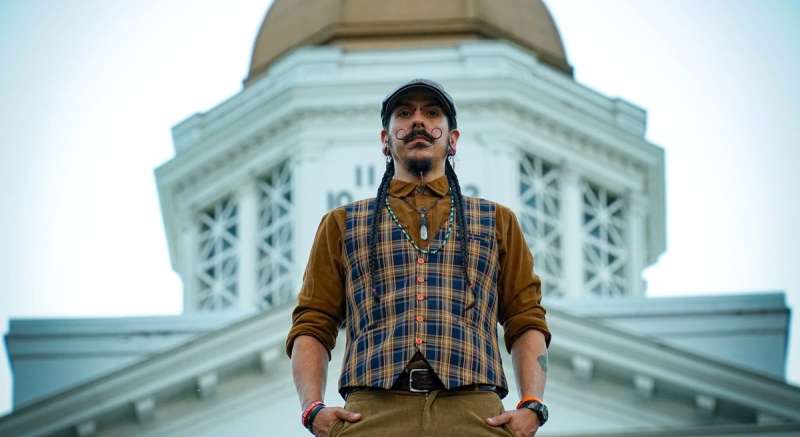
Yet Matthews, who works as a chef, caterer and culinary instructor at Southwestern Community College in Jackson County, chose to run for office anyway and is now part of a growing number of Cherokee people gaining power through public service outside the Boundary.
He was first elected to the Town of Sylva’s Board of Commissioners last fall, transforming citizenship from an idea into an action and showing how the story of America250 cannot be told only through presidents, battlefields and dusty founding documents; it has to pass through school systems, town halls, and everyday people who learned to be suspicious of government but still sought to govern.
Matthews sees that same turn in Anna Ferguson, an enrolled member of the EBCI who owns a boutique on the Qualla Boundary called the Dogwood shop.
Ferguson, 54, became the first enrolled member of the Eastern Band of Cherokee Indians to serve in the North Carolina House of Representatives after she was appointed following the death of Rep. Mike Clampitt earlier this year. Her three-county district includes Swain County, Macon County and Jackson County, named after Andrew Jackson in 1851.
To Matthews, Ferguson’s rise was something he did not expect to see so soon. A Cherokee person from this region serving in the General Assembly once felt like something that might happen down the road. Then it happened.
It doesn’t fix history. It suggests Cherokee people were not frozen in the role America assigned them and are now shaping the governments that once tried to shape them.
“They were like, ‘Well, if we can’t kill them, we’ll just make them like us. We’ll try to kill their language and kill their lineage and slowly eradicate them that way,” Matthews said. “I think that didn’t exactly work out the way they thought.”
The first, but not the last
Ferguson, a Republican, does not talk about history as something that can be fixed.
The Trail of Tears cannot be undone. Boarding schools cannot be unbuilt. The founding documents cannot be made to include the people they excluded at the moment they were written. To pretend otherwise would make history cleaner than it was.
“I do not believe you can truly ‘right a wrong’ when it comes to history,” Ferguson told the Citizen Times June 28. “Who we are directly corresponds to what we endured and what we prospered from. In my opinion, ‘righting a wrong’ is trying to put yourself in an imaginary place, one which exists if your past has been entirely different. I think this type of thinking dishonors what you experienced to make you who you are.”
That is not a surrender. It is a harder kind of patriotism.
Her role also weaves the exhibit’s matriarchal thread into the present. Ferguson did not initially see herself in the General Assembly. When the idea was first raised by supporters last year, she said no. She had a fixed image of what a state representative looked like, and no one like her had walked that path before. Then, she realized that was exactly the point.
“I may be the first member of the EBCI named to state leadership, but I am the result of a community who paved the way for me,” she said. “I am the product of my mother’s accomplishments and my grandmother’s accomplishments. I am the descendant of every tribal elder who worked hard and pushed forward to make better lives for their children.”
In that answer, Ferguson becomes more than a political first. She becomes a bridge between the lush, knobby peaks of the Qualla Boundary and the floor of the House in Raleigh, nearly 300 miles away.
Mothers. Grandmothers. Elders. A door opened, then held open. That is why the story cannot end in sorrow. Nor can it end in simple celebration.
Such is the answer “Unrelenting” offers to America250 — not forgiveness on demand. Not grievance as identity. Not patriotism scrubbed clean of blood and loss.
Memory. Sovereignty. Service. Survival.
As she runs to retain the seat this fall against Transylvania County Democrat Mark Burrows, Ferguson said her focus is being “the best female Indigenous Jackson County based representative” she can be. Her phrasing is specific because the history is specific. She is not simply entering American public life. She is entering American public life as herself.
The face in Lambert’s painting is split, but it is whole. At 250, America is too, whether it admits it or not. Cherokee people know how to live with that complexity because they have had to. The question now is whether America can.
For all the violence, the erasure and the discrimination, one fact still stands at the center of the room.
“When looking at 250 years, it is important to recognize our entire nation’s history without silencing the stories that are difficult to hear,” Ferguson said. “Being a true patriot is about looking at your history critically and using it to determine how to best serve when moving forward.”
Cory Vaillancourt is the Helene Recovery/Investigations Reporter for the Asheville Citizen Times. Find him on X at @The_CoryV or on Signal, via email at cvailllancourt@citizentimes.com or at 912-508-5640.
This article originally appeared on Asheville Citizen Times.
Related: Asheville immigrant advocates praise Supreme Court birthright citizenship ruling