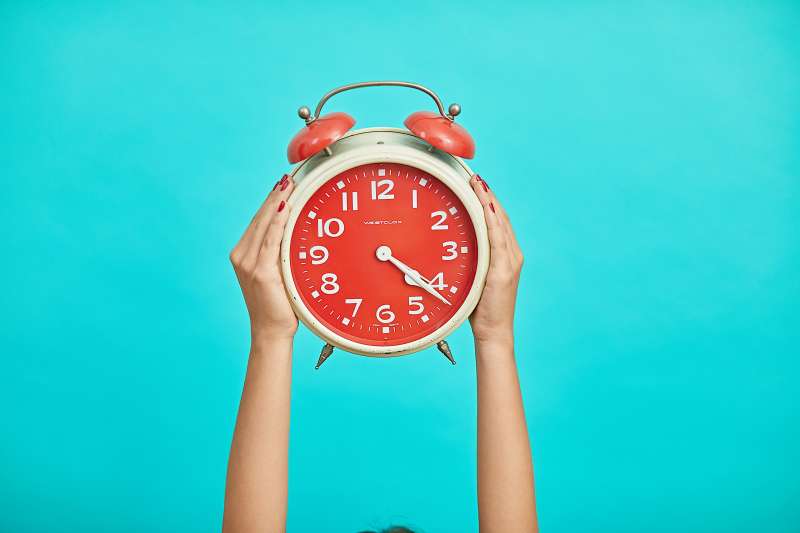
In a few short days, daylight saving time comes to an end in North Carolina, and for many in the United States, time will “fall back” once again.
The phrases “spring forward” and “fall back” refer to the seasons in which time changes occur. When daylight saving time begins on the second Sunday in March, clocks are set forward by one hour. When it ends, clocks are set back by one hour.
North Carolina news, culture, and politics in one free, award-winning newsletter. Sign up for Cardinal & Pine here.
The first Sunday of November marks the end of that roughly eight-month period between spring and fall when the sun stays out longer.
Here’s why we have daylight saving time to begin with.
When does daylight saving time end? When do we fall back in 2026?
Clocks will fall back on Sunday, Nov. 1, at 2 a.m., according to the Old Farmer’s Almanac.
When did daylight saving time start?
Daylight saving time began in Germany during World War I, when the country sought ways to save energy. Germany moved the clock forward to have more daylight while people were at work. Several countries, including the U.S. in 1918, followed suit for the duration of the war.
Daylight saving time was used again during World War II to conserve energy for war production and later became a national standard in the U.S. in 1966, when Congress passed the Uniform Time Act.
The only two states that don’t follow DST are Arizona and Hawaii.
Why do we have daylight saving time?
According to the Farmer’s Almanac, daylight saving time— not “savings” as many of us are guilty of saying— began as a way to use natural daylight more efficiently. This means more daylight in the summer evenings and more in the winter mornings.
You may have heard that daylight saving time was created to assist farmers by extending daylight hours and therefore optimizing work hours. This is actually a common myth. The Farmer’s Almanac points out that the practice even inhibits farmers who work with animals since livestock only know internal clocks based on sunrise and sunset.
Do all states observe daylight saving time?
Not every state observes daylight saving time.
Over the years, 19 states have tried to do away with daylight saving time, but there are only two states in the U.S. that don’t observe the practice. Hawaii and Arizona do not observe daylight saving time.
Arizona doesn’t follow daylight saving time (with the exception of the Navajo Nation) because of the desert climate. After most of the U.S. adopted the Uniform Time Act, Arizona decided against adjusting clocks to make sunset occur an hour later during the hottest months of the year, reports USA TODAY.
For Hawaii, the state is so close to the equator that there is not a lot of variance between hours of daylight during the year.
Five other U.S. territories do not participate, either:
- American Samoa
- Guam
- Northern Mariana Islands
- Puerto Rico
- U.S. Virgin Islands
Reporting by Joyce Orlando, USA TODAY NETWORK / Asheville Citizen Times
USA TODAY Network via Reuters Connect