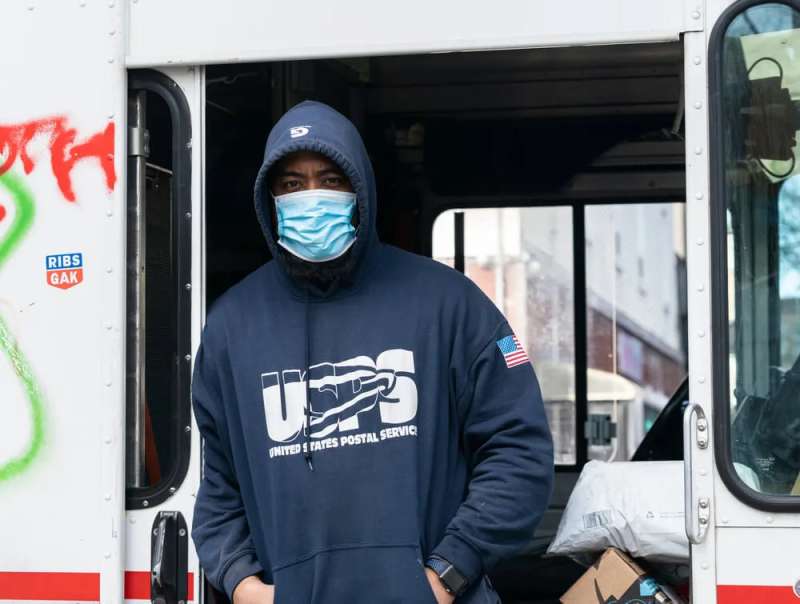
As the Trump administration and privatizers dismantle the US Postal Service, public educators can relate to their plight.
By rolling out changes too aggressively and shedding a veil of plausible deniability, those behind the privatization of public services overplayed their hand with the US Postal Service.
Their actions undermined service delivery of the Postal Service, but it’s important to note that the Postal Service isn’t the only frog that has been slowly boiled. Public schools keep the Postal Service company in that pot. Indeed, privatizers are salivating in anticipation of feasting on these government services.
Facts first. Subscribe to the Cardinal & Pine newsletter here.
As a social studies teacher—who is also the daughter of two USPS employees—I have witnessed and experienced the increasing heat of privatizers.
When I was in high school, my dad, a letter carrier, was able to finish his work day in time to make all of my late afternoon softball games.
But after I graduated college, it wasn’t unusual for my dad’s work day to end after dark six days a week.
Route consolidation and hiring freezes meant more work with fewer employees. My dad sympathized with carriers who had younger children, realizing that he would have missed many of mine and my brother’s activities if those conditions existed over a decade earlier.
In 2006, Congress passed a law requiring the USPS to pre-fund retiree health benefits. At the time, it was sold as a way to protect employees. Instead it turned a solvent public service into one bleeding cash. Six years later, the Postal Service defaulted on its payments. When the USPS requested aid from the same legislative body that created the adversity, they were dismissed as wasteful and unsustainable.
RELATED: Meet the Grammy-Nominated NC Musician Who Played For Protesters at Louis DeJoy’s Home
But planning for the simultaneous retirement of all employees is beyond fiscal conservatism. It is fiscally irrational.
The post office’s experience is not unique. Parallels can be drawn in the treatment of public schools nationwide, and North Carolina in particular.
Breaking public services by creating conditions that harm public trust and demoralizes employees are common tactics designed to make privatization more palatable.
In the past decade, North Carolina’s schools have seen class size caps in most grades removed, lower funded purchasing power for educator salaries and per pupil expenditure, cuts in teaching assistants and custodial staff, and many more. Like employees of the Postal Service, educators have been tasked with more work and less support, leading to lower morale and higher turnover.
In 2017, the NC General Assembly passed a law ending health coverage in retirement for any state employees and educators joining state service after January 1, 2021.
Borrowing a page from those undermining the Postal Service, lawmakers argued the State Health Plan was insolvent with over $42.2 billion in unfunded liabilities.
The total figure was based on the assumption of all employees retiring at once. In fiscal year 2017 alone they underfunded the health plan by $390 million. Teacher turnover rates were already on the rise and this new law would inevitably diminish the incoming pipeline by eliminating an incentive to join public service.
NC Treasurer Dale Folwell added his own hot air to the boiling.
Instead of waiting until the open enrollment period in October to complete an audit of non-employee dependents on the State Health Plan, Folwell’s office sent letters to employees in May 2017 instructing them to submit evidence that their children are their children no later than July 31. Otherwise, their dependents would be dropped from the State Health Plan in the name of rooting out fraud.
During the summer after my first year of college, I joined the “family business” as a substitute mail carrier. Through that experience I developed a healthy fear of dogs and an understanding of how to distinguish between mail classes.
When I first received notification from the treasurer that I needed to prove that my children are my children (despite having submitted this paperwork earlier in the year when a “qualifying event” allowed me to add them to my plan), I almost threw the letter away thinking it was a scam.
One would think such an important letter would have been sent with something better than “junk mail” postage.
The angst of that experience repeated the following summer when the “unfunded liabilities” of the State Health Plan were used to justify brinkmanship with the state employees’ health care provider network by threatening to kick out of the network any doctors or hospitals who did not submit to Folwell’s prescribed reimbursement rates.
After only a portion of providers and five hospitals signed on to Folwell’s project, Folwell was forced to blink and the network remained intact.
After three years of draconian measures supposedly on behalf of the stability of the State Health Plan, this June lawmakers took $47.2 million out to pay for step increases on the state’s teacher salary schedule.
This move contradicts the earlier messages that the sky is falling on the State Health Plan.
All of this to say: Some government officials don’t believe in the societal value of public services. We cannot continue to send people to government positions who facilitate the “we’ll break it so others can buy it” treatment of public services.
From a business perspective, it is not profitable to deliver to each address or educate children of all backgrounds.
The business of government is advancement of the public good, not private profit.
The founders of our country touted the public good generated by a national post office and emphasized the importance of education to prepare future participants in our democratic republic.
But by today’s broken standards, too many would label even our esteemed founders “socialists.”