As fighting in the Middle East drives up oil prices, North Carolina families are paying more at the pump and the supermarket—even though their paychecks haven’t budged.
Across North Carolina this spring, the routine has become familiar: fill up the gas tank, watch the number on the pump climb past four dollars per gallon, then walk into the supermarket and see a few basic grocery items add up to more than they did even a month ago. For many North Carolina families, incomes haven’t changed, but the cost of getting to work and putting food on the table has.
They’re not alone. Gas prices are rising again across the country. Since late February, when President Donald Trump ordered large-scale air and missile strikes on Iran, fighting in the Middle East has rattled global oil markets and put a key shipping route, the Strait of Hormuz, at risk. That narrow waterway off Iran’s coast carries a significant share of the world’s oil. When it is threatened or closed, traders and oil companies brace for shortages, and global prices jump.
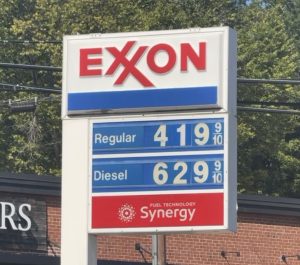
In the weeks after the war began, national gas prices surged. By the end of April, the American Automobile Association (AAA) reported that the average price for a gallon of regular gas in the US had climbed 27 cents in a single week to about $4.30, roughly $1.12 higher than at the same time last year and the highest level since late July 2022. As of May 11, that average is $4.52. In North Carolina, the climb has been similar. The statewide average for regular gas is now $4.16 per gallon, up from roughly $3.92 from a month ago and $2.84 from a year ago.
READ MORE: Why are gas prices so high? NC, US hit $4 as Iran war continues
Oil shockwaves felt at home
Energy officials have a technical term for moments like this: a supply shock. Analysts have long described the Strait of Hormuz as one of the most sensitive points in the global energy system because so much oil and gas normally moves through it. When war, blockades, or missile strikes threaten that route, markets react quickly.
At the same time the Iran war sent new waves of risk through the region, oil fundamentals tightened at home. In late April, crude oil prices jumped nearly $7 in a single day of trading to settle around $106 a barrel, according to data summarized by AAA from the US Energy Information Administration (EIA).
The EIA reported that US crude inventories fell by more than 6 million barrels from the previous week, while gasoline supply dropped from about 228 million barrels to 222 million as demand edged higher. Higher crude prices and tighter gasoline supplies tend to filter through quickly to the price on the sign outside a gas station.
Even as crude oil has slipped back below $100 a barrel amid negotiations to reopen the Strait of Hormuz last week, drivers are still seeing sharp increases at the pump. In North Carolina, that means regular gas now costs $1.34 per gallon more than it did last spring, and diesel—the fuel that keeps trucks and farm equipment running—is well above $5.40. For commuters, delivery drivers, and small businesses, those extra dollars accumulate fast.
A high-cost ripple effect
The most visible impact of higher oil prices is at the pump, but oil’s reach extends further.
When fuel costs rise, trucking and shipping companies pay more to move food and goods. Farmers pay more to run equipment and to buy fertilizer, much of which is made using natural gas. Warehouses and factories face higher energy bills to keep lights on, machines running, and trucks loading at all hours.
Over time, those costs are built into the price of a gallon of milk, a bag of rice, a frozen pizza, and other basics on the shelf. A single grocery run in North Carolina can carry the weight of decisions made in Washington and Tehran, even if the shopper paying the total has never heard of the Strait of Hormuz.
For households already stretched by rent, medical expenses, or debt, that extra pressure shows up as shorter trips, tighter lists, and more calculations in the checkout line about what can wait until next week.
Clean energy projects slashed as prices rise
In practical terms, North Carolinians are paying for this conflict in at least three ways.
First, through federal tax dollars that fund military operations overseas—money that might otherwise be available for schools, healthcare, or energy projects at home. Second, at the pump, where the statewide average for a gallon of regular gas is now above $4 and diesel well above $5.
Advocates for clean energy argue that there is a third cost as well. While families are paying more for oil, they note the Trump administration has moved to roll back or delay clean-energy projects and incentives designed to make power cheaper and more stable over time.
One high-profile example happened in March, when the New York Times reported on a nearly $1 billion approved payout that allowed a company to walk away from offshore wind farms off New York and North Carolina. Project supporters said offshore wind installations could have provided steadier, more local and affordable power for homes and businesses.
Oil is a globally traded commodity. The price drivers see in Raleigh or Charlotte depends not just on what happens in North Carolina, but on decisions in Washington and Tehran, and on whether tankers can safely move through vulnerable shipping lanes thousands of miles away. As long as the US builds its energy system around fuels that are priced on global markets and exposed to wards and blockades, household budgets here will remain sensitive to shocks that begin somewhere else.
Reduced dependence protects North Carolina families
Solar and wind power don’t erase oil’s role in the economy, but they can blunt it.
Once panels and turbines are built, their “fuel,” sunlight and wind, comes from home, not from a market that reacts to every explosion, blockade, or coup abroad. Their costs depend more on local construction, maintenance, and policy choices than on a tanker route half a world away.
That does not mean North Carolina can walk away from oil and gas overnight, but it does mean that the more power the state gets from steady, homegrown sources like wind and solar, the less vulnerable families are to oil shocks.
Researchers have found that as wind and solar generation have grown, they have delivered not only climate and air-quality benefits but also significantly avoided fuel costs. That’s because every megawatt-hour generated from wind or solar is one that doesn’t require buying unstable fossil fuel. In North Carolina, where solar installations are ranked high compared to other states and new projects are planned on rooftops, farmland, and commercial sites, that shift is already underway.
Oil will act as a pressure point as long as the economy leans heavily on it. Building more local wind and solar projects will not prevent every shock, but it can give North Carolina families something wars and oil markers can’t: more of their energy made at home, from a sun and wind that are beyond the reach of distant conflicts.