Here’s what to look for if you’re birding in Bertie County
Located in Bertie County, the Roanoke River National Wildlife Refuge runs along the banks of the Roanoke River just before it empties into the Albemarle Sound in northeastern North Carolina.
Established in 1991 to protect the forests in the Roanoke River floodplain, the refuge is considered the largest intact and least disturbed bottomland forest ecosystem remaining in the mid-Atlantic region.
While home to hundreds of species of flora and fauna, the area is known to support the highest density of nesting birds, especially songbirds, anywhere in North Carolina, including rare species. Wintering and migrant waterfowl also make extensive use of the refuge’s wetlands.
Below, we’ve compiled a checklist of sorts for the ornithologically minded who might be considering a birdwatching trip in Bertie. Pulling from the US Fish & Wildlife Service’s comprehensive list of plants and animals known to inhabit the area surrounding the Roanoke River, we’ve researched 10 awe-inspiring avians to catch from the other side of your binoculars while you’re traversing the refuge.
Swainson’s warbler
(Limnothlypis swainsonii)

This rare species of New World warbler is monotypic, meaning it’s the only member of the genus Limnothlypis. Named after English ornithologist William Swainson, these birds are rare, small, and relatively nondescript, making them a tough find for twitchers. You’ll want to look in the cold months to give yourself a better chance, as these birds migrate south to the Greater Antilles in the wintertime.
Fun fact: While the Swainson’s warbler is one of a kind in terms of its genus, there are some differences between those that have settled along the East Coast and those that ended up in Arkansas, with the latter wintering in Central America rather than Greater Antilles. In the rare cases that members of these two subpopulations do breed, the offspring have become confused about where to go in the winter, perishing somewhere in the Caribbean.
Wood duck
(Aix sponsa)
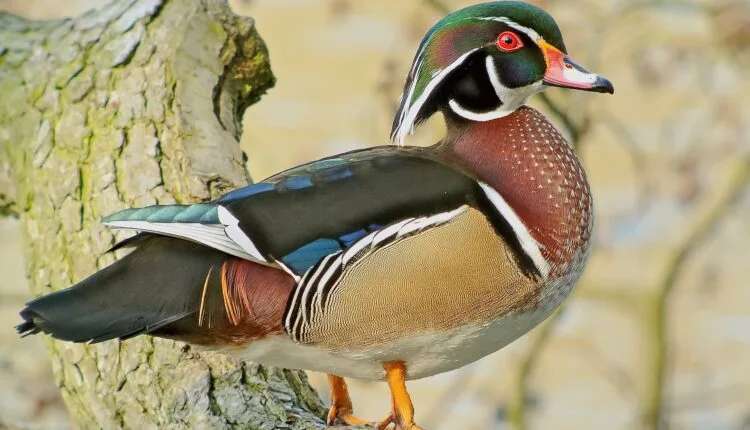
Often considered one of the most beautiful duck species in North America, the male wood duck is multicolored with iridescent greens, blues, and purples and a bold red bill. The species is known to nest in the cavities of trees (hence the name), which allows for a warm spot to brave the winter for those in southeastern spots like the Roanoke River.
Fun fact: You might catch a show if you go looking for wood ducks in the fall and winter, as that’s when males are likely to perform their courtship displays, raising their wings, heads, and tails to hold postures that best display their bright colors as they swim past females.
Cooper’s hawk
(Accipiter cooperii)
Named for 19th-century naturalist William Cooper, the Cooper’s hawk is a bit smaller than other common hawks, with a wingspan of up to 36 inches. It feeds mostly on smaller birds but has no problem feeding on other creatures like rabbits, squirrels, bats, rats, and mice.
Fun fact: While young Cooper’s hawks have brown upperparts and yellow eyes, an adult can be identified by its black or blue-gray cap, a defined transition in color around the neck, and reddish eyes.
Red-winged blackbird
(Agelaius phoeniceus)
Frequently seen sitting on tall grasses, cattails, wires, or fence posts along canals, ditches, ponds, lakes, or wetlands like those found at Roanoke River Wildlife Refuge, you may have to look closely to find that flash of red and yellow that sets the red-winged blackbird apart. When they’re not mating, these birds are known to roost in huge concentrations.
Fun fact: This species has a distinct call that it will make year-round for any number of reasons. We would try to describe it — it’s been dubbed an “okalee” call — but you may just have to listen to get the full effect.
Anhinga
(Anhinga anhinga)

This large waterbird has a long tail, a winding S-shaped neck, and a dagger-like bill that you wouldn’t want to be on the business end of. They use the bill to catch fish, which make up most of their diet. You can find the Anhinga swimming through the water with only its long neck and bill exposed—resembling those old Loch Ness Monster photos—or perched on a branch or bank spreading its wings to dry after a swim.
Fun fact: The name Anhinga (Anhinga anhinga) comes from a Brazilian Indian tribe and translates to “devil bird” or “evil spirit of the woods.” Nicer nicknames include “water turkey” because of the shape of its tail or “snake bird” because of the way it swims with just its neck and head exposed.
Cedar waxwing
(Bombycilla cedrorum)
The cedar waxwing sports a silky, shiny collection of brown, gray, and lemon-yellow, accented with a subdued crest, rakish black mask, and red wax droplets on the wing feathers. In autumn, these birds gather by the hundreds to eat berries, while in summer you’re more likely to find them flitting about over the Roanoke in pursuit of flying insects.
Fun fact: The cedar waxwing is one of the few North American birds that specializes in eating fruit, and can survive on that alone for several months. Because they eat so much fruit, cedar waxwings have been known to become intoxicated or even die when they run across overripe berries that have started to ferment, producing a natural alcohol.
Great horned owl
(Bubo virginianus)

With its long, earlike tufts, intimidating yellow-eyed stare, and deep hooting voice, the Great Horned Owl is the quintessential owl of storybooks. This powerful predator can take down birds and mammals even larger than itself, but it also dines on daintier fare such as tiny scorpions, mice, and frogs. It’s one of the most common owls in North America, equally at home in deserts, wetlands, forests, grasslands, backyards, cities, and almost any other semi-open habitat between the Arctic and the tropics.
Fun fact: When clenched, a great horned owl’s talons require a force of 28 pounds to open. The owls use this deadly grip to sever the spine of large prey.
Green heron
(Butorides virescens)
Standing at just 17 inches tall, the green heron is a fraction of the size of the great blue heron, but that doesn’t mean it can’t be great in its own right. According to the Cornell Lab of Ornithology, the green heron’s call is a loud and sudden “kyow,” though it also makes a series of more subdued “kuk” calls. During courtship, the male gives a “raah-rahh” call with wide-open bill, makes noisy wingbeats and “whoom-whoom-whoom” calls in flight, and sometimes calls “roo-roo” to the female before landing again. While sitting, an “aaroo-aaroo” courtship call is also given.
Fun fact: Green herons are one of the few species of bird known to use tools. In particular, they commonly use bread crusts, insects, or other items as bait, dropping it onto the surface of a body of water to lure fish. When a fish takes the bait, the green heron grabs and eats the fish.
Northern cardinal
(Cardinalis cardinalis)
Cardinals are often viewed as a sign that spring has arrived, but they can also be found in the winter—more easily, in fact, thanks to the lack of bright colors to serve as a backdrop. Not that anyone’s struggling to find cardinals—they were the most identified bird in America in 2023, likely because of their penchant for visiting feeders. The male has a black “face mask,” a distinctive shaggy crest, and a thick bill for crushing seeds while the female has a similar shape but is mostly brownish.
Fun fact: The cardinal’s name was inspired by the bird’s bright red plumage, which reminded people of the crimson robes and caps worn by the cardinals of the Roman Catholic Church. A group of Northern Cardinals can even be referred to as a college, conclave, or Vatican.
Chimney swift
(Chaetura pelagica)
Among the fastest flyers in the bird world, able to reach 60 miles per hour or more, the chimney swift is a small, sooty-gray bird that spends its days on the fly capturing insects in midair. It has a cigar-shaped body; a short, stubby tail; and long wings that beat so rapidly it can sometimes look like a bat. Chimney swifts arrive in the US in the spring to breed and roost then depart in August or September for South America’s upper Amazon basin, where they like to spend the winter.
Fun fact: During fall migration, swifts gather by the hundreds to thousands to spend nights together inside masonry chimneys that are usually larger than nesting chimneys. When re-entering these migration staging roosts at dusk, thousands of chimney swifts can create a swirling vortex that captures the interest and imaginations of crowds of people who gather to view these stunning displays in neighborhoods across the U.S. These events are called Swift Nights Out or Swift Sits.
Information for this article was gathered from the US Fish & Wildlife Service, the Cornell Lab of Ornithology, and the National Audubon Society. Check them out to learn more.
This article first appeared on Good Info News Wire and is republished here under a Creative Commons license.