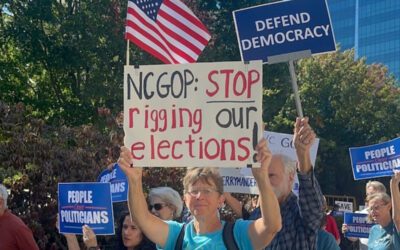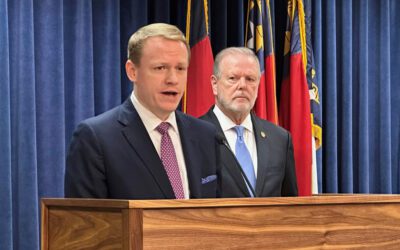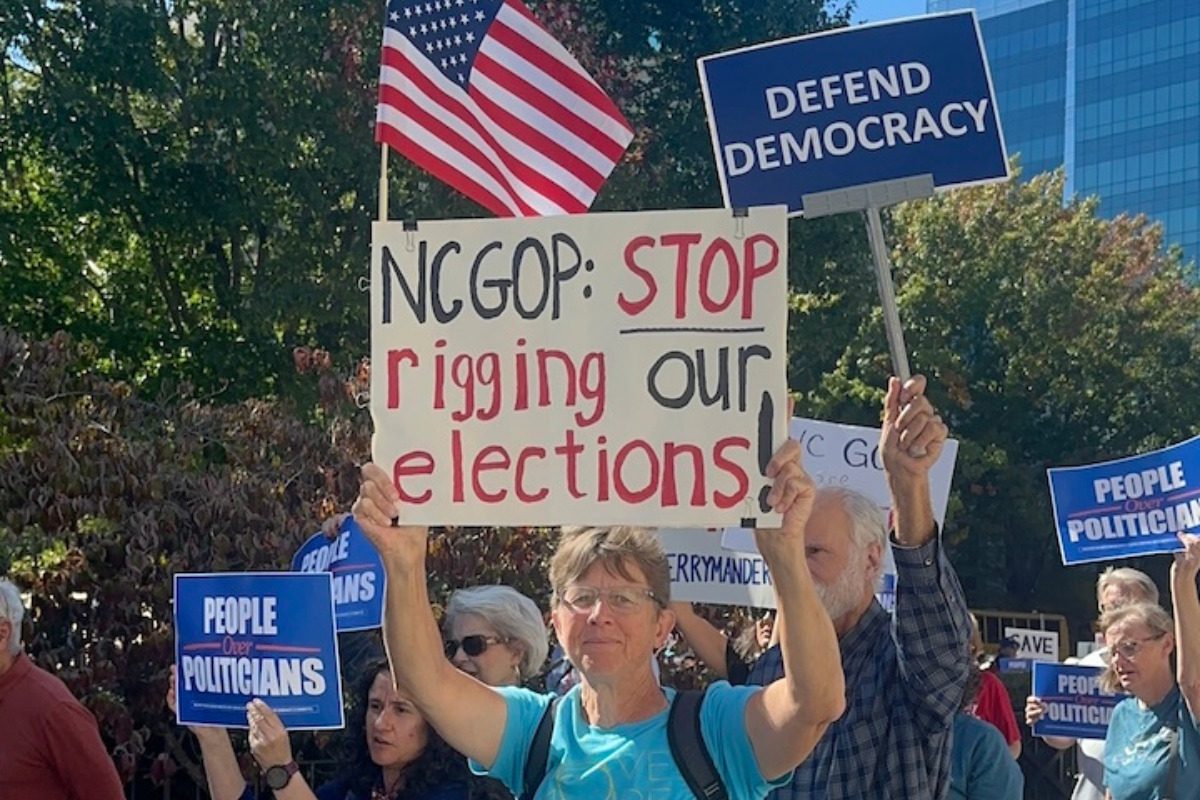
Despite public opposition, NC Republicans passed a gerrymandered map Thursday that is meant to help President Donald Trump and Republicans maintain control of Congress after the 2026 elections. (Photo by Michael McElroy for Cardinal & Pine)
Heeding orders from President Trump, NC Republicans moved US Rep. Don Davis out of his district, leaving him with virtually no chance of winning re-election.
Four months late in passing a new budget and in the midst of a Medicaid shortfall that threatens the state’s most vulnerable residents, Republicans in the North Carolina General Assembly returned to session this week to protect President Trump’s hold on power in 2026.
Following Trump’s orders, the NC House on Wednesday passed a new Congressional map that will make it virtually impossible for incumbent Democrat Don Davis to win re-election in the 2026 midterm elections, an effort that aims to ensure Republicans maintain control of the US House.
The NC Senate passed the map on Tuesday in a 26-20 vote, and since redistricting legislation cannot be vetoed by the governor, the map is now the official Congressional map for 2026, barring any court rulings. No Democrats in either chamber voted for the map.
Lawsuits are likely, but so far the conservative-controlled US Supreme Court and state courts have made it clear there are few if any judicial constraints on partisan gerrymandering.
Gerrymandering has been a sordid tool wielded by both Democrats and Republicans throughout the state’s history, a point Republicans gerrymandering this time made again and again during the debates over the new map.
But this is the fourth time in five years that Republicans in the General Assembly have sought new maps to ensure their electoral victories before any votes were cast. Redistricting is only meant to occur every 10 years after a new census.
A couple of hours after the Senate vote on Tuesday, hundreds of people gathered at the North Carolina Capitol building to protest the map. Several Democrats gave speeches, including US Reps. Alma Adams and Deborah Ross, and the Democratic leaders in the General Assembly, Senate Democratic Leader Sydney Batch and House Democratic Leader Rep. Robert Reives.
“They believe your vote should be worthless. They believe that your vote shouldn’t matter,” Reives told the crowd.
Batch agreed, saying that Republicans had chosen deference to Trump over their obligation to their constituents.
“They care more about [Trump] than the people that sent them to Raleigh,” Batch said.
“I dunno about y’all, but I got a daddy and his name ain’t Donald Trump.”
What does the map do?
The map not only makes it virtually impossible for Davis to win re-election in 2026, it removes him from his district entirely.
Davis, who lives in Snow Hill in Green County, currently represents District 1 in Congress, a 20-county district stretching along the northern part of the state that then dips down several counties to Lenoir.
But in the new map, Republicans removed Green County from District 1 and added several heavily Republican coastal counties. They then crammed Green and a few other counties into US Rep. Greg Murphy’s heavily conservative district, District 3.
The map also breaks up voters in Black communities in Davis’ current district and divides them into the two new conservative districts, diluting the power of their votes.
NC Sen. Ralph Hise, a Republican who represents several counties in western North Carolina, drew the maps for the Senate after using a consultant based in Ohio. Hise said he gave clear instructions not to use racial data to draw the maps, but as many Democrats pointed out, using racial data is not the only way to ensure a map disproportionately affects Black voters.
If a certain county is predominantly Black, for instance, and most Black voters are registered Democrats, then you don’t have to strain to understand that diluting that county’s Democratic vote also dilutes its Black vote.
Now the Black counties that have elected a Black congressperson since 1993 will be split, divided, and crammed into two separate, largely white, and very conservative districts.
Under state law, Davis could choose to run in either district, but each would be rash-red.
At the protest on Tuesday, Batch said Republicans were quite clear that they were following Trump’s orders and had not reached out to the communities in these districts that would be directly affected.
“When we asked them if they were gonna go out into the counties, if they had reached out to the congressional members that it was affecting, if they had gone to eastern North Carolina and talked to all of the Black voters in the Black belt of northeastern North Carolina, they said, ‘no,’” Batch said.
Donald Trump won the state by just over three percentage points in 2024, but he was virtually the only Republican to win a high-profile statewide race that year. Democrats won the races for governor, lieutenant governor, attorney general, secretary of state, schools superintendent, and the only open seat on the state supreme court.
Trump won the 2024 version of District 1, but so did Davis, which means lots of voters in those counties who voted for Trump chose Davis rather than his Republican opponent.
Gerrymandering, Batch said, is the only way Republicans can stay in power in North Carolina.
“Republicans always say they don’t like DEI, but let me tell y’all something. Political gerrymandering is their DEI. That’s the only damn way that they could serve [in Congress],” she said.
How did we get here?
North Carolina joins several other Republican-led states that have sought to remove Democratic representatives from Congress by drawing districts they can’t win.
Following directives from President Trump, NC Senate majority leader Phil Berger and House Speaker Destin Hall, both Republicans, proposed the new map last week.
The new map comes a couple of weeks after multiple news outlets reported that Berger, facing a primary challenge in 2026, sought a Trump endorsement in exchange for redrawing the map to Trump’s liking.
Berger denied a quid pro quo, but the new map’s only intent is to remove Davis from Congress rather than leave the choice to the voters: no districts other than his and Murphy’s change at all.
Hise and NC Rep. John Bell (R-Wayne County) each said that the new maps were simply a response to gerrymandering efforts in blue states, namely California.
But they are either confused or intentionally misleading about the timing.
Gov. Gavin Newsom of California, a Democrat, did not announce his efforts to draw new Congressional maps until after Texas became the first Republican state to heed Trump’s calls to erase Democratic seats and add Republican seats so that they could decide who controls the US House instead of the voters.
And, as NC House Democrats pointed out, Newsom did not just redraw maps on his own whim, he put the issue on the ballot as a referendum that the state’s voters will decide on for themselves in November.
Maps yes, Medicaid funding, no
Republicans have a supermajority in the NC Senate and a large majority in the House, but they have not been able to agree on a budget to fund teacher raises and state employee pay, nor have they been able to pass a bill to fill a large Medicaid funding gap.
Nearly every lawmaker agrees on the urgent need, but Republican leaders can’t agree on which chamber’s plan is the best.
The map might make Trump happy, Reives said, but it does nothing to address the urgent and growing problems facing many North Carolinians.
“Once they do these maps, we’re still not going to have a budget … your food prices are not going down. Your ability to get a job is not going up. Your ability to buy a house is not going up,” Reives said.
“It’s amazing they can get together and agree on stuff that’s affecting them and their power, but when it comes down to helping you, suddenly we can’t come to an agreement,” Reives said.
The House passed two bills on Wednesday that would address the Medicaid shortfall, but they still have to go to the Senate.
‘Why even have a public comment period?’
The General Assembly received nearly 12,300 public comments about the maps, the vast majority of which were strongly opposed. Those comments were ignored, NC Rep. Phil Rubin, a Wake County Democrat, said during the debate of the bill.
“No one looked at those comments, we all know that,” Rubin said.
“No one tried to take their feedback into consideration. Why even have a public comment period if you’re going to dismiss all of their comments when they’re clearly one direction?” he said.
The gerrymandering in the new Congressional map, Rubin added, can’t be separated from previous gerrymandered maps that created the General Assembly’s current political makeup and contributed to the current budget delay and to longstanding funding shortfalls in public schools, health care, and disaster response.
“Everything that you see happening is a product of what happens when politicians pick their voters,” Rubin said.
“This General Assembly, despite rigging every district to make sure Republicans control this body regardless of what the people think, still can’t pass a budget,” he added.
“This is the result of rigging electoral districts to isolate the members of the legislature, and now our members of Congress … from ever having to answer to the people.”
He continued: “It is the opposite of what democracy is meant to be.”
Author

Support Our Cause
Thank you for taking the time to read our work. Before you go, we hope you'll consider supporting our values-driven journalism, which has always strived to make clear what's really at stake for North Carolinians and our future.
Since day one, our goal here at Cardinal & Pine has always been to empower people across the state with fact-based news and information. We believe that when people are armed with knowledge about what's happening in their local, state, and federal governments—including who is working on their behalf and who is actively trying to block efforts aimed at improving the daily lives of North Carolina families—they will be inspired to become civically engaged.


North Carolina’s most powerful leader, Phil Berger, concedes primary loss
North Carolina's most influential politician, Republican state Senate leader Phil Berger, conceded the primary race for his seat to Sam Page on...

NC Democratic primary challenger has history of racist remarks, lawmaker says
Michael Wray, a former 10-term state Representative running for his old seat in 2026, faces claims that he once told a fellow lawmaker to “watch out...
NC Republicans face criticism from the right as they slap each other over a stalled budget
Republicans control both chambers of the NC legislature, but have failed to pass a budget 6 months after it was due. Even conservatives are losing...
NC Republicans face criticism from the right as they slap each other over a stalled budget
Republicans control both chambers of the NC legislature, but have failed to pass a budget 6 months after it was due. Even conservatives are losing...

Federal judges uphold several North Carolina US House districts drawn by Republicans
Federal judges will allow some of North Carolina state lawmakers' gerrymandered US House districts to go on, but this year's Trump-endorsed...