Immigration enforcement and food stamp policies aren’t abstractions—they show up as empty seats in class and empty bellies at home.
The morning the federal agents showed up, Charlotte did not look like a city in crisis, as Family Support Director Lili Jaramillo recalled. The mid-November sky was clear, the school bus was on time, and at an apartment complex in the city, four children barreled down the stairs to start their school day.
Only their parents gave the emergency away, Jaramillo said. In the doorway of one apartment, a mother stayed half-hidden as she watched her child head for the bus stop, stepping back every time a car crept past.
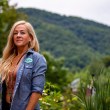
Down at the bus stop, Jaramillo wore an ourBRIDGE for Kids t-shirt, identifying her as part of the program the kids attended after their school day was over.
“The kids just ran out and were like, ‘Miss Lili, I can’t believe you’re here,” she said. “I feel like they probably didn’t know why their mom couldn’t stand outside with them.”
Jaramillo was there to help shepherd the kids to school on days when it was dangerous for their parents to be outside due to the increased US Customs and Border Protection (CBP) and Immigration and Customs Enforcement (ICE) presence last November.
At the time, WBTV reported that over 30,000 students were absent from school because of CBP and ICE operations. When children miss school, they miss more than class time—they also miss the free or low-cost breakfast and lunch that the school provides.
RELATED: Food insecurity is hitting thousands of NC children—and it’s following them into the classroom
At that Charlotte apartment complex, four children ran to meet Jaramillo—but others who were expected never came.
“I remember after I left that day, I just cried in my bed,” Jaramillo said.
A deepening hunger
OurBRIDGE for Kids, a Charlotte nonprofit, works with immigrants, refugees, and newly arrived families. The group runs a free after-school program and summer camp, and a family support team that connects parents to resources in more than 23 languages, from Spanish and Burmese to Dari and Pashto.
Staff said the federal immigration raids that shook immigrant neighborhoods last fall deepened an already persistent crisis of child hunger. The raids forced parents to pull their children from school at a time when families were also losing jobs and struggling to access SNAP, and when utility bills had begun to skyrocket.
While President Donald Trump boasted of “lifting” millions off food stamps and implementing new Supplemental Nutrition Assistance Program (SNAP) eligibility and work requirements, and state Gov. Josh Stein promotes his recommended “pro-family” state budget with free school breakfast and targeted tax relief, workers like Jaramillo warn that immigrant children are still bearing the brunt of policy choices made far from the bus stops and apartment doorways where they spend their days.
From after-school to grocery deliveries
According to the North Carolina Department of Health and Human Services, more than 1.4 million North Carolinians receive SNAP benefits, including more than 580,000 children. And although food pantries and nonprofits like ourBRIDGE help out where they can, for every one meal a pantry provides, SNAP provides nine others.
At ourBRIDGE for Kids, food has always been one of the most common needs.
“That’s one of the top resources that’s requested,” Jaramillo said. “We do at least almost 100 referrals a month for families.”
In its 2024-2025 annual report, ourBRIDGE said its after-school program served 250 kids from more than 20 countries and provided 41,370 meals during out-of-school time, including breakfasts, lunches, and dinners.
That baseline shifted sharply after federal agents arrived in Charlotte last fall.
“Even since November, when CBP was present in Charlotte, we kind of switched our work to deliver groceries to families,” Jaramillo said. “We’ve seen a huge increase in food requests, because a lot of families lost their jobs or a lot of moms lost their partners because they were detained by ICE while they were at work.”
Disinformation from the Trump administration
In November, CBP launched “Operation Charlotte Web”—an aggressive push that deployed agents in tactical gear to arrest hundreds of people from Charlotte to Raleigh to the Research Triangle. It marked a new phase of off-border enforcement in a politically key state.
RELATED: Arrests now top 250 in immigration crackdown across North Carolina
A Border Patrol chief explicitly framed the tactics as designed to create “self deportation,” using weaponized fear and militarized street enforcement. A large majority of detainees had no criminal convictions, undercutting the official emphasis on “violent criminals.”
Among the results of the raids, businesses were forced to close, construction and landscaping sites lost workers, and city leaders questioned why the Border Patrol was profiling Latino residents well away from the US border.
Today, ourBRIDGE is planning for the possibility of a repeat operation.
RELATED: Charlotte immigration crackdown goes on, Homeland Security says, despite sheriff saying it ended
Meanwhile, the Trump administration is celebrating a “victory.” A senior White House official told Politico that the president considered the NC surge a model for deportation campaigns. And with more deportation campaigns come more children whose parents are taken, children whose parents are worried about being targeted, and children whose parents must make hard decisions about whether leaving the house for work or food is worth the risk of being torn away from their kids—even if they’re citizens or legal lawfully present noncitizens.
Like his framing of the raids, Trump has called his administration’s efforts to reduce the number of people on government support programs a success. In his State of the Union address, Trump claimed they’d “lifted” 2.4 million Americans off food stamps, a line that earned applause from his base but scrutiny back in North Carolina.
READ MORE: Trump says millions are ‘lifted’ off SNAP. A Charlotte nonprofit says hunger hasn’t gone away in NC
State Rep. Jordan Lopez, a Democrat who represents part of east Charlotte and House District 112, said his first instinct was to double-check the claim.
“I immediately hit Google and asked, ‘Is this true?’” Lopez said in an interview with Cardinal & Pine. “Because my first thought was, did you lift people off food stamps, or did you kick people off of food stamps via the ‘Big Beautiful Bill?’”
Lopez believes the administration did the latter.
“They’re using very creative language or creative descriptions to describe how they were able to remove 2 million people off of the program,” he said. “I wouldn’t consider it lifting people out if you’re changing the rules around who’s accessible or who’s eligible to access it in the first place.”
Additionally, he said simply rolling people off of food stamps does not guarantee food access. He pointed to a hypothetical worker whose income rises just above an eligibility cutoff: someone earning $50,000 one year, then $51,000 the next.
“Your checks at the end of the month are probably $60-$70 more a month,” Lopez said. “Are you really that much better off that you don’t need the assistance of the federal government…to ensure that you can feed your family than you were a year ago? No, not really, because that $60 can barely get you a full tank gas these days. It can barely get you a week’s worth of groceries.”
From 300 families a year to 300 in two months
Before the raids, ourBRIDGE typically worked with about 300 families over the course of a year across its East Charlotte site, its program at Pinewood Elementary in South Charlotte, and the Charlotte Is Home newcomer center.
By the end of February, Jaramillo said, they had already reached roughly 300 families in just two months and were on track to serve more than 800 this year.
The organization responded by expanding its network. Jaramillo estimates about 550 volunteers stepped up during the CBP operation to help sort clothes and food, pack boxes, and drive deliveries when families were too afraid to come pick items up.
Monica Rodriguez, now ourBRIDGE’s family support navigator coordinator, originally came in as one of those volunteers.
“I delivered to the homes with some of the families,” Rodriguez said. “You could see them peeking out of the window to see who I was. It was kind of weird to see that instance, but it’s also sad because we shouldn’t be going through that situation.”
Lawmakers should experience the impacts of their policies
Jaramillo said policies that seem successful on paper don’t always work out that way in real life.
“Everybody deserves to be fed,” she said. “And everybody deserves access to critical resources, but a lot of times there’s so many barriers put in place for them not to access it.”
Asked what she wishes lawmakers understood about child hunger in her community, Jaramillo didn’t talk numbers. She talked about proximity.
“They won’t know unless they’re in it,” she said. “I think they should take a walk in our shoes one day and just see what it’s like to actually be affected by this.”