
For four years, Nancy Weaver has accessed essential health insurance through the Affordable Care Act. Now she faces an uncertain future as Republicans in Congress are set to allow key subsidies to expire, raising her monthly premium by $1,600 a month.
Enrolling in health insurance through the Affordable Care Act (ACA) in 2021 was a life- changing experience for Nancy Weaver.
For the first time in 12 years, the Ashe County resident was able to afford essential medications, go to the doctor, and afford hospital stays, if necessary.
“The ACA was absolutely just life changing for me,” Weaver said. “All of a sudden, I could go get bloodwork, I could get a mammogram, all of these things where I could go to the doctor. I could say ‘something’s wrong,’ and I could go to the doctor and find out what it was.”
In just a few weeks, however, Weaver will likely lose her insurance and with it, her sense of security and safety. Like millions of Americans enrolled in ACA plans, the 60-year-old Weaver recently learned that her monthly premium will skyrocket in the new year. Weaver currently receives a tax credit that reduces her out-of-pocket cost from $1,280 to $144 each month.
But the credit Weaver and millions of other Americans rely on to afford care are set to expire at the end of the month. Democrats in Congress have spent months pushing to extend them, but the Republican-controlled US House and US Senate have blocked these efforts.
Weaver discovered weeks ago that her subsidy will no longer be available, drastically raising her premium. If Weaver stays enrolled in her current plan, her health insurance premium will be a staggering $1,759 per month.
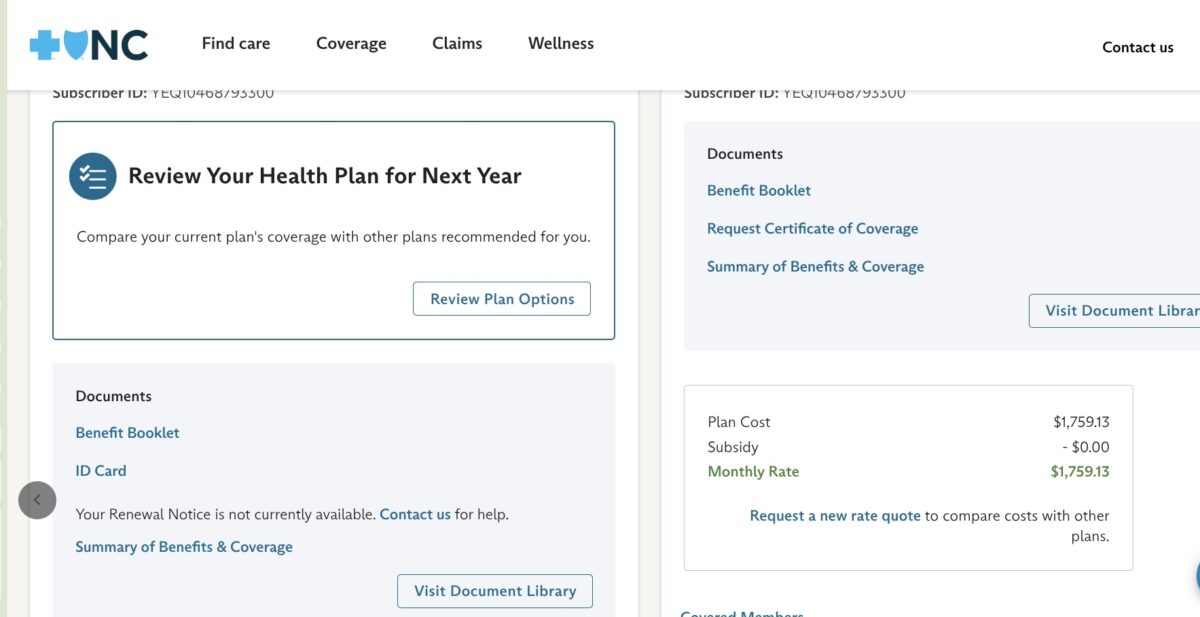
She told Cardinal & Pine she will have no choice but to drop her insurance. Weaver’s income comes largely in the form of a widow’s benefit through Social Security, which she says pays out around $2,300 per month.
“That would leave me $600 to live on to pay the rest of my bills. It’s not possible,” she said.
Without her ACA plan, Weaver will no longer be able to pay for hospital stays, doctor’s visits, or blood work, reversing years of improvement for her health.
A lifeline after years without insurance, treatment
From 2009 to 2021, Weaver was uninsured andunable to afford hospital visits. Ailments, both physical and mental, went untreated.
In 2013, Weaver was diagnosed with thyroid autoimmune disease, a disease with symptoms that can cause muscle weakness, exhaustion, and depression. She was initially able to get medication to treat her condition for a year, but she couldn’t afford the cost of insurance or lab tests—about $600—which was necessary to continue receiving medication for her condition.
Without this medication, she suffered physically and emotionally.
“I had gone from farming 16 hours a day to completely being crashed. I was raising pastured pork and poultry. I was raising grassfed beef and lamb, and teaching spinning, weaving, fiber arts lessons,” she said. “I crashed. Just completely couldn’t do anything. Some days I couldn’t walk across the floor.”
She reached a breaking point around a decade ago at a diner in West Jefferson. She was talking to close friends when the conversation turned to health. Weaver revealed that she’d been considering suicide, but was holding off until her grandchild was born.
“I said ‘I have been putting off killing myself until this baby was born,’” Weaver explained. “In my mind, which was being told lies by my mental state, I just needed to go. It would be better off for all concerned if I just went.”
Weaver’s family heard about her comments and were alarmed. They reached out to a local nurse practitioner, who helped Weaver get lab work completed for $70.
“She could get all the labs that were needed to re-prescribe my medication, and that set me on a path of health. My children paid for that. My children paid for all those doctor visits and all that lab work. They just pitched in together,” Weaver said.
But it was enrolling in the ACA—which came about through unusual circumstances—that kept Weaver on that path. In 2021, her daughter Christy’s employer hired her to care for her newborn grandchild while Christy worked.
“Her boss turned the office adjacent to hers into a nursery and hired me to keep my grandbaby at two weeks old,” Weaver said.
The job provided Weaver enough money to be able to get health insurance for the first time in a decade.
“He paid me $15 an hour. And that was enough for me to [afford] the ACA,” she said.
“I could see an endocrinologist. I could focus on my health. I could get therapy because I had some PTSD and childhood trauma. That helped me learn how to deal with things and heal even more,” Weaver said.
On one occasion, Weaver feared she might be having a heart attack and went to the hospital.
“It turned out to be my gallbladder. I had three days in the hospital, completely paid for. All sorts of heart tests, gallbladder removal, and it didn’t cost anything,” she said.
Weaver no longer works, but she’s been able to keep her ACA plan because subsidies help make it affordable for her.
In two weeks, that will no longer be the case.
How we got here
During the government shutdown debate in the fall, Congressional Democrats called on Republicans to support an extension of the subsidies as part of the negotiations to keep the government open.
Republicans refused. On Nov. 10, eight Senate Democrats voted with the Republican majority to reopen the US government without an extension of the subsidies, but they won a promise to hold a vote on an extension this month.
The Senate defeated that proposal, which would’ve extended the subsidies for three years, in a 51-48 vote last week. North Carolina’s Republican senators, Ted Budd and Thom Tillis, both voted against extending the subsidies. A bill needs 60 votes to pass the upper chamber.
House Speaker Mike Johnson (R-Louisiana) said this week that he would not call a vote to extend the subsidies in the House of Representatives, prompting four Republicans to break ranks and join Democrats in signing a discharge petition to bypass Johnson and force a floor vote on a three-year extension. It’s unclear if such a vote will happen before the subsidies expire at the end of the year, and even if it passes the House, it will almost certainly die in the Senate.
Without an extension, 22 million Americans receiving health insurance through the ACA will see their monthly insurance costs increase by an average of 114%, according to KFF. An estimated four million people—including 157,000 North Carolinians like Nancy Weaver—will no longer be able to afford their coverage due to the exorbitant cost.
What’s next for Weaver?
Barring a Christmas miracle, Weaver is soon likely to find herself in the same place she was nearly five years ago: uninsured and facing an uncertain future.
She’s unsure if she has a way to get insurance without her ACA plan and worries she could face a serious medical diagnosis or emergency and that she won’t be able to afford treatment.
“This is really devastating,” she said.