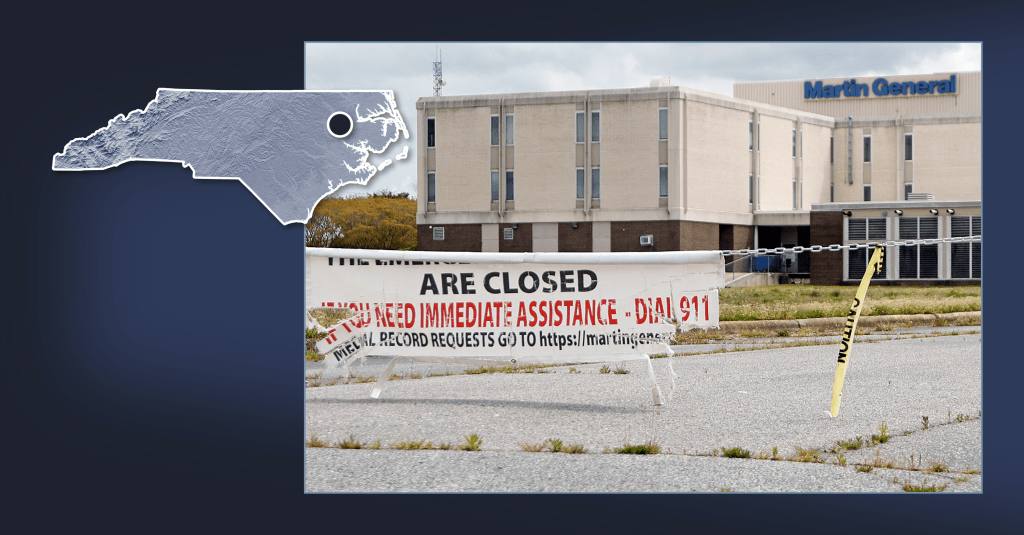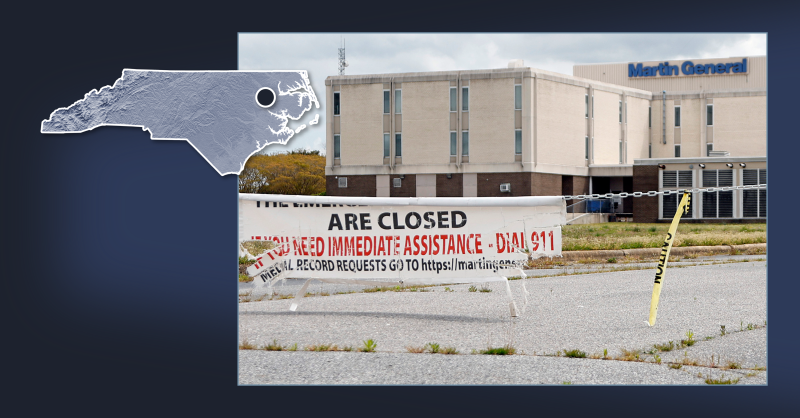
For 29 years, BJ Warren worked as a nurse at Martin General Hospital, providing critical health care to the community she’s called home her entire life.
She took care of people she knew—family, friends, coworkers, even fellow church members. Warren worked as a charge nurse, ensuring that the emergency department (ED) ran smoothly and that patients were being given adequate medication and treatment.
“I helped regulate the patient flow in the ED, helped facilitate discharges, admissions, things of that nature,” she said.
But when Martin General closed in 2023 after 73 years of operation, Warren lost her job—and an entire community lost essential care.
“It’s a poor county. A lot of people don’t have access to transportation to get places. We have one cab in the whole town. We don’t have Uber here in our county,” Warren said. “I feel like a lot of people go without health care because there’s no hospital here.”
The loss of the hospital exacerbated some of the harsh realities facing the rural eastern North Carolina community. The US Census Bureau estimates Martin County’s poverty rate to be around 20%, far higher than the statewide rate of 12.5%. Nearly a quarter of the population receives food stamps and 40% of residents are enrolled in Medicaid.
Warren, who lives just two miles from the former hospital’s site in Williamston, says it’s critical that a rural community like Martin County have a hospital for its residents.
“Time is tissue, and when you’re having a true emergency, and you’ve got to go a minimum of 30 minutes away, that 30 minutes could make a big difference,” she said.
Warren now works part time at Eastern Carolina University (ECU) Health in Edgecombe County, a 35-mile drive each way. She says other former Martin General employees are now driving just as far, if not further, to provide medical services to other communities.
Local EMS crews have also been forced to transport patients to hospitals in other counties, delaying care.
“All calls are stressful to a certain point. But it did give you a certain level of ‘okay, take a deep breath, we’re 10 minutes away,’”Jennifer Page, the Lieutenant for Jamesville Fire & Rescue, said of life before Martin General closed. “Versus now, it’s ‘okay, take a deep breath, we’re 30 minutes away.’”
Page’s team has two emergency vehicles to transport patients in an emergency situation, so every minute spent driving one patient a longer distance is time they can’t spend responding to other calls.
For County Manager Drew Batts, the loss of emergency services for the community is personal. A friend of his passed away last year after suffering from a medical emergency.
“Who knows, in the time that it took to get her from her home to ECU Health in Bertie, if the outcome would have been different. We don’t know, but I would like to have seen what the alternative could have been,” he said.
A plan to reopen Martin General
The consequences of the loss of Martin General have made it all the more urgent for leaders like Batts that the community finds a way to reopen it.
Last spring, one possible avenue emerged. ECU Health proposed a plan to reopen Martin General as a Rural Emergency Hospital (REH), a new provider type established by Congress in 2021. REHs offer emergency and certain outpatient medical and health care to patients that generally stay less than 24 hours.
A reopened Martin General would be the first REH in North Carolina.
“I would love to see the whole hospital open back up. A lot of our elderly patients, they didn’t want to go to the larger hospitals because they felt like they got better care in a smaller environment,” Warren said. “But ultimately, if we just get an emergency department back, I feel like that would alleviate a lot of the stress on our EMS people…I would love to just see an emergency department open back up with the hopes of expanding at some point.”
A reopened Martin General would not only reduce the distance to a hospital for Page and her EMS team, but would allow them to get to their next call much sooner.
“The turnaround time, you would think it would be much better. Because if we’re coming from Martin General, we know we’re about eight minutes from our district,” she said.
ECU has asked that three core objectives be met by August 2028 in order for the hospital system to reopen Martin General under their umbrella. First, ECU has requested that Medicaid reimbursement be on par with Medicare, which currently provides a higher level of payments.
ECU also wants Martin County to agree to fund the daily functions of the hospital. Martin County’s Board of Commissioners unanimously approved a letter of intent last summer to reopen the hospital under the ECU plan. To date, the county has spent $2 million keeping the hospital site up to date, Batts said.
“Martin County has put millions into that hospital since the closure to try to bring it up to REH standards,” he said. “We have put quite a bit of our resources into that facility to make it easier for any provider that would like to come in.”
Lastly, ECU requested state funds for both the reopened Martin General and the expansion of ECU’s health center in neighboring Beaufort County.
Batts told Cardinal & Pine that the cost of reopening Martin General would be $70 million, with the total cost of the regional plan, including the expansion of Beaufort County’s hospital, reaching $220 million.
“Initially, we would operate out of the current facility, a small portion of that facility, and then they [ECU] would build a new facility,” he said.
The North Carolina General Assembly and Congress now hold the fate of the hospital in their hands, but Washington may have created additional barriers to its reopening last summer.
Trump’s ‘One Big Beautiful Bill’ could be an obstacle
In July, President Trump signed into law “The One Big Beautiful Bill Act,” which will cut nearly $1 trillion from Medicaid over a 10-year period. In North Carolina, this could threaten coverage for some of the 3 million North Carolinians who rely on Medicaid.
State Rep. Shelly Willingham (D-Martin County) believes that cuts to Medicaid could hinder a reopening of the hospital, and said the plan to reopen Martin General was put forward with the belief that Medicaid would provide funding for the hospital as part of the REH agreement.
“Medicaid would pay a certain amount of money each month to the hospital, regardless,” he said. “We don’t know how that’s working now, we don’t know how it’s going to work, whether they’ll continue it or if the present administration is going to do away with that because they are in the process of cutting funds to Medicaid.”
Rural hospitals rely heavily on Medicaid, which covers around 20% of patients they see. Estimates show that cuts from the Big Beautiful Bill could lead to 21% decline in Medicaid reimbursement, depriving these hospitals of crucial revenue.
Last year, ECU acknowledged the “One Big Beautiful Bill” complicated a potential reopening.
“…Challenges include navigating new federal health care legislation as well as securing vital public funding needed to build a long-term, sustainable regional system of care,” ECU Health spokesperson Brian Wudkwych said in a statement to Carolina PublicPress in August.
The state budget could be crucial to securing funding
For ECU Health and Martin County’s local leadership, a key piece to reopening the hospital is securing funding for ECU’s regional plan through a state budget. North Carolina is currently the only state in the country without a budget.
“The biggest obstacle right now is knowing whether or not we’re going to get the funding,” Batts said.
The legislature returned to Raleigh last week, and budget negotiations between the Republican leadership in the House and Senate are ongoing.
Willingham says the lack of a budget stalls any plans local leaders in Martin County have, stressing that communities like his rely on support from the state and other government entities in a way others do not.
“UNC Chapel Hill and Duke, they have endowments and other ways they can end up doing things. We don’t. If it’s not taxes, or from the feds or something from the state, then we just don’t have it,” he said.
Willingham says getting support both for hospital funding and other services for Martin County is a priority in the legislative session.
“We’re still trying to influence a lot of the folks who are in a position to get some of those resources,” he said.
In a meeting earlier this year between county leaders and Speaker of the House Destin Hall (R-Caldwell County), Batts said Hall was receptive to the regional proposal put forward by ECU.
“He liked the regionalization effort to try to create a healthcare system, not just try to service one county,” Batts said. “The impression that I got from Speaker Hall was that he is a proponent. He is very in support of what we’re trying to do.”
“The biggest obstacle right now is knowing whether or not we’re going to get the funding,” Batts added. “Once you see that funding come through, I really think it will take off like wildfire.”
What a reopened hospital would mean for the community
Reopening the hospital in any capacity would provide a needed lifeline for a community that lost its emergency services three years ago.
Willingham says that having a hospital in Martin County is about more than just health care. It opens doors for the community.
“It’s having an effect on the ability to have industry, or people to open businesses. Medical facilities and schools, those are two basic things that people look for,” he said.
Batts agreed, saying it’s difficult to recruit businesses without a hospital. In eastern North Carolina, 15 counties lack a hospital.
With the future of a hospital site partly in the hands of lawmakers in Raleigh, Warren wants them to understand the community’s need for health care.
“I feel like the situation is dire,” she said. “We desperately need a hospital in this area. We have such a rural county.”