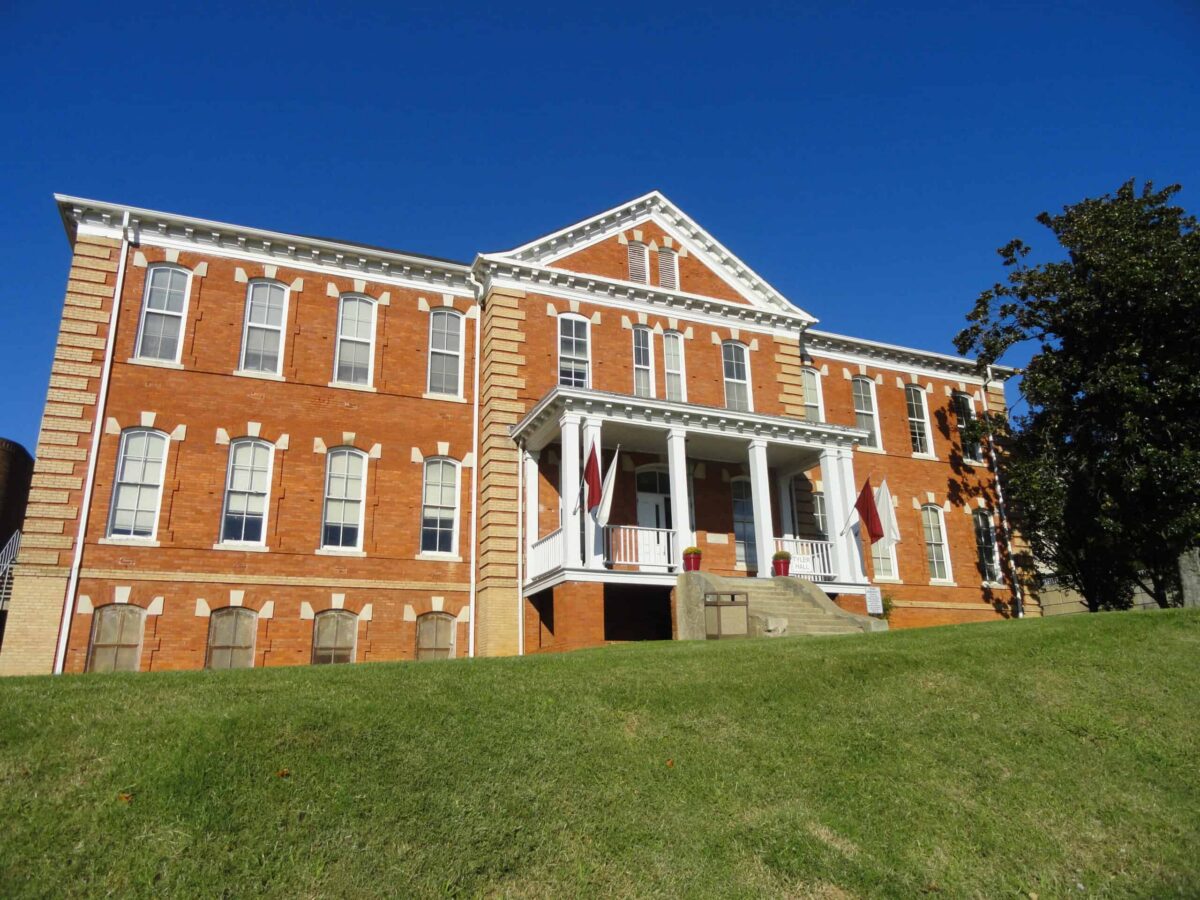
Shaw University’s Tyler Hall, a designated historical landmark (Daderot/Wikimedia Commons)
Discover key stats and dive into the history of each of North Carolina’s 10 historically Black colleges and universities.
North Carolina is home to 10 historically Black colleges and universities (HBCUs)—one of the highest concentrations in the United States.
To be considered an HBCU, a college or university must have been founded prior to 1964, its primary mission must be the education of Black Americans, and it has to be accredited by a nationally recognized accrediting agency.
The HBCUs in the Tar Heel state range from private institutions with small class sizes to public universities with large student bodies and diverse academic program offerings. Keep reading to learn more about each of North Carolina’s HBCUs.
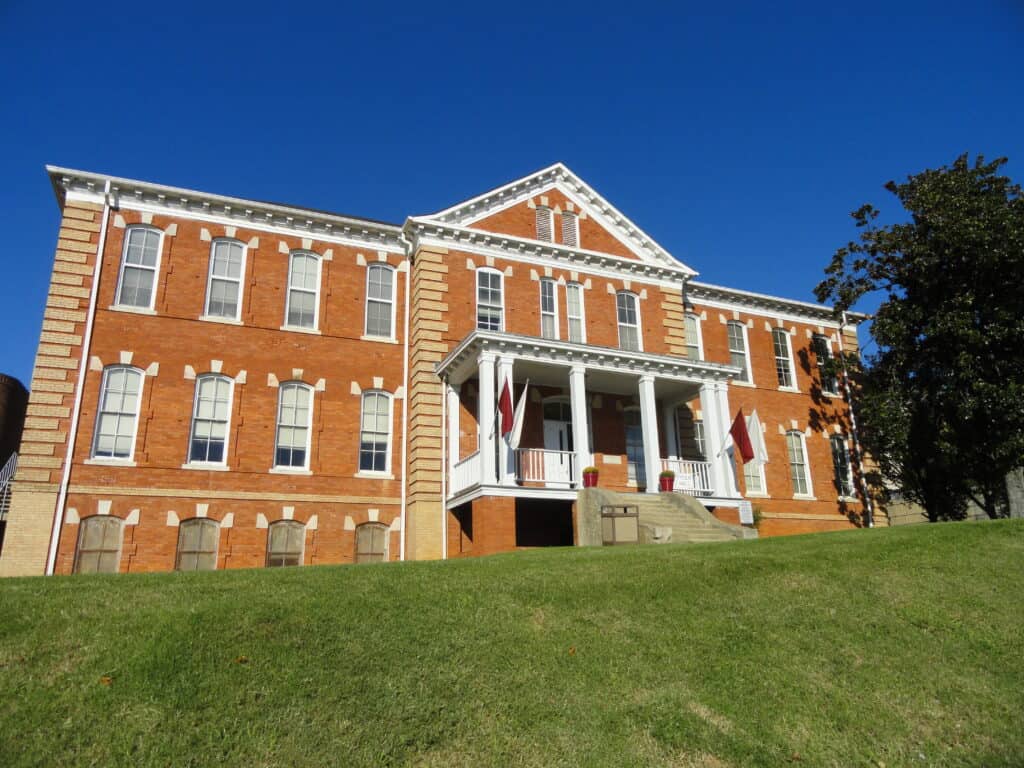
1. Shaw University
Shaw University is North Carolina’s oldest HBCU. The private liberal arts institution was founded in 1865 by the American Baptist Hope Mission Society.
Originally called Raleigh Theological Institute, the school was established to provide theological education to freedmen after the Civil War. In its first four years, more than 1,000 former slaves were taught to read at the university.
Today, Shaw University offers associate’s, bachelor’s, and master’s degrees to about 1,100 students. The academic programs offered are diverse, ranging from cyber operations and political science to early childhood development and recreation management.
Year founded: 1865
Number of academic programs: 23 majors
Number of students: About 1,100
Tuition cost: $24,994 per year for a full-time undergraduate student (on campus); $16,480 (off campus)
Address: 118 E South St., Raleigh
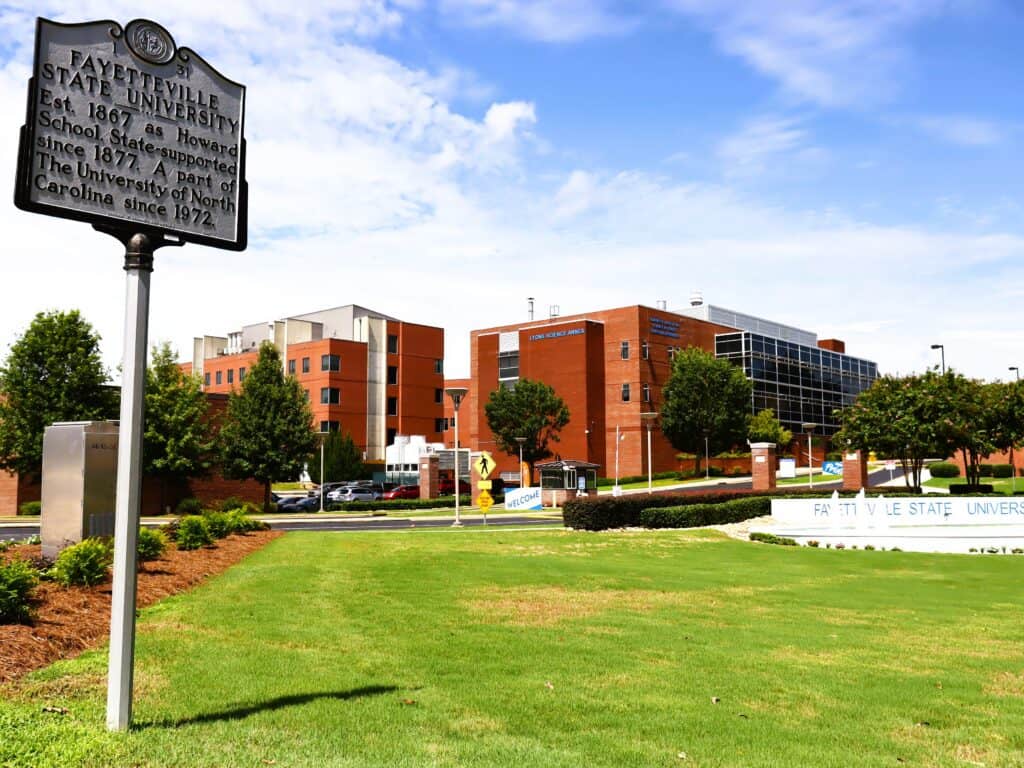
2. Fayetteville State University
Fayetteville State University was founded by seven Black men for the education of Black children in their community with a curriculum focused on reading, writing, practical math, and moral development.
The university currently has more than 6,700 enrolled students studying everything from sociology and visual arts to accounting and history.
As an NC Promise School, undergraduate tuition for in-state students at Fayetteville State University is just $500 per semester, making it one of the cheapest colleges in the Tar Heel State.
Year founded: 1867
Number of academic programs: 33 bachelor’s degrees; 18 master’s degrees; 1 doctoral degree
Number of students: 6,726
Tuition cost: $7,613.35 per semester for a full-time undergraduate student (on campus, including room and board and health insurance); $3,305.58 (off campus with health insurance, excluding room and board)
Address: 1200 Murchison Rd., Fayetteville
3. Johnson C. Smith University
Johnson C. Smith University is a private university founded by the Rev. S.C. Alexander and the Rev. W. L. Miller. Originally named Freedmen’s College of North Carolina, the school became Johnson C. Smith University in 1923 to honor a donation by Jane Berry Smith in memory of her late husband.
The small university offers a curated selection of nearly 20 academic programs, including biology, criminology, and public health.
Year founded: 1867
Number of academic programs: 17 undergraduate programs; 1 master’s program
Number of students: 1,302 students
Tuition cost: $11,075 per semester for a full-time undergraduate student (not including room and board fees, which vary based on residence hall and meal plan selection)
Address: 100 Beatties Ford Rd., Charlotte
4. St. Augustine’s University
St. Augustine’s University is a private liberal arts school established by the Episcopal Diocese of North Carolina.
The university made history as the first HBCU in the country to own an on-campus commercial radio station (WAUG-AM 750) and TV station (WAUG-LD). Other history-making moments came in 2020, when the university became the first HBCU to start a cycling team, and in 2022, when it became the first to launch a women’s rowing team.
Undergraduate program offerings include exercise science, communications, sport management, and biology.
Year founded: 1867
Number of academic programs: More than 23 undergraduate programs
Number of students: About 1,000
Tuition cost: $13,606.02 per semester for a full-time undergraduate student living on campus
Address: 1315 Oakwood Ave., Raleigh
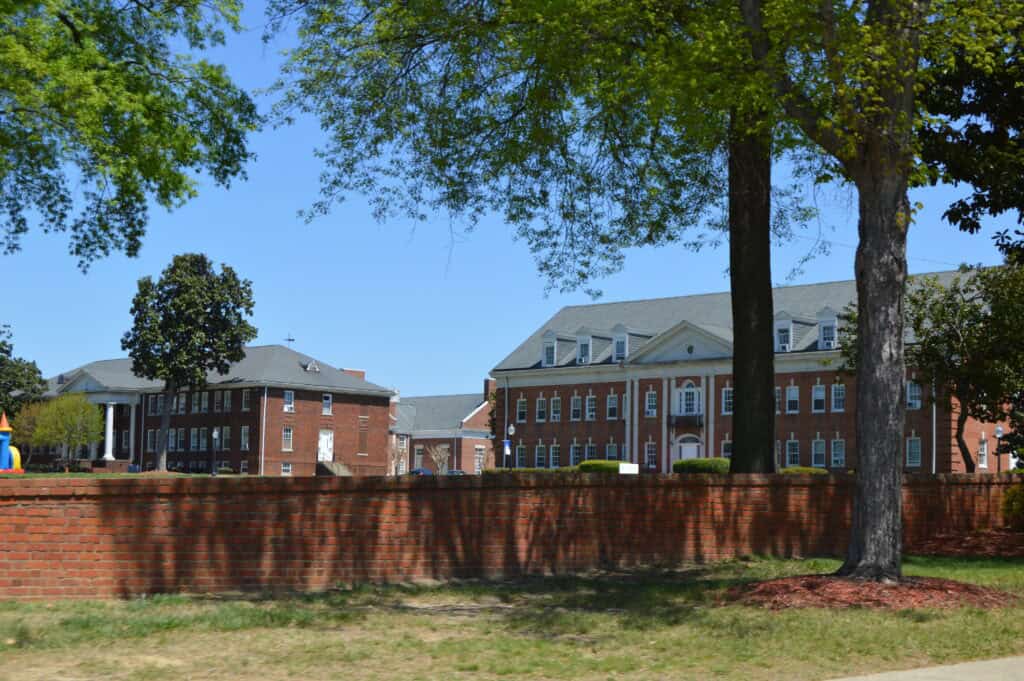
5. Bennett College
Bennett College is a private liberal arts college and one of only two all-female HBCUs in the U.S. (and the only one in this roundup).
The school has humble beginnings in the unplastered basement of a Methodist Episcopal church, where initially only elementary and secondary level studies were offered to males and females. College-level courses were added to the mix about five years later, and the school became a women’s college in 1926.
Bennett College has the smallest student body of all North Carolina’s HBCUs, with about 195 enrolled students. It also offers the fewest academic programs: There are nine listed on the school’s website, including elementary education, psychology, and journalism and media studies.
Year founded: 1873
Number of academic programs: 9
Number of students: 195
Tuition cost: $15,892 per semester for a full-time student living on campus
Address: 900 E. Washington St., Greensboro
6. Livingstone College
Livingstone College was established by a group of A.M.E. Zion ministers for the purpose of training ministers. The school was originally called Zion Wesley Institute and was located in Concord. It closed in 1881, relocated to Salisbury, and changed its name to Livingstone College.
The private liberal arts school is one of the smallest in this roundup, with less than 1,000 enrolled students. It offers a decent selection of academic programs, with options ranging from English and music to mathematics and biology.
Year founded: 1879
Number of academic programs: 23
Number of students: About 820
Tuition cost: $25,491.72 per year for a full-time student living on campus
Address: 701 W. Monroe St., Salisbury
7. Elizabeth City State University
Elizabeth City State University was originally founded as a teaching college, but today, its signature areas of study include the humanities, education, and aviation.
The NC Promise School offers an affordable education to more than 2,000 enrolled students studying everything from digital media to emergency management to pharmaceutical sciences.
Year founded: 1891
Number of academic programs: 27 undergraduate programs; 4 master’s degree programs
Number of students: 2,360
Tuition cost: $500 per semester for in-state undergraduates (room and board not included)
Address: 1704 Weeksville Rd., Elizabeth City
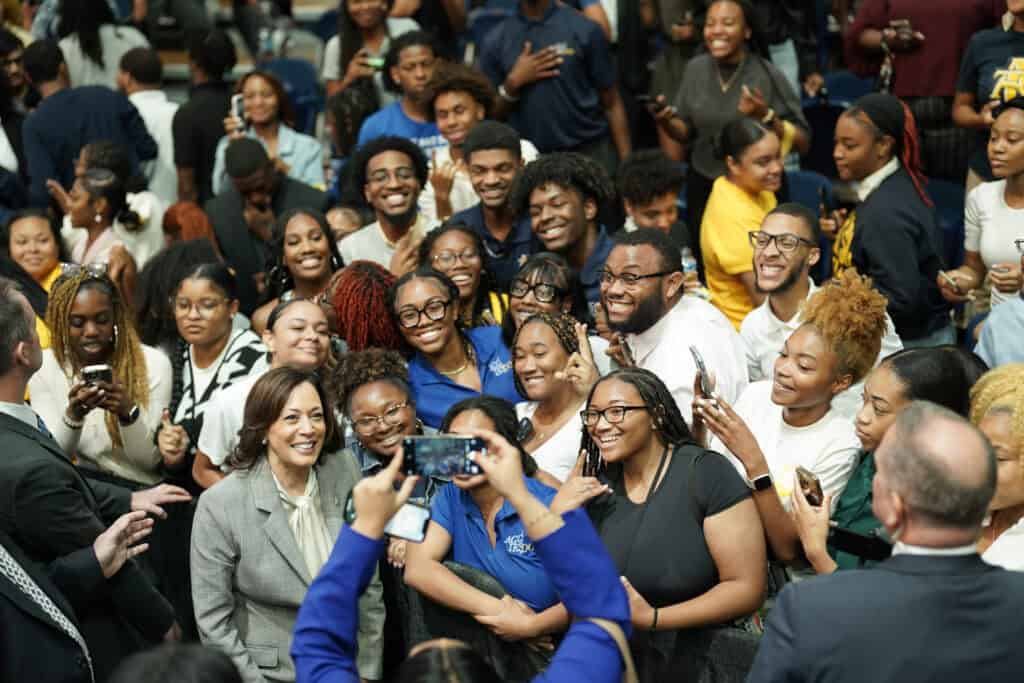
8. North Carolina Agricultural & Technical State University
North Carolina Agricultural & Technical State University is the largest public HBCU in the U.S., and in the fall of 2025, it became the first HBCU to enroll more than 15,000 students in a semester.
The HBCU is also a land-grant, doctoral research university, and when it was founded in 1891, it became the second land-grant institution for people of color in the U.S. The school’s name was originally the Agricultural and Mechanical College for the Colored Race, and it was first located in Raleigh before relocating to Greensboro in 1893 and changing its name in 1915 and again in 1967.
In addition to having the largest student population of all the schools in this roundup, North Carolina Agricultural & Technical State University also offers the most academic programs. Undergraduate degree offerings range from aeronautical and astronautical engineering to computer science to landscape architecture.
Year founded: 1891
Number of academic programs: 61 undergraduate degree programs; 35 master’s programs; 14 doctoral degree programs
Number of students: 15,275
Tuition cost: $3,540 per semester for an in-state undergraduate (excluding fees and room and board)
Address: 1601 E. Market St., Greensboro
9. Winston-Salem State University
When Winston-Salem State University was first founded—as the Slater Industrial Academy—it consisted of one room where 25 students were taught by a single instructor. The university has grown to include more than 39 buildings spanning a 117-acre campus.
Undergraduate and graduate students can choose from about 40 majors, such as chemistry, art, gerontology, and justice studies.
Year founded: 1892
Number of academic programs: More than 40 undergraduate majors; 10 graduate programs
Number of students: 4,972
Tuition cost: $3,049 for an in-state, full-time undergraduate student (excluding room and board)
Address: 601 S. Martin Luther King Jr. Dr., Winston-Salem
10. North Carolina Central University
North Carolina Central University was originally founded as the National Religious Training School and Chautauqua for the Colored Race, undergoing several rebrandings before it became North Carolina Central University.
In 1923, when it was renamed North Carolina College for Negroes and dedicated to liberal arts education by the North Carolina state legislature, it became the country’s first state-supported liberal arts college for Black students.
Today, top undergraduate degree programs include business administration, pre-nursing, psychology, criminal justice, and information technology.
Year founded: 1910
Number of academic programs: 54 bachelor’s; 28 master’s; 3 doctoral
Number of students: 9,281
Tuition cost: $ 12,373.80 per semester for a full-time, in-state undergraduate (includes a meal plan but not housing)
Address: 1801 Fayetteville St., Durham
Related: Good News Friday: This NC HBCU Wants to Make Real Estate Less White
Author


All about the Barn Dinner Theatre in NC, the oldest dinner theater in America
Enjoy dinner and a show at Barn Dinner Theatre—the country’s longest-running dinner theater. Learn more about the iconic dinnertainment...

Billy Ball Explains NC: 3 North Carolina women who changed history
Three stories of history-making North Carolina women who should be household names. It's the latest episode of Billy Ball Explains NC. The first...
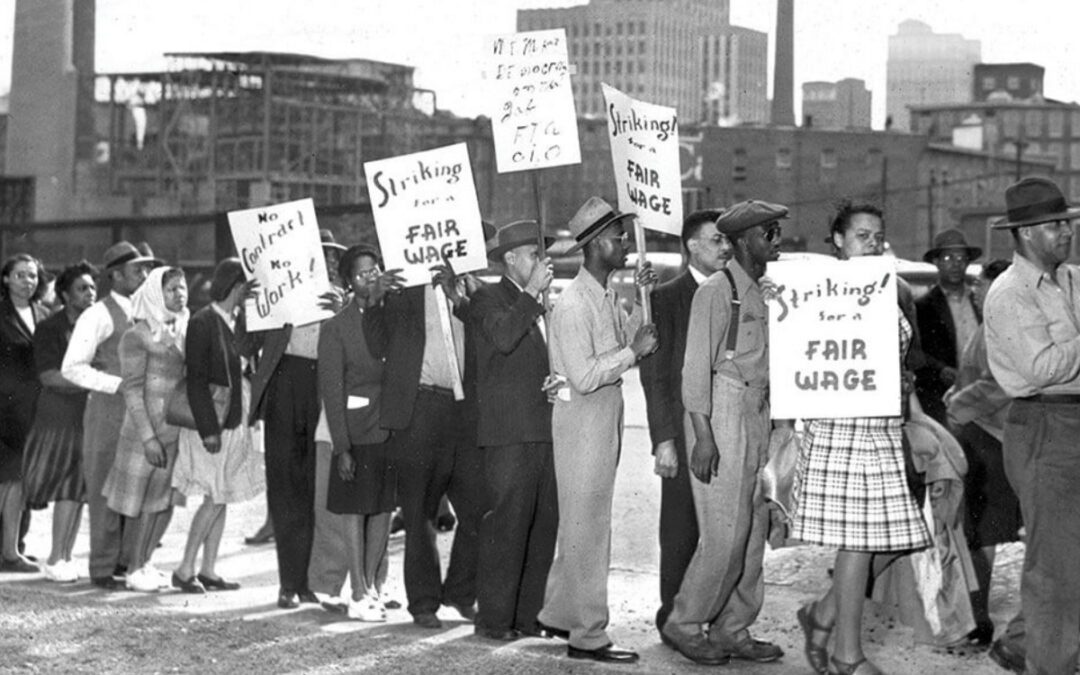
13 times labor unions made history in North Carolina & beyond
Learn about the 13 most groundbreaking events for North Carolina’s labor unions over the years. If you’re an N.C. local who reads headlines, you may...
13 times labor unions made history in North Carolina & beyond
Learn about the 13 most groundbreaking events for North Carolina’s labor unions over the years. If you’re an N.C. local who reads headlines, you may...
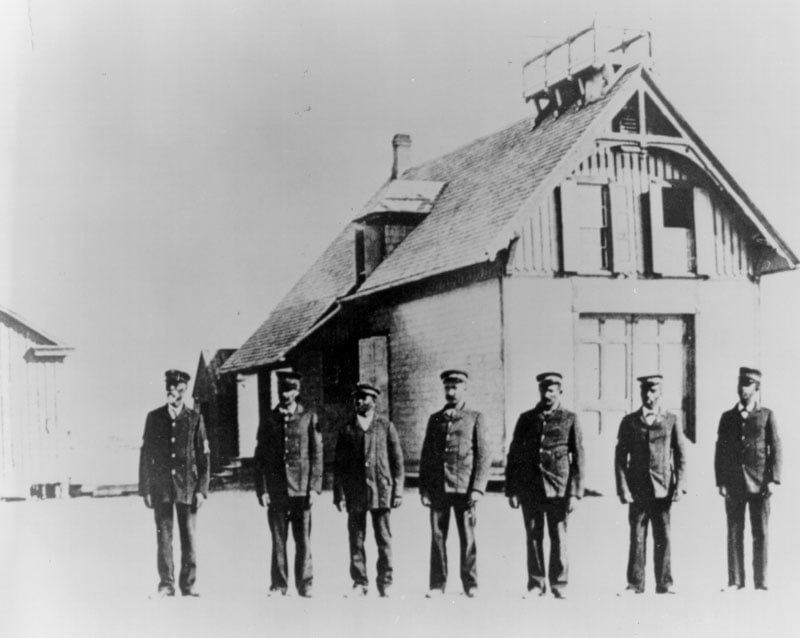
Discover the Pea Island Life Saving Station, the only all-Black station of its kind in the US
Dive into the legacy of North Carolina’s iconic Pea Island Life Saving Station and its heroic, history-making crew. Every year, North Carolina’s...