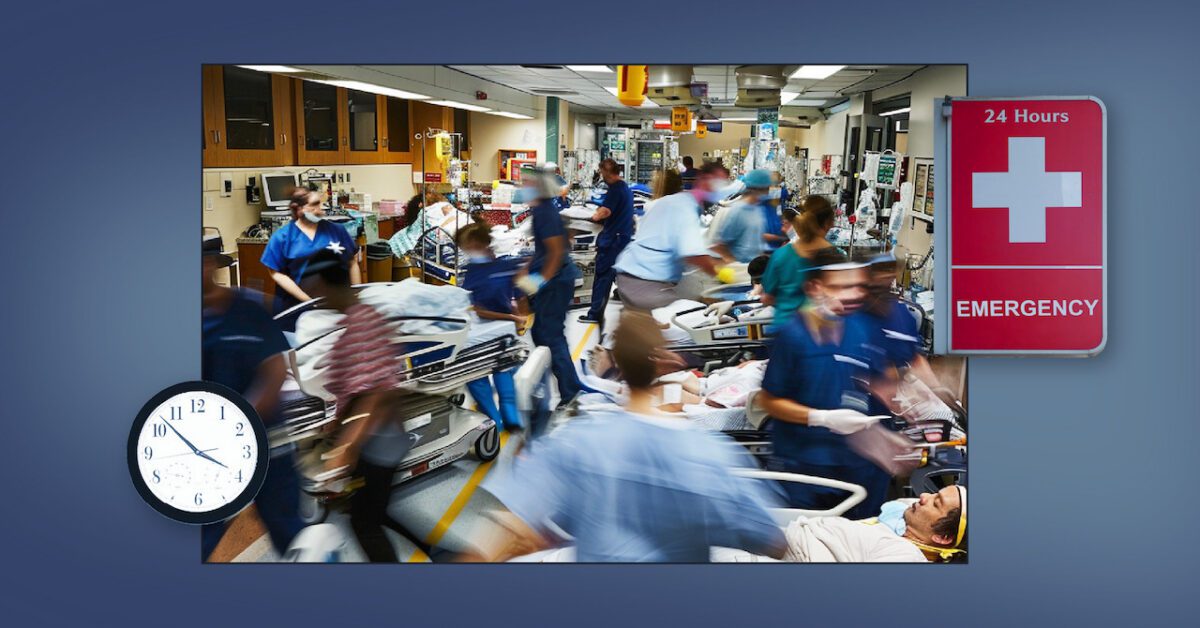
Emergency rooms are meant to stop a heart attack in real time, they are not meant to provide the care that can prevent a heart attack in the first place, North Carolina doctors and nurses told Cardinal & Pine.
When people lose insurance, they often rely on emergency rooms. But ERs were never intended to replace primary care, doctors warn
North Carolina emergency rooms are not built for what’s coming.
President Donald Trump’s Medicaid cuts are set to go into effect next year, the Republican-controlled North Carolina General Assembly has still not passed a budget—meaning the state’s Medicaid fund could run out of money this spring—and premiums are already soaring for patients who get their insurance through the Affordable Care Act.
Add these together and you get hundreds of thousands of North Carolinians who could lose their health insurance in the coming years.
Just because a patient loses their insurance, however, doesn’t mean their healthcare needs magically disappear. Without insurance, a patient with chronic conditions that are easily treatable loses access to primary doctors. And treatable conditions left untreated can quickly develop into emergencies and visits to the ER.
Several studies show a link between losing insurance and worsening health, a connection that often puts extra strain on emergency rooms, especially in rural areas.
Emergency rooms in North Carolina are already crowded, and the doctors and nurses who work there are already overworked and understaffed.
If large numbers of people lose their insurance, emergency rooms will become their only available option for care, further straining already strained facilities with emergencies that could have been prevented with primary care.
“If [patients are] worried that something that they have may be serious, their only option is going to be to go to the emergency department,” Dr. Wes Wallace, an emergency medicine doctor in Chapel Hill, said.
“That increases our workload and the nurses’ workloads enormously,” he said. “We’re going to be flooded.”
Emergency rooms, of course, are already flooded. But are they even designed to replace a patient’s primary care doctor?
“Absolutely not,” Dr. Erica Pettigrew, a family physician in Orange County, told Cardinal & Pine.
“It’s a totally different model of care.”
Emergency rooms are for emergencies
Emergency rooms are meant to stabilize a life-threatening condition in real-time. They are not meant to help you prevent that condition from getting worse over time. If an emergency room doctor is responding to a heart attack down the hall, she’s not going to have the time to sit with you to figure out a long term plan for managing diabetes.
“Emergency rooms function to decide are you dying or not? And if the answer is no, [the patients] no longer need to be there,” Pettigrew said.
“I often get patients who get frustrated because perhaps they went to the emergency room and I’ll hear things like ‘they didn’t even figure out what was wrong with me.’ And I can completely understand that frustration, but I try to explain to my patients, that’s my job,” she said.
Emergency rooms are for emergencies, and ER doctors “don’t have the time or the structure to be methodically figuring out what might be wrong,” Pettigrew added.
Kerri Wilson, a nurse at Mission Hospital in Asheville, agrees.
“Our ER should be reserved for medical emergencies, … the chest pain that wakes someone up at night, the patient who’s out to dinner and collapses, the grandma who’s at home and suddenly starts slurring her words.”
It is not meant, Wilson said, for “someone who maybe has a sore throat and they’ve tried to deal with it for a couple days, but since they don’t have a primary care [doctor] or they don’t have insurance, they can’t really go to the urgent care.”
When people come to the ER for things the ER is not intended for, it makes wait times longer for everyone, Wilson said.
To respond to a heart attack, you need an emergency room. To prevent it, you need a primary care doctor.
‘A continued cycle’
Studies present a somewhat complicated picture of how people without insurance visit emergency rooms.
A 2018 study showed that people without insurance do not use the emergency room any more than people with insurance, but that they skip going to the doctor at much higher rates, the study found.
A separate study in 2012, however, showed that changes in insurance status do lead to an increase in ER visits. And both studies show that losing insurance is terrible for people with chronic conditions.
Without insurance, people stop going to the doctor, and when they stop going to the doctor, they don’t get the medication they need, and when they don’t get their medicine, their diabetes or congestive heart failure or high blood pressure gets worse, and then they have to go to the emergency room.
Wilson said she often sees patients who ration needed medications because they are uninsured or underinsured.
“And they come in with their diabetes now out of control and they’re in the hospital for several days for us to try and get things fixed for them,” she said.
RELATED: Mission Hospital nurses detail the ‘moral distress’ of working understaffed
Heart disease is the leading cause of death in the United States and in North Carolina, and North Carolinians have high rates of diabetes. But while these issues are among the most preventable diseases, once they get to the point of needing an ER visit, they are a whole new thing, Zoey Clarke, another Mission Hospital nurse, said.
“Then you get to the point where you have a heart attack, or you get to the point where are you in diabetic ketoacidosis, or you develop a wound on your foot and you have neuropathy so you can’t feel your foot and then it won’t heal because you have poor blood flow and then you have to have your foot amputated,” Clarke said.
An emergency room is exactly where you want to be in those situations, but if the patient had access to primary care, they wouldn’t need the ER—and the ER is not equipped to provide the care needed to prevent a trip to the ER.
“[These patients] wind up in the hospital because they’ve been without the right dose of medication for a week, two weeks, maybe they’ve survived for a month, but then they wind up in the hospital because they’re so much sicker and they’re there for days and days trying to get well enough to go home, and we know full and well that this is gonna be a continued cycle.”
‘A very dangerous Petri dish’
A crowded emergency room is dangerous for Naomi Reeves.
Naomi, who will turn 10 this month, was born with a heart defect, and needed a heart transplant at 4 months old. She has to take medication to suppress her immune system so that it doesn’t attack her heart. She’ll be on that medicine all her life.
Crowded waiting rooms mean exposure to viruses that she won’t be able to fight. A common cold can be dangerous. Measles has returned, and because of her heart, Naomi can’t get the vaccine.
“There are several layers of issues with emergency rooms for my family,” Naomi’s mother, Bethany Reeves, told Cardinal & Pine.
“When we’ve had to go, it’s usually been very busy, everyone’s sitting out in one communal room and all I can see is a very dangerous Petri dish,” she said.
RELATED: How measles came back from the dead and what it means for North Carolina
And when Naomi has an emergency, she needs emergency room doctors to focus right away.
Overly crowded emergency rooms in which nurses and doctors are scrambling to decide what is an emergency and what is strep throat is a problem, Reeves said.
When doctors or nurses are overworked and understaffed, mistakes are inevitable. Mistakes will increase if emergency rooms are even more flooded after people lose their insurance.
Reeves understands all that. But mistakes could be dangerous for Naomi.
“We’re already seeing the burnout that’s happening with our nurses and hospital staff and doctors, and that is only going to get worse as more people flock to the ER,” Reeves said.
“We have had an incident where a nurse put an IV into Naomi in the emergency room, and they did not check the IV and it ended up emptying out into her tissue and necrotizing, killing the flesh and the muscle at the IV site,” Reeves said.
“Now that it wasn’t intentional, but that’s something that should have been checked,” she said. “She still carries that scar.”
Reeves added: “Hindsight’s 2020 and mistakes happen, but when my daughter hangs in the balance, it’s not acceptable.”
Resolve amid a ‘broken system’
The US healthcare system was struggling even before Trump signed legislation into law last year cutting Medicaid in 2027, Dr. Wallace, the Chapel Hill emergency medicine doctor, said.
“Even before the dramatic changes that we saw since our current administration came on board, American medical care was in many ways badly broken,” Wallace said. “The United States spends more per person on healthcare than any other nation in the world by a huge amount, and yet in many, by most measures, we don’t deliver good healthcare to our population.”
He continued: “We’re the only prosperous nation in the world that hasn’t figured out a way to provide healthcare for everybody. [The country is] filled with very smart people. I can’t believe that we can’t figure it out.”
Even though ER doctors shouldn’t have to be serving as primary care doctors, if that is what is demanded of them, they are going to try their best, Wallace said.
“Almost overwhelmingly, emergency physicians are happy that we at least still are a refuge for people who have no insurance and no medical care,” Wallace said.
“It’s gonna be very difficult,” he added, but “we’ll do whatever we need to to take care of people.”
[This story is part of Cardinal & Pine’s “Bad Medicine” series, a wide-ranging look at how new federal healthcare policies threaten to overwhelm already overwhelmed doctors and nurses, widen health disparities in rural areas, and make North Carolinians sicker. For more of Bad Medicine, tap here.]
Author

Support Our Cause
Thank you for taking the time to read our work. Before you go, we hope you'll consider supporting our values-driven journalism, which has always strived to make clear what's really at stake for North Carolinians and our future.
Since day one, our goal here at Cardinal & Pine has always been to empower people across the state with fact-based news and information. We believe that when people are armed with knowledge about what's happening in their local, state, and federal governments—including who is working on their behalf and who is actively trying to block efforts aimed at improving the daily lives of North Carolina families—they will be inspired to become civically engaged.

North Carolina has a shortage of nurses. It’s expected to get a lot worse.
Medicaid cuts could worsen an existing nursing shortage that is already exhausting nurses and putting patients in danger. [This story is part of...
Every minute counts: Rural NC faces longer distances for emergency care
Across eastern NC, emergency care services aren’t always easy to come by and often require long wait times or distant drives. The consequences can...
Mission Hospital nurses detail the ‘moral distress’ of working understaffed
Mission Hospital in Asheville, like many across the country, is severely understaffed, posing a risk to patients who seek care there. If Trump’s...
Mission Hospital nurses detail the ‘moral distress’ of working understaffed
Mission Hospital in Asheville, like many across the country, is severely understaffed, posing a risk to patients who seek care there. If Trump’s...

Your zip code can determine your fate in North Carolina’s medical deserts
Seventy of North Carolina’s 78 rural counties are considered “medical deserts.” That means patients often can’t get the care they need, and in many...