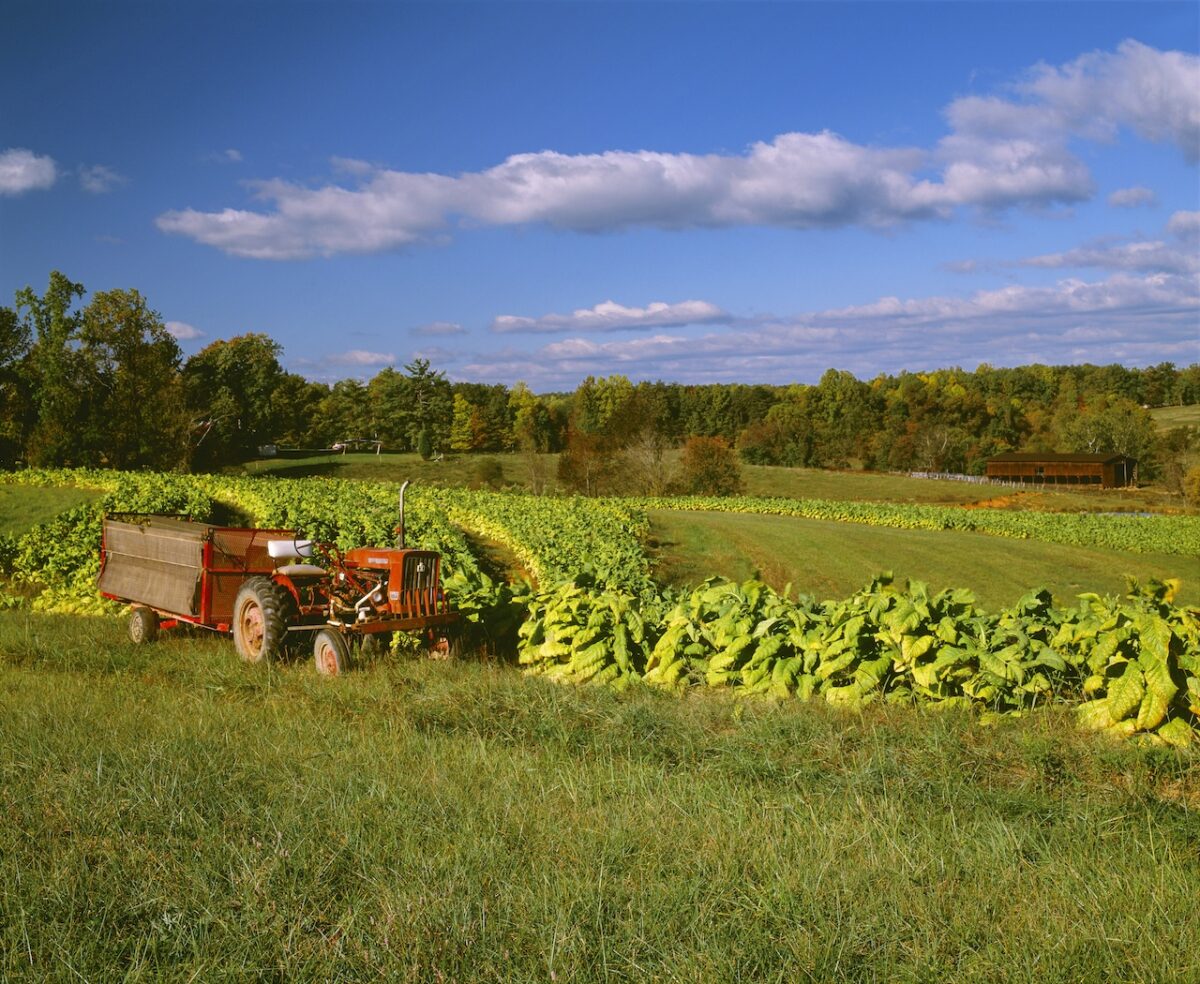
A tobacco farm near Winston-Salem, N.C. (Richard Hamilton Smith/Design Pics Editorial/Universal Images Group via Getty Images)
The study by the conservative John Locke Foundation shows how Trump’s tariffs could start a widespread trade war that devastates farms and the rural communities that depend on them.
President Donald Trump’s tariff policies could devastate North Carolina farmers and rural communities, a new study from the conservative John Locke Foundation says.
The study, published this month, finds that Trump’s widespread tariffs could ultimately cost farmers nearly $700 million in lost revenue and lead to the elimination of 8,000 jobs, a double whammy that risks nearly $2 billion in “potential total economic losses” for North Carolina’s largest industry.
President Trump has cast his tariff policies, which target nearly every one of America’s trading partners, as harmful only to other countries. But that’s not the case.
Tariffs are essentially a tax on foreign goods paid by US businesses and consumers, but if a given country retaliates for those tariffs by refusing to buy American commodities, then American producers lose key customers and a huge source of their income.
That is exactly the danger facing North Carolina farmers, the study says, especially those raising hogs, or growing tobacco, cotton, and sweet potatoes, commodities that are among the state’s biggest exports. And since farms are in mostly rural areas and are big sources of jobs, a threat to a rural farm is a threat to the entire community.
“When agriculture is targeted in international trade disputes, North Carolina is especially vulnerable,” Donald Bryson, the CEO of the John Locke Foundation, said in a news release announcing the study.
“This report shows that the costs are not abstract — they mean lost farm income, lost jobs, and real harm to rural communities.”
The damage done at the local level could also mean serious harm statewide, the report says. In all, the tariffs could cost North Carolina a third of its average net farm income each year.
“Agriculture in North Carolina, its rural economy, and even the state economy all face considerable risks if major trading partners such as China, the European Union, Canada, and Mexico retaliate against the U.S. to protest President Donald Trump’s more aggressive trade policy,” the report says. “The estimated losses would deal a significant blow to North Carolina’s economy.”
“Agricultural production in North Carolina employs roughly 72,000 people, while producing approximately $20 billion in agricultural and forestry commodities,” the study said.
If export markets remain closed to North Carolina farmers, farmers would reduce production to avoid perpetual losses, and that smaller production would necessitate fewer workers.
While the job losses would cut the deepest on farms with “more labor-intensive commodities” like tobacco and sweet potatoes, they would contribute to additional job losses in downstream industries like “food processing, cigarette manufacturing, fiber manufacturing, and wood product manufacturing.”
The ripple effects would not stop there.
“In addition to these job losses, the loss of $695 million in net farm income would reduce the spending of farmers and their families on all types of purchases: farm related (new equipment purchases would be delayed) and otherwise (less money would be spent on new cars, boats, clothes, and dining out),” the report says.
These losses would lead to losses throughout rural communities, the study said, “as local businesses earned less due to those reduced sales, employers consequently hired fewer employees, and the affected business owners and employees would have less to spend themselves at other local businesses.”
Add all the potential damage together, the report says, and “that would bring potential total economic losses due to trade policy retaliation to $1.9 billion, equal to over 2 percent of the gross state product of North Carolina.”
A separate study this month showed that despite Trump’s promises to the contrary, US businesses and consumers paid 96% of the extra costs associated with his tariffs.
The study, by the Kiel Institute for the World Economy, showed that while the tariffs generated more than $200 billion in extra revenue for the United States, foreign exporters paid only 4% of those extra costs. American taxpayers paid the rest.
“The tariff functions not as a tax on foreign producers, but as a consumption tax on Americans. Every dollar of tariff revenue represents a dollar extracted from American businesses and households,” the Kiel Institute said.
Author

Support Our Cause
Thank you for taking the time to read our work. Before you go, we hope you'll consider supporting our values-driven journalism, which has always strived to make clear what's really at stake for North Carolinians and our future.
Since day one, our goal here at Cardinal & Pine has always been to empower people across the state with fact-based news and information. We believe that when people are armed with knowledge about what's happening in their local, state, and federal governments—including who is working on their behalf and who is actively trying to block efforts aimed at improving the daily lives of North Carolina families—they will be inspired to become civically engaged.


NC farmers are facing a severe financial squeeze in 2026. Here’s why
In North Carolina, farming has always been a challenging profession. From the weather to politics to changing consumer habits, many factors outside...

From Minneapolis to your block: Real people are proving politics isn’t just for watching
Consuming political news isn’t the same as building political power. From Minneapolis to small-town America, rural organizer Gwen Frisbie-Fulton...

Millions could go hungry in NC if SNAP benefits are paused during government shutdown
Kids, seniors, and veterans are among those who rely on the Supplemental Nutrition Assistance Program to eat. The Trump administration has warned it...
Millions could go hungry in NC if SNAP benefits are paused during government shutdown
Kids, seniors, and veterans are among those who rely on the Supplemental Nutrition Assistance Program to eat. The Trump administration has warned it...

Opinion: From firehouses to schools, North Carolina’s small towns run on local elections
Millions of Americans turn out to vote in presidential elections, but most of us don’t engage in the local elections that have an outsized impact on...