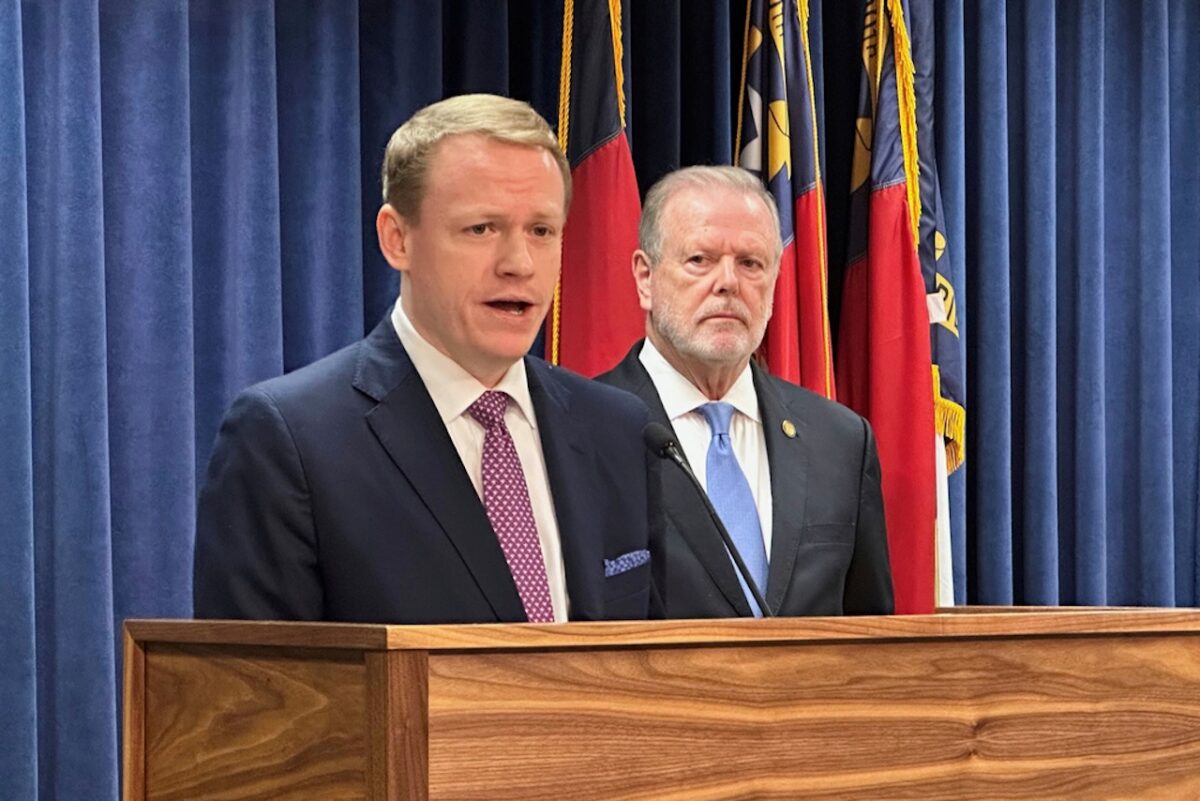
Republicans in the General Assembly, including House Speaker Destin Hall and Senate leader Phil Berger, have previously accused Democrats of lying about needing $319 million to fill the Medicaid gap. On Tuesday they provided just that amount. (AP Photo/Gary D. Robertson, File)
Since last August, Republicans repeatedly accused Democrats of lying about needing $319 million to fill a funding gap in the state’s Medicaid program. On Tuesday they provided just that amount.
Eight months after dismissing warnings from state health officials that North Carolina faced an urgent $319 million shortfall in its Medicaid program, Republican leaders in the General Assembly voted for a bill on Wednesday that allocates $319 million to fill the state’s Medicaid shortfall.
It was a big shift from Republican leadership in both chambers, who, while long agreeing that new Medicaid funding was needed, spent the late summer, fall, and winter last year accusing Democrats, Gov. Josh Stein, and state health officials of exaggerating the problem, and calling the $319 million figure dishonest.
Members of both parties, however, celebrated getting the bill done on Wednesday, though it still faces a final vote in the House and Senate next Tuesday.
The bill, House Bill 696, also makes several changes to state Medicaid law, including new stringent eligibility requirements, and, its sponsors said, protects the state’s Medicaid expansion from federal cuts and policy changes that Congress passed last year at the behest of President Donald Trump.
While Democrats cited concern on some of the eligibility requirements, like requiring state health officials to confirm recipient eligibility every single month. They also expressed relief that action was finally being taken to fill the shortfall, protect Medicaid expansion, and head off what would have otherwise been devastating cuts.
NC Rep. Tim Reader, (R, Pitt Co.) said HB 696 does not contribute any state money to expansion, but works with state hospitals to increase their contributions and uses “a little bit of different Algebra and a little bit of math” to avoid any risk to expansion in the state.
The measure passed in the House, 112-1, and in the NC Senate, 48-1.
“Today is a happy day,” NC Rep. Sarah Crawford (D-Wake Co.) said on the House floor on Wednesday ahead of the vote.
“There are things that are imperfect about this bill,” she said, but “three million North Carolinians will continue to have access to healthcare and services that they desperately need.”
Lawmakers are in the first week of their “short session,” a legislative calendar that’s usually intended merely for tweaks to an existing budget, but since Republican leadership has still not passed a 2026-2027 budget, which was due last July, the to-do list this spring is full of big-picture unfinished business.
The Medicaid shortfall was top of the list.
Better late than never?
Only two Democrats across both chambers voted against the bill, and many Democrats praised their Republican colleagues for their votes, but that didn’t prevent some from reminding leadership that this was long overdue and could have been accomplished in the fall.
Crawford last year frequently implored Republicans in both chambers to fill the shortfall and warned that Medicaid providers and patients were being put through undue stress by the possibility of losing care. Sheshe reminded Republicans of that fact in her comments on Wednesday.
“It’s been eight months—eight months since the cuts were initially proposed,” Crawford said. “Providers and families felt the enormity of this stress, of potentially losing their coverage, losing access to services.”
Gov. Josh Stein and Dr. Devutta Sangvai, the secretary of the North Carolina Department of Health and Human Services, first alerted lawmakers to the shortfall last August, warning them that without new funding, they would have to enact brutal cuts in the fall to avoid even more catastrophic cuts closer to the funding cliff.
Disagreements among House Speaker Destin Hall (R-Caldwell, Watauga Counties) and Senate leader Phil Berger (R-Guilford, Rockingham Counties) derailed multiple efforts to address the issue last fall.
Concerns over Immigration provisions …
Despite the lopsided vote totals, Democrats and advocates expressed concerns about the eligibility requirements and a provision, buried deep in the 33-page bill, that would require state social workers to alert federal immigration officials if they could not confirm the immigration status of any of their patients.
The provision would cause “a chilling effect” that would prevent immigrants from seeking the health care they need, the immigrant rights group Siembra NC said in a statement.
“This law doesn’t just target immigrants; it targets the stability of North Carolina families,” Kelly Morales, a co-director with Siembra said in the statement.
“This isn’t about eligibility; it’s about terrorizing parents who just want to take their kids to a doctor. By forcing our county workers to act as federal informants, the state is making every child in our community less safe,” Morales said.
… and undue burdens
The new eligibility requirements also caused concerns for those who ultimately supported the bill.
Requiring health officials to detail recipient eligibility each month, instead of each quarter, as is the case under current law, will add significant burdens to already strapped health officials and inevitably impact recipients who genuinely need Medicaid and already face rigorous paperwork requirements to show they’re eligible.
Republicans say the provisions are necessary to combat fraud and waste, but Democrats called those concerns disingenuous and accused Republicans of undercutting the fight against fraud with other actions.
Republicans in the state have long complained of waste and fraud in the state’s Medicaid program and accused Democrats, including Attorney General (AG) Jeff Jackson, of not doing enough to prosecute recipients or providers who make fraudulent claims. In a hearing before the state, Jackson disputed the notion that his office was slacking in its fight against fraud.
North Carolina has “one of the most efficient and productive Medicaid Fraud Control Units in the nation,” he told lawmakers, and has done better than many other states at recovering funds lost to fraud.
“Between 2019 and 2025, [North Carolina] recovered $296,014,563, the eighth highest recovery total in the nation,” he said.
In a press conference on Wednesday ahead of the vote on the Medicaid bill, NC Rep. Robert Reives, the House Democratic leader, called the Republican focus on fraud disingenuous.
Republicans blame Jackson for Medicaid fraud, Reives said, but ignore the fact they cut staff from the AG’s office under Jackson’s predecessor, Josh Stein. Those cuts were political, Reives said, and so are the current accusations.
“If you restored the cuts they did to Josh Stein when Josh had the nerve to win Attorney General,” Reives said, “[Jackson] could do his job.”
Author

Support Our Cause
Thank you for taking the time to read our work. Before you go, we hope you'll consider supporting our values-driven journalism, which has always strived to make clear what's really at stake for North Carolinians and our future.
Since day one, our goal here at Cardinal & Pine has always been to empower people across the state with fact-based news and information. We believe that when people are armed with knowledge about what's happening in their local, state, and federal governments—including who is working on their behalf and who is actively trying to block efforts aimed at improving the daily lives of North Carolina families—they will be inspired to become civically engaged.


Trailing in US Senate race, NC Republicans launch probe to go after Roy Cooper
With Republicans facing an uphill climb to beat Roy Cooper, they've created a partisan commission to "investigate" the Democratic candidate. by...

Opinion: On marijuana, North Carolina needs to join the 21st century
Today, North Carolina is one of 10 states in the US without medical marijuana or some kind of regulated adult-use market. We’re a throwback, and not...
NC lawmakers return to Raleigh this week. Here’s what that means for Medicaid and teacher pay
The General Assembly returns for a “short session,” a legislative calendar that’s intended merely for tweaks, but will instead feature a lengthy...
NC lawmakers return to Raleigh this week. Here’s what that means for Medicaid and teacher pay
The General Assembly returns for a “short session,” a legislative calendar that’s intended merely for tweaks, but will instead feature a lengthy...

18 months after Helene, this western NC lawmaker is still fighting for funding to rebuild
Western North Carolina has received less than 20% of the $60 billion needed to recover from Hurricane Helene. On the morning of Sept. 27, 2024,...