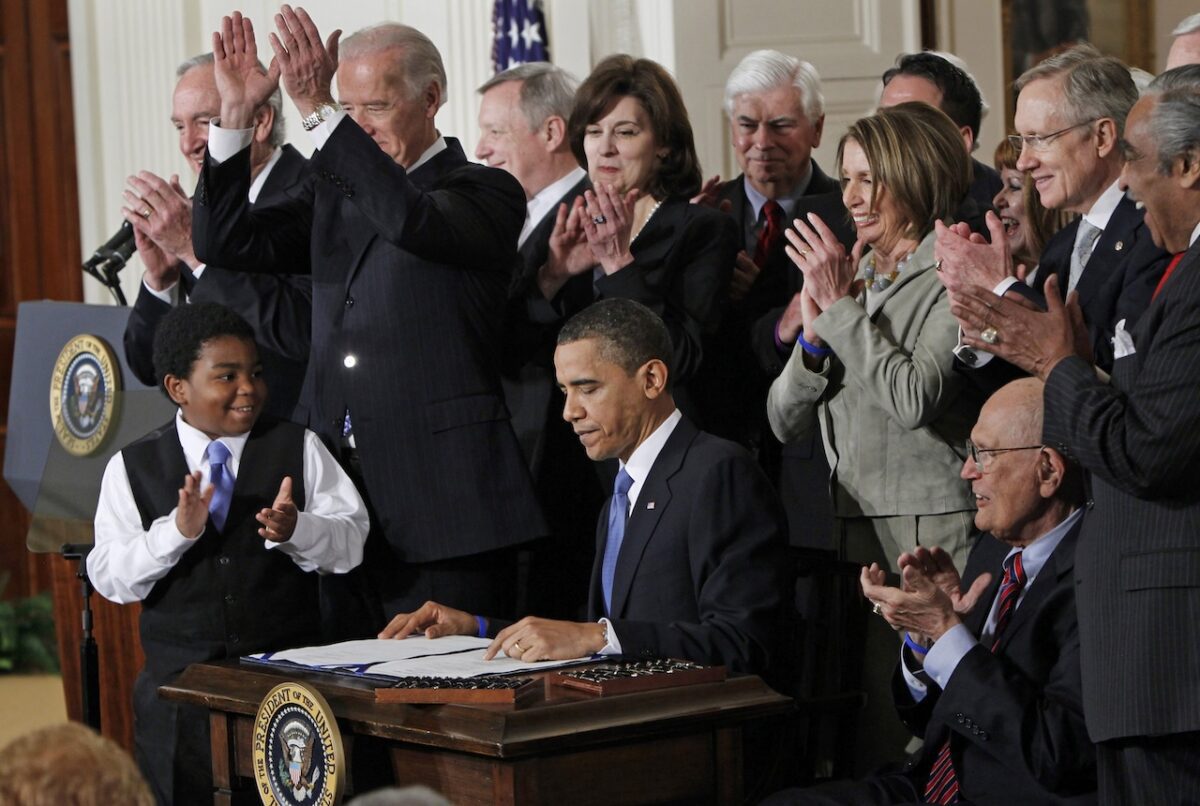
President Barack Obama signed the Affordable Care Act on March 23, 2010. (AP Photo/Charles Dharapak, File)
The ACA helped North Carolina expand Medicaid to more than 720,000 people, and prevented insurers from refusing to cover people with pre-existing conditions.
Sixteen years ago, insurers could legally and blatantly deny health coverage to someone with cancer simply because they had cancer.
Today, they cannot.
You can thank the Affordable Care Act (ACA).
The ACA has faced intensive criticism from Republicans nearly every day since President Barack Obama signed the law on March 23, 2010. But even as the country continues to fight over health care and soaring costs, the ACA’s impact was immense.
The ACA “affects virtually all aspects of the health system,” the Kaiser Family Foundation wrote last year, “including insurers, providers, state governments, employers, taxpayers, and consumers.”
By requiring insurers to assure access to essential services, the ACA, Obama said at the signing, codified “the right of every American to have access to decent health care.”
Despite several attempts to repeal or weaken the law across the two Trump administrations, the ACA is still here. While Republicans have been unable to kill it, they have cut off some sources of funding and allowed crucial parts of the law to lapse.
The landmark law faces new threats too.
Congressional Republicans allowed COVID-19 era subsidies to expire at the end of 2025, causing ACA premiums to double or even quadruple for hundreds of thousands of North Carolinians. Many others were unable to afford coverage at all.
Alongside the lapsed subsidies, the Trump administration also passed extensive cuts to Medicaid last year, creating a two headed threat that could make life-saving insurance unaffordable for hundreds of thousands of North Carolinians, strain already strained emergency rooms, and drive up costs for those who have insurance.
The consequences of losing health insurance are as fresh and raw now as before the ACA was passed, but 16 years is long enough to forget why it was passed and what exactly it did. So here’s a quick refresher of its main components and why they continue to matter.
What is the ACA again?
The Affordable Care Act did a lot of things.
It created a marketplace for people to compare and buy plans, and helped North Carolina expand Medicaid to more than 720,000 people.
It also told insurers to stop refusing care to the people who need it most.
Let’s take a look.
Protected pre-existing conditions
It used to be perfectly legal for insurers to refuse to cover people with cancer or other preexisting conditions.
The ACA made it illegal.
More than 130,000 North Carolinians are living with cancer, state data shows, and in 2024, there were 69,060 new cases diagnosed.
The ACA forces insurers to cover them all. It also prevents insurers from charging them higher premiums.
Eliminated spending caps
Not only could insurers deny you coverage for expensive illnesses, they could cancel your existing coverage once your total expenses exceeded an intentionally low cap. If you got into a car accident that required major surgeries or extensive rehabilitation, you could find yourself on the hook for the expensive treatment.
Not any more.
The ACA banned annual and lifetime caps on essential health benefits.
Protected young adults
The ACA required insurers to allow young adults to stay on their parents insurance until they turned 26. That’s a big deal for folks trying to find their footing in their first jobs or in grad school, when they are most likely to be underinsured or not have insurance at all.
Established the health insurance marketplace
Most people get their insurance through their employers, but that still leaves huge pools of artists, freelancers, and small businesses owners with almost nowhere to go.
The ACA created an insurance marketplace that allowed people to compare and sign up for policies that meet their needs. The tax credits helped assure those plans were affordable.
ACA enrollment more than doubled between 2021 and 2025 after a Democratic-led Congress made the tax credits more generous and expanded access to them.
But because Republicans in the current Congress allowed the credits to expire, enrollment in the ACA marketplace coverage declined in 2026 for the first time since 2020.
Covered most preventive care
The ACA also required insurers to cover all the vaccines, screenings, and other measures that can prevent more serious, and more costly, health issues down the road.
And this, doctors say, is one of the most important factors of all. Because without insurance, people put off primary care, leaving treatable issues to become emergencies.
It’s also why it is so dangerous that as the ACA and Medicaid continue to wilt under the Trump administration’s increased cuts.
Remaining challenges
The healthcare economy is a complex machine, but the bottom line is clear. Even with the ACA, healthcare spending is soaring in the United States, and there remains a huge disparity in who can access affordable care.
Republicans have long claimed that by forcing insurers to cover people with pre-existing conditions, it will make all care more expensive. But studies show that ACA provisions aren’t the only reason premiums have increased so much.
Insurers have found loopholes to charge more despite the caps, and the expired subsidies are driving up costs for those who keep their insurance, too.
Several subsequent analyses also show that any flaws in the law required adjustments, not neglect or abandonment.
It’s not the car’s fault for running out of gas, after all, if you refuse to refuel it.
Allowing the tax credits to expire puts millions of people across the country at risk of losing their insurance.
The Congressional Budget Office told lawmakers that 4.2 million people will become uninsured by 2034 if they allowed the ACA subsidies to expire.
Without the subsidies, the number of people enrolled in the ACA in North Carolina fell by 22% this year, the biggest decrease in the country.
Ralph’s tale
Why does the ACA matter? Because there is a direct line between the lack of insurance and worst case scenarios, Dr. Wes Wallace, an emergency room physician in Chapel Hill, told Cardinal & Pine.
The ACA helped North Carolina expand Medicaid because it promised that the federal government will pay for 90% of expansion costs. But when the Republican-controlled General Assembly passed the expansion bill in 2023, they included a trap-door clause. If the federal portion ever fell below 90%, then expansion in the state might fall apart.
People without health insurance often skip routine doctor appointments and are unable to afford the medicine they need, meaning they wait until they are too sick for anything but the emergency room, where they still can’t afford treatment, but where the hospitals can’t turn them away. That raises costs for everyone.
One particular patient came to mind, Wallace told Cardinal & Pine.
“Let’s call him Ralph, to protect his identity,” Wallace said.
Ralph was in his mid 40s, and worked construction. Worked hard, made pretty good money, but his employer did not offer insurance.
Ralph had a wife and three kids, and he had diabetes.
“He just felt like he couldn’t afford insurance, and so as a consequence he had no connection with a physician, and his diabetes was really poorly managed,” Walllace said.
Without insurance, Ralph had no access to a doctor or to the medications that “could have given him a much healthier life,” Wallace said.
Like many chronic conditions, diabetes makes other issues worse, Wallace said.
“People with diabetes are much more likely to get heart attacks, they’re much more likely to get strokes, they’re much more likely to get bad infections,” he said.
At a construction site one day, Ralph stepped on a nail that went through his boot and punctured his foot.
That night it was sore, but he returned to work the next day. He did not go to the doctor.
Over the next few days, the pain got worse. His foot began to swell, and he missed work. Then several days later, he went to the emergency room.
Ralph’s foot “now looked like a water balloon with toes,” Wallace said.
“He was swollen all the way up to his knee and it was red and it was hot, and he was sick as crap.”
He had a fever. His blood pressure was low. The wound had turned septic.
“He had to be admitted to the intensive care unit, where the bills are tens of thousands of dollars a day,” Wallace said.
Eventually, doctors amputated Ralph’s leg.
Ralph’s lack of a primary care physician caused his diabetes to get out of control, which made the infection worse.
“This all likely stemmed from his lack of healthcare,” Wallace said. “If Ralph had not been diabetic, he’d probably had a sore foot and maybe gotten a mild infection, but he would’ve kept his leg.”
North Carolina was able to expand Medicaid because of the ACA. If Trump’s Medicaid cuts threaten to knock many of those 720,000 North Carolinians off their insurance in 2027, then it will be harder for people like Ralph to avoid these worst-case scenarios.
This story is part of Cardinal & Pine’s “Bad Medicine” series, a wide-ranging look at how new federal healthcare policies threaten to overwhelm already overwhelmed doctors and nurses, widen health disparities in rural areas, and make North Carolinians sicker. For more of Bad Medicine, tap here.
Author

Support Our Cause
Thank you for taking the time to read our work. Before you go, we hope you'll consider supporting our values-driven journalism, which has always strived to make clear what's really at stake for North Carolinians and our future.
Since day one, our goal here at Cardinal & Pine has always been to empower people across the state with fact-based news and information. We believe that when people are armed with knowledge about what's happening in their local, state, and federal governments—including who is working on their behalf and who is actively trying to block efforts aimed at improving the daily lives of North Carolina families—they will be inspired to become civically engaged.


Federal judge blocks HHS vaccine changes, citing a lack of scientific rigor
A US District Court sided with major medical institutions that the changes pushed by US Health Secretary Robert F. Kennedy Jr. were unlawful partly...

Medicaid helps keep this NC teen alive and at home. Trump’s health care cuts will put her at risk.
With $1 trillion in federal cuts to Medicaid looming and further cuts expected at the state level, the families of North Carolinians who rely on the...

North Carolina’s ERs are already strained. Trump’s Medicaid cuts could make it worse.
When people lose insurance, they often rely on emergency rooms. But ERs were never intended to replace primary care, doctors warn North Carolina...
North Carolina’s ERs are already strained. Trump’s Medicaid cuts could make it worse.
When people lose insurance, they often rely on emergency rooms. But ERs were never intended to replace primary care, doctors warn North Carolina...

North Carolina has a shortage of nurses. It’s expected to get a lot worse.
Medicaid cuts could worsen an existing nursing shortage that is already exhausting nurses and putting patients in danger. [This story is part of...