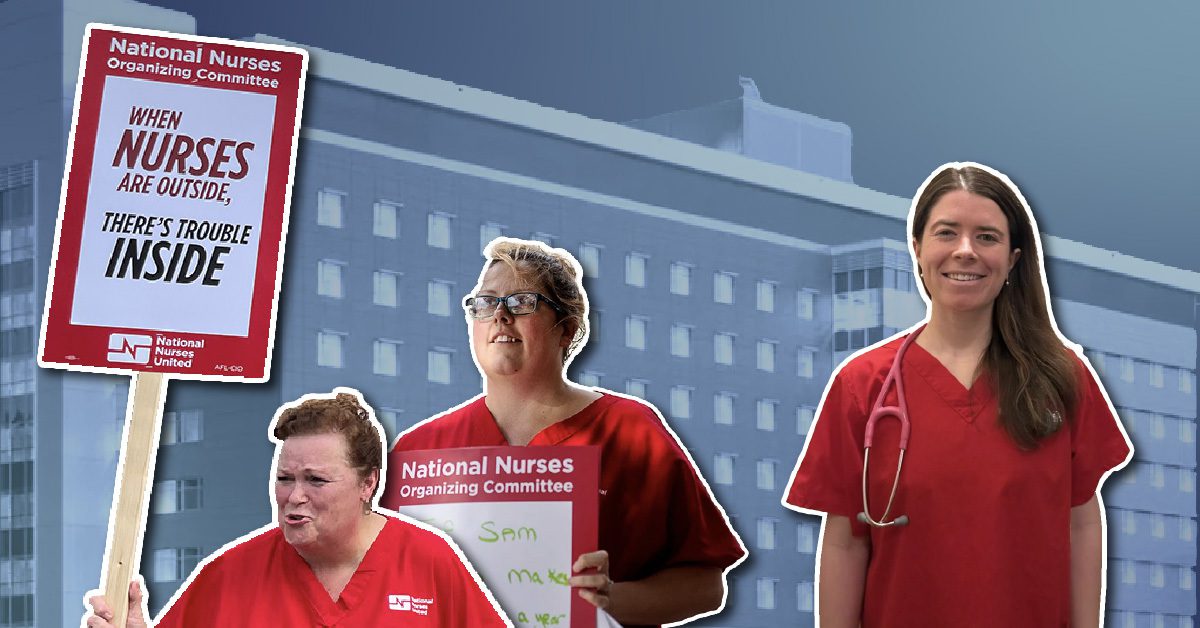
Mission Hospital nurses, including Kerri Wilson, center, and Zoe Clarke, right, have been fighting for improved staffing levels for several years.
Mission Hospital, like many across the country, is severely understaffed, posing a risk to patients who seek care there. If Trump’s Medicaid cuts go through, a bad situation will get much worse.
Kerri Wilson and Zoe Clarke spend their days saving their neighbors’ lives.
They are nurses at Mission Hospital in Asheville; Wilson in the cardiology wing, and Clarke in the intensive care unit. The patients they are responsible for face urgent dangers: heart attacks and aneurysms, strokes and pneumonia.
But these patients are also the people Wilson and Clarke have to face later in the grocery store, post office, and local restaurants.
“This is the community I was born in. This is the community I’m raising my family in,” Clarke told Cardinal & Pine.
Wilson, too.
She grew up 10 minutes from Mission and has worked there for 10 years.
“My mom, my dad have both had major surgeries at Mission Hospital, and if something happens to them, that is where they will go. This is my community,” Wilson said.
Helping their patients heal, they said, is personal.
So is watching them get sicker and being unable to help.
Mission Hospital, like many across the country, is severely understaffed, Clarke and Wilson said, posing a risk to the patients they treat and leaving nurses there feeling an increasing “moral distress.”
On top of that, looming cuts to Medicaid and rising premiums for people who get their insurance through the Affordable Care Act could knock more than 700,000 North Carolinians off their insurance entirely, denying preventative care for treatable illnesses that will soon become emergencies instead, sending even more people to already overcrowded emergency rooms.
Hospital understaffing makes overcrowding worse, which means folks might not get the care they need, which means their conditions will worsen, which means they come back to the crowded ER and restart the cycle.
Mission nurses and their patients are in the path of several runaway trains at once. But Mission’s struggles are not just about a single hospital: This is a national problem.
A 2022 study found that nearly 30% of nurses nationwide were considering leaving the profession, citing low pay, an unreasonable workload, and the lingering effects of the COVID-19 pandemic. And the conditions are making it harder to recruit the next generation of nurses, too, increasing fears not just of understaffed hospitals but of a total shortage of available, qualified nurses.
The growing and overlapping burdens risk pushing nurses across the country toward an exhausted breaking point.
Moral distress
Under the best conditions, it’s hard to be a nurse.
At Mission, nurses don’t work under the best conditions, Wilson and Clarke said.
Mission needs 2,200 bedside nurses to safely staff the hospital, National Nurses United, the union that represents Mission nurses, says. As of August 2025, Mission has just 1,523.
Mission also has more patients than many other hospitals in North Carolina, and its emergency room wait times are longer. Nurses are unable to provide the best care for their patients under these circumstances, Clarke and Wilson said, and when those circumstances persist and patients suffer, it can cause nurses moral distress, a growing nationwide problem that leads to burnout and nurses leaving the profession.
“Moral distress in nursing is largely the result of hospitals creating poor working conditions for nurses and putting profits over patients,” Clarke said.
It creates a dangerous environment for patients and a terrible environment for nurses, she said.
Because the patients who die at Mission are also part of the nurses’ larger community.
“I go home nearly every day feeling guilt about something that happened, feeling regret, feeling bad about something, wondering if some call I made or something I did led to a patient suffering or led to a patient dying,” Clarke said.
Understaffing, the nurses said, makes terrible outcomes more likely.
Clarke and Wilson are active members in their union and have been pressing for changes to these problems for years.
It has been a protracted battle.
‘Immediate jeopardy’
Mission Hospital serves 19 counties in NC and is the only option for the most severe injuries or illnesses that strike in the western part of the state.
In recent years, however, Mission has gained a completely different kind of notoriety.
HCA Healthcare, one of the largest and most lucrative hospital chains in the country, bought Mission Hospital in 2019. Over the last seven years, HCA has made huge cuts to the hospital staff, including nurses and physicians.
In the seven years since HCA acquired Mission, the Centers for Medicare & Medicaid Services (CMMS) placed the hospital in “immediate jeopardy” status four times. That designation is reserved for hospitals whose actions or inactions cause or could cause injury or death.
It is among the most severe rebukes a healthcare facility can face, and CMMS can cut Mission off from federal Medicaid funding if the hospital fails to correct the issues, depriving the hospital of one of its biggest sources of revenue and making even more cuts likely.
The jeopardy designations over the years cited at least 9 deaths, including a man who died of a heart attack in an ER bathroom a year ago as the emergency call-light he triggered flashed unheeded for nearly half an hour.
The latest jeopardy designation came last month.
Investigators cited two deaths and, amid a growing measles outbreak in South Carolina, “a breakdown in infection control practices” that allowed two children with measles symptoms to remain in the open waiting room for 30 minutes, the Asheville Watchdog reported.
This is what happens when emergency rooms are understaffed and overcrowded, Clarke said.
“[The jeopardy status] has largely been the result of staffing issues,” Clarke said.
Cardinal & Pine reached out to a Mission spokesperson via email last week seeking comment for this story, but received no response.
‘Catastrophic cuts’
Federal Medicaid cuts pushed by President Donald Trump will go into effect in 2027, and the North Carolina General Assembly has yet to fill current Medicaid funding gaps that could lead to service cuts across the state. At the same time, people who get their insurance through the Affordable Care Act saw their premiums skyrocket this year after Republicans in the US Congress allowed federal subsidies to expire. Combined, some 700,000 North Carolinians could lose their health insurance entirely over the next year.
That, the Mission nurses said, will be catastrophic for their patients.
“It’s important to recognize that we serve a lot of folks who are underinsured, uninsured, or on Medicaid and Medicare,” Wilson said.
“I’ve had patients who work full-time jobs, 40-plus hours a week, and they are living in their car because they can’t afford a home in our area, and they are choosing to ration their insulin or their diabetes medications because they can’t afford it,” she added.
“These medicines are really expensive,” she said. “If we see these cuts go through, I’m scared for what that means for those patients.”
Without their medications, patients will get sicker and sicker patients mean more work for the nurses.
The western North Carolina communities that depend on Mission are already older and sicker on average than other parts of the state.
Heart disease is the leading cause of death in the United States and in North Carolina. It is also, state data shows, the leading cause of death in Buncombe County, where Mission Hospital is based, and in five of the seven counties that share borders with Buncombe.
Heart disease is also one of the most preventable diseases, highlighting another danger cuts to Medicaid pose across the country. Access to a primary care physician can prevent heart conditions from unraveling and, after a heart attack, ensure a lengthy follow-up process that prevents another one.
Without insurance, people with chronic conditions will be cut off from preventable treatments, and will wait until things are true emergencies before seeking care. Crowded ERs will grow more crowded, Wilson and Clarke said.
‘Busting at the seams’
Medicaid cuts are also direct threats to rural hospitals. Mission has five smaller hospitals in its system, and while they often need to send their patients to Asheville, they still keep smaller issues out of Asheville’s waiting room.
Two of the five sibling facilities could be in danger of closing if neither Congress or the General Assembly prevents the Medicaid cuts, Wilson said.
“All those patients that maybe could have been treated in those 20 or 30 beds in the smaller hospital, all now need to come to the Mission main campus,” Wilson said.
“It’s supply and demand. If these cuts come through, [smaller hospitals] can’t remain open, and the supply [of care] is cut, but the demand is still there. We still have these sick patients.”
She continued, “It means an already overburdened hospital will be just busting at the seams.”
What does it look like when a hospital’s seams burst?
“Our ER has 94 beds, and there’s already been times when they are full,” Wilson said, “and there’s still more patients coming in.”
She continued: “So you have patients in hallway beds, you have patients hooked up to IVs sitting in the waiting room. You have patients maybe with the flu or something in these waiting areas, not properly isolated from other patients. And there’s not enough staff to take care of them.”
‘Thank union nurses’
Mission hospital nurses voted to join National Nurses United in 2020, during the heart of the COVID-19 pandemic. Mission is still understaffed and faces renewed jeopardy, but the union gives nurses a potent way to fight back, Clarke and Wilson said, and protects them while they fight.
“This is why it’s so important to have a union,” Clarke said, “because I am protected [as] I speak out about what’s going on at our hospital … the poor outcomes we’ve seen … and how I’m worried that things will get worse.”
Wilson, who is the chair of the union’s professional practice committee, said the union also gives the nurses a way to bolster one another.
“We’re proud to have our union and be able to fight for better staffing and speak up and we have seen staffing getting better,” Wilson said. “Seeing more people willing to stand up speak out about what’s going on, that gives me hope.”
Clarke agreed.
“There will be a better day in nursing,” Clarke said. “You can just thank union nurses for making our hospitals safer.”
Author

Support Our Cause
Thank you for taking the time to read our work. Before you go, we hope you'll consider supporting our values-driven journalism, which has always strived to make clear what's really at stake for North Carolinians and our future.
Since day one, our goal here at Cardinal & Pine has always been to empower people across the state with fact-based news and information. We believe that when people are armed with knowledge about what's happening in their local, state, and federal governments—including who is working on their behalf and who is actively trying to block efforts aimed at improving the daily lives of North Carolina families—they will be inspired to become civically engaged.


Your zip code can determine your fate in North Carolina’s medical deserts
Seventy of North Carolina’s 78 rural counties are considered “medical deserts.” That means patients often can’t get the care they need, and in many...
Potential measles exposure in Wake County, health officials say
A person with measles visited several public locations in Wake County on Feb. 5 and 6, including a gym and supermarket. A person with measles...

Most Americans disapprove of RFK Jr.’s changes to vaccine policy, new poll says
A Kaiser Family Foundation poll found that adults who had heard of federal changes to the childhood vaccine schedule were twice as likely to say it...
Most Americans disapprove of RFK Jr.’s changes to vaccine policy, new poll says
A Kaiser Family Foundation poll found that adults who had heard of federal changes to the childhood vaccine schedule were twice as likely to say it...
Looking for reliable resources about childhood vaccines? Start here.
It can be hard to know where to find good information about vaccines, but these organizations offer clear and sound medical guidance on what can be...