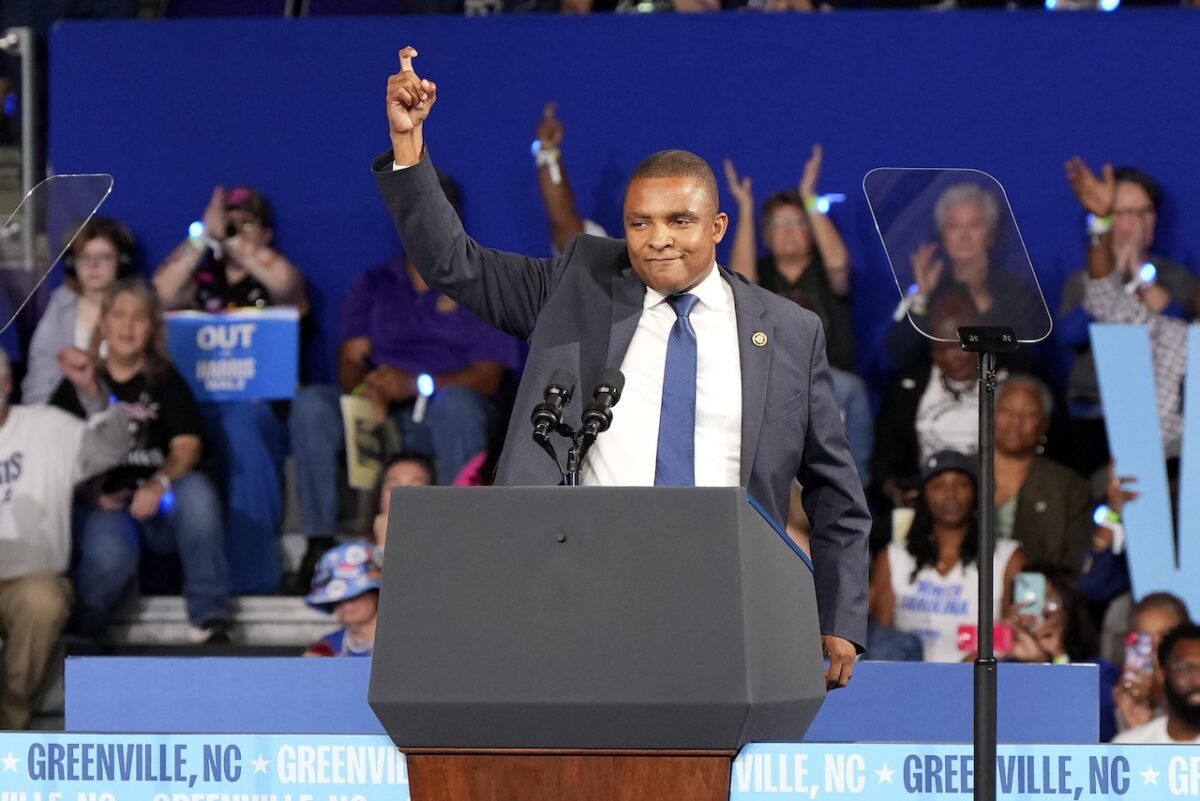
Rep. Don Davis in 2024. (AP Photo/David Yeazell)
A federal court recently approved a new 2026 election map intended to make it impossible for Davis, the incumbent Democrat, to win. But that Republican calculus may not be as certain as it once seemed.
On the day before Thanksgiving, a panel of federal judges approved a new congressional map for North Carolina drawn by Republicans to ensure Democratic US Rep. Don Davis lost his seat in Congress. On Monday, Davis filed for reelection anyway, vowing to win the redrawn district Republicans stacked against him.
“I’m running in NC-01 to ensure everyone, from the northeast to the coast, has a powerful voice in Congress. We’re in this fight together,” Davis said on X this week.
Davis won reelection in 2024 by a narrow margin, as Black voters in District 1 helped push him across the victory line. In the new map drawn in October, Republicans cut a large percentage of those Black voters out of District 1 and lumped them into a neighboring, highly conservative district represented by US Rep. Greg Murphy, a Republican.
Voting rights groups and Black and Hispanic voters in the district sued over the map, arguing that Republicans in the legislature—who control both chambers of the General Assembly—used racial data to draw the districts, which is illegal. Republicans said they did not target Black voters, just Democratic voters, an act of partisan gerrymandering that is not illegal.
The three-judge federal panel rejected the claims of racial gerrymandering and sided with Republicans.
The ruling means this is the North Carolina Congressional map for 2026, a midterm election year as consequential as any in recent memory. And Davis’ race will be among the most important in the country, both as an epicenter of a nationwide fight over partisan redistricting, and as an amplifier of urgent issues like affordable healthcare and the surging cost of living that even Republicans acknowledge could cost them control of congress in 2026 and the White House in 2028.
Those concerns are red-level alerts across most of the country, but they are especially acute in rural areas like District 1, where 18% of the total population lives below the poverty line.
So far, several Republicans have filed to run in the district, including Republican state Sen. Bobby Hanig, a staunch supporter of Trump who has publicly backed many of the policies hurting rural communities.
“Many feel Washington D.C., isn’t serving their needs,” Davis said. “The redistricting battle clearly proves it.”
A yearslong effort to oust Davis
This is not the first time NC Republicans have redrawn a map to target Congressional Democrats or Davis in particular.
Republican leadership drew a highly partisan map for the 2022 election, but that year, the North Carolina Supreme Court, then with a Democratic majority, said that map was illegal and ordered the state to use a map drawn by an independent panel.
Davis was first elected to Congress under that map, defeating his Republican opponent by a sizable margin. Under the independent map, Democrat and Republicans each won 7 seats in Congress, a result in keeping with arguably the most competitive swing state in the country.
But in the same election, Republicans took control of the state Supreme Court, and one of their first orders of business was to reverse the previous court decision on the redrawn map, ruling that the state legislature could essentially draw an election map however it wanted.
And that’s what they did. Republicans then drew a map for 2024 that crammed three incumbent Democrats into highly conservative districts. Those three Democrats—Wiley Nickel, Kathy Manning, and Jeff Jackson—declined to seek reelection, citing the political realities.
That 2024 map also shifted Davis’ district from a strong Democratic district into a competitive district, with Republicans hoping that they could win his seat too. It didn’t stop Davis from winning, but it significantly cut into his margin of victory. Davis won in 2022 by 6 percentage points. In 2024, he won by less than 2.
Republicans seemed to learn their lesson: A marginal approach was not enough.
In the new map for 2026, Republicans cracked and packed the district into a highly favorable Republican target.
The new map
The 2024 version of District 1 was a swath of 21 counties in northeastern North Carolina that stretched from Currittuck on the coast into Granville County, then dipped down like a schnauzer’s snout through Rocky Mount, Goldsboro, and Kingston.
The new map cuts off the snout, including two Democratic counties, and adds six deeply conservative counties from the southern coast, including Carteret County, which Murphy won in 2024 by 71 percentage points.
Republicans and the courts may say that they did not target voters by race, but the effect is the same.
Wilson and Greene counties have large Black populations and helped Davis secure his narrow victory in 2024. Under the new map, those voters are now in a district whose representative is likely to be far less interested in their concerns.
And by adding so many deeply red counties to District 1, Republicans dilute the votes of the Black voters who remain.
According to an analysis of the new map by the North Carolina Black Alliance, the new District 1 cuts “many of the historically Black majority or heavily Black populated counties in eastern and northeastern North Carolina, disrupting “some of the oldest Black communities in the United States.”
The previous District 1’s population had not elected a Republican to Congress since 1883, and has elected a Black representative in every election since 1992.
The Republican effort may still not be enough, however, and Davis’ chances in the new district look better now than they did in October.
Hints of miscalculation
NC Republicans drew the new Congressional map in October at Trump’s instruction, joining several other Republican-led states in seeking to remove Democratic representatives from Congress by drawing districts they likely can’t win. That effort, Republicans openly said, would ensure they keep control of the US House after the midterms.
That political calculus looks fuzzier now.
Republicans lost so badly in the 2025 off year elections—including in conservative areas—that a repeat of those percentages in 2026 means even the new map may not prevent Democrats from retaking the House.
The odds are still against Davis in the new District 1, but he is a centrist Democrat who is betting he can appeal across the aisle. It is possible he could inspire increased turnout from Democrats while winning enough votes from moderate Republicans who’ve become disillusioned with the increasing costs, high tariffs, and neglect of affordability issues in the second Trump administration.
Trump’s tariff and economic policies have hit rural counties hard, and Republican voters have expressed outrage throughout the year in town halls across the state. Trump, who won the state easily in every election he’s run in, is beginning to slip in some NC polls, as recent surveys show voters of both parties are unhappy with the direction of the country.
And Trump’s attacks on Medicaid, healthcare, and food assistance are especially damaging for voters of both parties in eastern North Carolina.
Whoever wins the new District 1 will have to at least pretend to address these concerns and, despite the new political demographics, appeal to a relatively broad swath of voters.
While Hanig has so far kept in lock step behind Trump’s policies, Davis often shuns hyperpartisanism. He has one of the most bipartisan voting records in Congress and broke with most of his fellow Democrats by voting to reopen the government after the recent federal government shutdown.
Davis says he will continue to reach out to all voters in 2026.
Hanig, who has never had to cast a wide net for votes, recently called Democrats “wicked” and “evil.”
Author

Support Our Cause
Thank you for taking the time to read our work. Before you go, we hope you'll consider supporting our values-driven journalism, which has always strived to make clear what's really at stake for North Carolinians and our future.
Since day one, our goal here at Cardinal & Pine has always been to empower people across the state with fact-based news and information. We believe that when people are armed with knowledge about what's happening in their local, state, and federal governments—including who is working on their behalf and who is actively trying to block efforts aimed at improving the daily lives of North Carolina families—they will be inspired to become civically engaged.

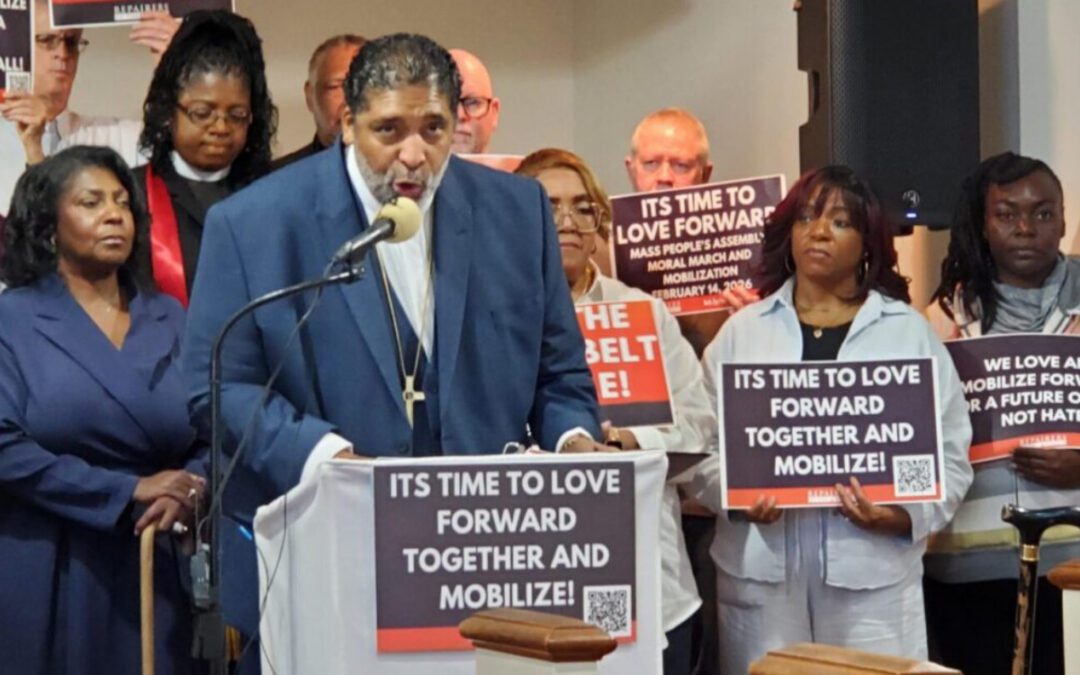
Mobilizing with love: NC faith leaders launch Selma march for overlooked voters
A Selma-inspired march from Wilson to Raleigh is part of a broader effort to turn moral urgency into voter participation ahead of the midterm...
Election Night was a bad night for NC Republican incumbents
NC Democrats flipped Republican mayoral offices and several seats on city councils on Tuesday, but what does that mean for the next election? Here...
NC Republicans release electoral map that would push Democrat Don Davis out of Congress
Republican leaders in the General Assembly say they will vote on a new congressional map next week that removes US Rep. Don Davis from his district...
NC Republicans release electoral map that would push Democrat Don Davis out of Congress
Republican leaders in the General Assembly say they will vote on a new congressional map next week that removes US Rep. Don Davis from his district...
Judge approves plan to settle Trump voter registration lawsuit with North Carolina
A federal judge on Monday approved a plan to settle a lawsuit filed by President Donald Trump’s Justice Department that demanded North Carolina...