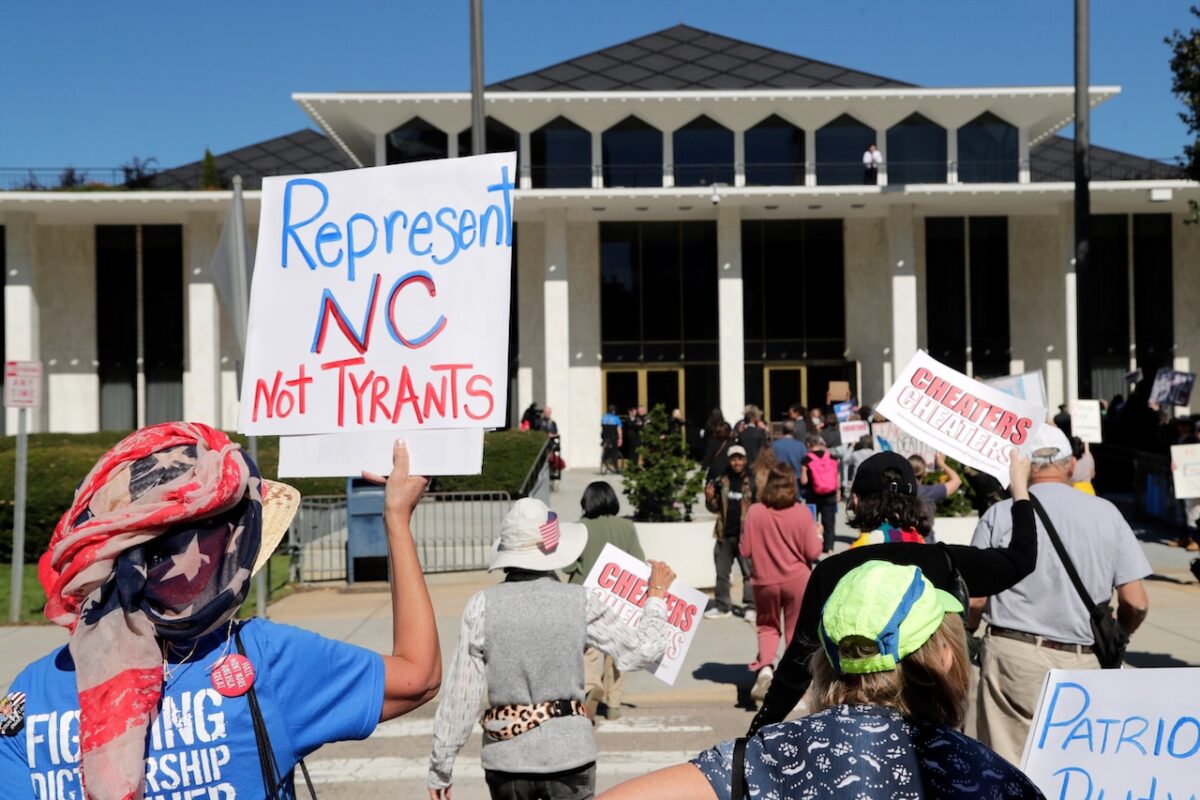
Demonstrators approach the Legislative Building during a rally protesting a proposed election redistricting map Tuesday, Oct. 21, 2025, in Raleigh, N.C. (AP Photo/Chris Seward)
NC Democrats flipped Republican mayoral offices and several seats on city councils on Tuesday, but what does that mean for the next election? Here are some takeaways about what the results could mean moving forward.
Democrats are celebrating in Virginia, New Jersey, California, and New York City this week after blowout victories in high-profile elections that most people see as an indictment of President Trump’s second term. North Carolina, which is normally center stage in national elections, did not have any high profile races this year, but the results here on Tuesday still offer a sharp, if limited, glimpse of how voters feel about the state of things.
In short, many Republican incumbents in North Carolina lost their jobs.
Democrats flipped several mayoral races and city and town council seats across the state, some of which had been held by Republicans for decades. Voters in Charlotte and Greensboro ousted the lone Republicans on their city councils, and several Raleigh suburbs chose Democrats over longtime Republican mayors.
The results are still unofficial and won’t be certified until the 10-day canvassing period ends on Nov. 14, but it was undoubtedly a good night for Democrats.
Even the conservative-leaning Carolina Journal wrote that “Democrats dominate[ed]” the election, and in an opinion column for the Charlotte Observer, Andrew Dunn said the Charlotte results were “the crest of a blue wave that hit across North Carolina and around the country.”
Perhaps. But good nights in off-year municipal elections often have brief resonance, and the political realities in North Carolina make it harder to tell if Tuesday’s results were a typical voter reflex against an unpopular president or a sign of rising momentum that will endure through the 2026 midterms, where nearly every race in North Carolina will be as high-stakes and high-profile as they come.
Here are some takeaways of the 2025 elections in North Carolina and what they might mean moving forward.
A bad night for Republican incumbents
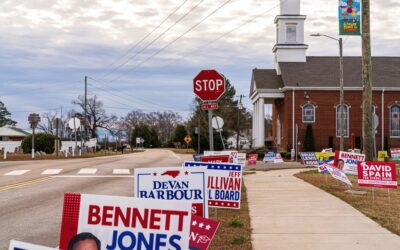
Let’s start with an important caveat. Municipal elections in North Carolina are bipartisan on paper. No party affiliation is listed on the ballots for mayor, city council, town commissioner, and the like. And as The Assembly pointed out this week, many candidates avoid the partisan rancor of national elections to focus on the specific, street-by-street concerns of their cities and towns.
“That appears to be over,” The Assembly wrote.
The candidates’ party affiliation might not be on the ballot, but both the NC Democratic and Republican Party made several endorsements, and it is easy enough—if time consuming—to look up how each candidate is registered.
Voters know, and in big cities, small towns, and suburbs alike, they chose Democrats in large numbers.
The Democratic incumbent mayors easily won reelection in Durham, Charlotte, Fayetteville, and Wilmington. In Greensboro, where the incumbent Democrat decided not to run again, the Democratic mayor pro tem defeated her Republican opponent by more than 20 percentage points.
Those results are hardly unexpected since those cities are Democratic strongholds.
But Democrats also won the mayoral elections in several towns previously held by Republicans, including Burlington, Graham, Fuquay-Varina, and Holly Springs.
One of the biggest surprises of the night came in Wake Forest, a Raleigh suburb that has seen significant population growth over the last few years, in part because Raleigh is becoming unaffordable.
In the Wake Forest mayoral race, Democrat Ben Clapsaddle beat incumbent Vivian Jones, a registered Republican, by 31 percentage points. That’s gigantic.
Jones has been the mayor since 2001 and until this year, she won each of her re-election races by large margins. Jones, who was not endorsed by the NC GOP, faced widespread criticism in September when she signed a proclamation to honor LGBTQ+ history month only to abandon the plan after receiving vitriolic and far-right attacks online.
Democrats also flipped several seats on city councils across the state, including in Wilmington and in Jacksonville.
In Charlotte, Kimberly Owens became the first Democrat to win District 6 on the city council, a seat Republicans have held for decades and the only seat they had on the 11-member body.
Owens beat her Republican opponent, Krista Bokhari, by 13 percentage points.
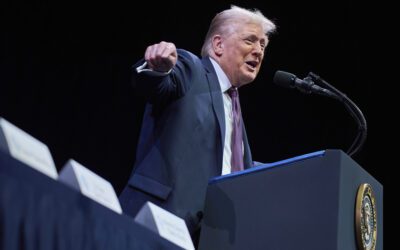
Bokhari was running to replace her husband on the council after he took a job in the Trump administration, providing a link between local election results and the national anger over many of Trump’s policies.
While many Republicans suggested Trump had nothing to do with the widespread Republican losses in North Carolina and the rest of the country, in her concession speech, Bokhari acknowledged the two could not be separated, even if she disparaged the outcome.
“The voters of Charlotte completely voted in this election based on national politics, and that was a big mistake,” Bokhari said.
But there can be no distance between local and national politics—or local and national elections—when the consequences of federal policies besiege communities in big cities and rural towns alike, leaving even Trump supporters facing rising costs, diminished benefits, and weakening job markets.
National issues are local
In his second term in office, President Trump has made huge cuts to federal aid that helps millions of North Carolinians eat and see their doctors. He has dismantled huge swaths of federal infrastructure to improve roads, fight cancer, and battle climate change, a-billion-dollar-a-year threat in North Carolina. And because of his policies, people who get their health insurance through the Affordable Care Act (ACA) will soon see their premiums sky rocket.
His threats to restrict voting access, efforts to prosecute his political enemies, the violent abductions and deportations of even legal immigrants, and the mobilization of the military against peaceful protesters are not normal. And they are not confined to the national stage.
Thousands and thousands of North Carolinians joined massive protests in the state over these and other concerns, and there is little doubt that the energy behind the No Kings rallies last month is at least partially connected to the increased voter turnout on Tuesday and the outsized Democratic victories.
The elections in New York, New Jersey, and even in Virginia, North Carolina’s next door neighbor, might seem unrelated to what happened here, but the issues at the center of the Democrats’ winning campaigns in those states are most certainly North Carolina issues too.
New York City Mayor-elect Zohran Mamdani won, in part, because he promised to freeze rents for 2 million rent-stabilized tenants and provide free childcare. North Carolina is facing an acute housing shortage and rents beyond the reach of many residents, and the childcare crisis here has gotten so bad Gov. Josh Stein appointed a bipartisan commission to try to find solutions.
Abigail Spanberger in Virginia and Mikie Sherrill in New Jersey won their gubernatorial races in part because they promised to confront rising utility costs in their states. Policies pursued by Duke Energy and greenlit by Republicans in the General Assembly are set to send rising utility costs here even higher over the next two decades.
Now what?
Politicians, political operatives, and political journalists feed their families by spinning prophecies out of each election. What does what just happened say about what will happen? It’s a natural extension of the anxiety that follows every election, every vote.
Will it be ok now? Will things get better?
The boring and frustrating truth is that one election yields few certainties about the next, and the reasons for a given election result are often far more numerous and tangled than whichever spin happens to take hold in the public narrative.
Democrats had an outstanding night in North Carolina and the rest of the country, but it’s much harder to parse what, if anything, that says about what WILL happen in 2026 or 2028.
Still, while every election likes to paint itself as THE election, there is no question that this year is different than most, and that the cliches “unprecedented” and “more than ever” might actually be true this time.
The 2026 and 2028 elections are far away, but a year is also a long time to go hungry, a long time to watch the costs of living move further and further out of reach.
Over the next two election cycles, North Carolinians, including plenty of Trump voters, will continue to be hit hard by Trump’s SNAP cuts, Medicaid cuts, rising grocery costs, and soaring ACA premiums. And then they will vote.
Author

Support Our Cause
Thank you for taking the time to read our work. Before you go, we hope you'll consider supporting our values-driven journalism, which has always strived to make clear what's really at stake for North Carolinians and our future.
Since day one, our goal here at Cardinal & Pine has always been to empower people across the state with fact-based news and information. We believe that when people are armed with knowledge about what's happening in their local, state, and federal governments—including who is working on their behalf and who is actively trying to block efforts aimed at improving the daily lives of North Carolina families—they will be inspired to become civically engaged.

Strap in. It might be a while before the Page-Berger race is decided.
Rockingham County Sheriff Sam Page declared victory with a two vote lead over Phil Berger, the most powerful Republican in the state, but there are...
NC political titan Phil Berger trails by 2 votes, several Dem incumbents fall
Phil Berger, the most powerful Republican in North Carolina, trails his Republican opponent by two votes and three conservative Democrats got shown...
NC primary elections could see high-profile Republicans, Democrats lose their seats
Powerful incumbents of both parties, including NC Sen. Phil Berger and Democratic US. Rep. Valerie Foushee face surprisingly tight primary...
NC primary elections could see high-profile Republicans, Democrats lose their seats
Powerful incumbents of both parties, including NC Sen. Phil Berger and Democratic US. Rep. Valerie Foushee face surprisingly tight primary...
Mobilizing with love: NC faith leaders launch Selma march for overlooked voters
A Selma-inspired march from Wilson to Raleigh is part of a broader effort to turn moral urgency into voter participation ahead of the midterm...