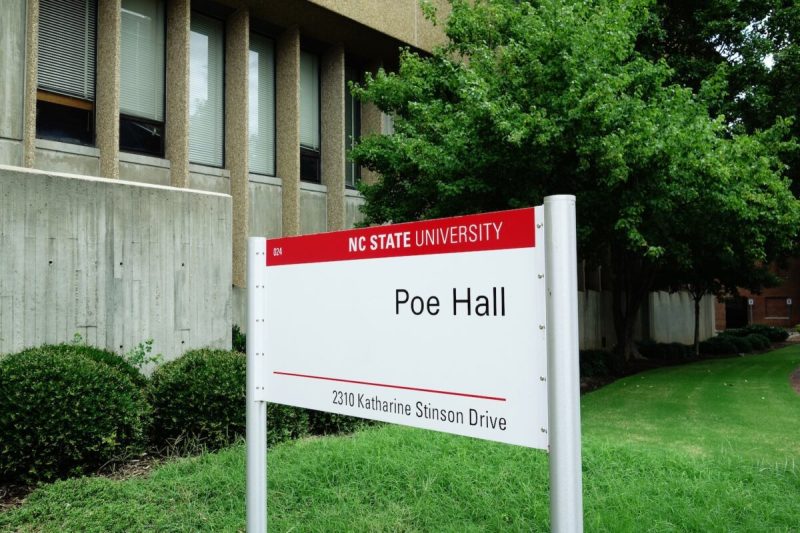
Members of the North Carolina State University community are still seeking justice over cancer-causing toxins which caused the closure of one of its buildings.
The Campus Community Alliance for Environmental Justice began its campaign in 2023 to spread awareness about the high levels of polychlorinated biphenyls found in Poe Hall after its closure.
Sandy Alford, a North Carolina State University alumna who has breast cancer, like hundreds of other workers and students who spent time in Poe Hall, remembers when she first heard about the PCB contamination in 2023 and thought of a doctoral student she worked with who died at the age 42 from a rare brain cancer.
“Suddenly the penny dropped,” Alford recounted. “That’s why my former boss might have died. This is why I have breast cancer. I have a favorite professor from NC State who was in that building for 13 years and she has cancer as well as neurological damage.”
Alford has gone through surgery and radiation for her cancer and noted her disease followed a similar path as others from the building who have been diagnosed with cancer and other diseases. Alford is one of the lead litigants suing the university over the chemicals on behalf of more than 600 alumni and former staff.
A North Carolina State spokesperson said safety is the school’s top priority and pointed to a website which provides updates on Poe Hall. Earlier this month, the university announced a multimillion-dollar lawsuit against Monsanto for PCBs in building material it used constructing Poe Hall. It is unclear if the lawsuit will provide a path to compensation for former workers and students.
Reporting from WRAL-TV found 23 buildings tested positive for PCBs going back to 2017. Alford added she has connected with more than 70 people over their potential exposure in Poe Hall and she thinks the school should do more to inform people.
“As alumni, former faculty, former staff, why are we doing that? Why isn’t the university doing that?” Alford asked. “And the bigger question that I ask is why isn’t there a federal mandate or some kind of state mandate that said once you find PCBs you have to do due diligence in communicating this.”
Chelsea Lundquist-Wentz, founding member of the Campus Community Alliance for Environmental Justice and an instructor at N-C State, said there were gender disparities in Poe Hall, which houses the College of Education and humanities courses, and wonders if the response would have been faster in more male-dominated career paths.
“There’s a lot of women that were in that building, and of course, there are men in there as well,” Lundquist-Wentz pointed out. “It just raises those kind of questions for me.”
Lundquist-Wentz stressed other institutions have been more proactive in responding to PCBs, including four universities in the University of North Carolina system, which have tested buildings for the chemical. She thinks universities across the state need to figure it out.
“We can test and mitigate this,” Lundquist-Wentz contended. “It’s possible, and so that’s what we want not only NC State to do but the University of North Carolina System as a whole.”
Related: Good News Friday: A North Carolina college battled homesickness by letting pets into dorms