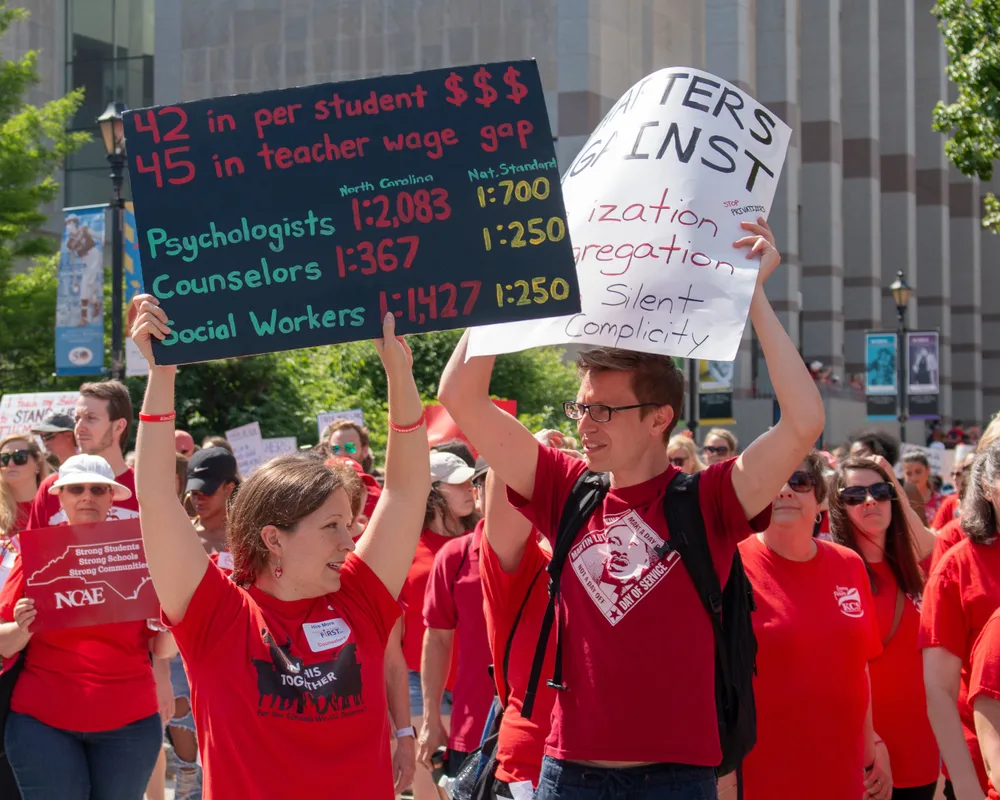
In this 2019 file photo, educators and their supporters protested low education funding at the state legislature in Raleigh. (Shutterstock)
Local school systems used pandemic relief dollars from the federal government to fill holes torn by the pandemic and underfunding from the state. Now those federal dollars are going away.
Schumata Brown has been hearing the “horror stories,” as he calls them.
Brown’s the local school board chair in his native Jones County, N.C. When the federal COVID money dries up in September, his county will, one way or another, feel the pain.
“It’s scary just to hear 21 million, 14 million cuts,” Brown says. “I’m like, fortunately for us, we kind of got ahead of the ball game with that.”
We know public education: Sign up for our free, award-winning newsletter
They’re one of the lucky ones. Congress dispatched almost $200 billion to states during the pandemic. NC got about $3.6 billion. It was meant to help reeling schools transition to remote learning and pandemic life. Come Sept. 30, that money has to be spent with little chance of another federal intervention.
Educators are calling it the “funding cliff.” Local governments develop their budgets in the spring and early summer, so leaders like Brown are standing on the edge of that cliff right now.
Counties like this one used the federal money to fill the holes torn by the pandemic. They fixed HVAC systems. They bought computers to connect kids with teachers. And they paid teachers who might otherwise have quit, teachers who were running virtual classrooms they never imagined they’d run.
Schools used the money on tutoring and summer programs too, because virtual learning and in-person learning aren’t equal. The kids who struggle tend to struggle even more.
“I think when the pandemic began, when the funding was first approved, it was absolutely not clear how much disruption there would be and what would happen to student learning,” Lindsey Dworkin of the Northwest Evaluation Association, a national K-12 assessment nonprofit, told The Hill in March.
Dworkin said another federal intervention is needed. But there’s little hope of another rescue from Congress, even if there was an appetite for it. Congress has struggled to pass bills under divided GOP leadership.
Which means public schools will have to rely on state leaders. And in North Carolina, help from the state legislature could be optimistically described as murky. Republicans in the General Assembly are expanding privatized school options, but public school funding is near the bottom of the nation.
@cardinalandpine WATCH: There is no teacher shortage, but there is a shortage of people willing to get bad pay for a hard job. 🤕 Senior Editor Billy Ball takes a look at a new report documenting more than 10,000 educator departures in NC in 2023. That’s the highest number in two decades. For more NC news and politics, follow @cardinalandpine. #school #education #ncpol #unionstrong #publiceducation #ncteachers #nceducators #teachersofnc #nced
“Money answers all things”
Brown’s southeastern county is home to about 10,000. It’s old Tuscarora land, a short trip from the Croatan National Forest and the Outer Banks. It’s sparse, scruffy, and swampy—not quite the beach, not quite inland.
And, like many places in this part of the state, it became a plantation county after the Europeans arrived, surrounded by low-lying swamps and coastal forestland. The end of slavery meant the end of relative prosperity. The 20th-century decline of tobacco hurt too, so Jones County, like most rural NC places, is not flush with cash.
“I tell people all the time, our conversations, our ability to do things helps out,” says Brown. “But like the Bible says: ‘Money answers all things.’”
Jones County is fortunate though, he says. The end of September will hurt, he says, but his county was for the most part able to avoid spending the federal money on things they would have to pay for every year. “We anticipated that pain and started it early instead of getting it at the end of these funds.”
When teachers retired, Jones County didn’t fill those positions, he said, or they eliminated positions in other areas. He says his county, like most in the state, needs more support for staff and teachers, but Jones County avoided big funding traps.
That’s sound budgeting. You don’t, ideally, meet recurring expenses with one-time cash. But these were not ideal times, and, while it might not apply to Jones County, this fiscal best practice became one of the first victims of the pandemic in many counties.
School administrators stitched together their budgets during the pandemic out of funds like these.
A 2023 report from K-12 consultants ERS summed up the challenge for states like North Carolina, which have a high percentage of children from low-income families. The federal funds accounted for a relatively high proportion of total K-12 revenue, more than 11%.
At the same time, NC is one of many states cutting taxes in recent years. National budget experts say the loss of state revenue for public services like schools makes for a bad combination as federal funds slow, NC Newsline reported recently.
Joanna LeFebvre of the nonpartisan Center on Budget and Policy Priorities told The Hill in March that states like NC used “the influx of federal dollars as cover to push permanent tax cuts,” with the federal funds now set to take a hit.
NC Republicans have been slashing taxes for more than a decade, but the 2023 budget “doubled down,” NC Newsline wrote, by moving up personal income tax reductions and other cuts. By 2029, the GOP tax cuts will be costing the state more than $13 billion a year in lost revenue, and it’s likely that public education—the largest portion of the state budget—will feel it most keenly.
State officials told NC lawmakers in February that the biggest hurdles remained for rural districts who rely on the money for tech updates and staffing. “Those funds aren’t going to be growing on trees for them to pluck and use on those valuable tools,” Bruce Mildwurf with the NC School Boards Association told lawmakers, CBS-17 reported.
State Superintendent of Public Instruction Catherine Truitt recommended local districts offset the loss by applying for federal grants, asking local county commissioners for more funding, or finding funding within their current budget.
It’s notable though that Truitt, a Republican, did not recommend asking for help from the single largest source of public education money—the Republican-controlled N.C. General Assembly.
“I just think, in a perfect world, you definitely would love unlimited funding,” Brown told Cardinal & Pine. “But we know that our state lawmakers can’t do that. They got budget limits, they got budget limitations and there’s always going to be the debate on how education should be funded. It should be the number one priority though.”
Author

Support Our Cause
Thank you for taking the time to read our work. Before you go, we hope you'll consider supporting our values-driven journalism, which has always strived to make clear what's really at stake for North Carolinians and our future.
Since day one, our goal here at Cardinal & Pine has always been to empower people across the state with fact-based news and information. We believe that when people are armed with knowledge about what's happening in their local, state, and federal governments—including who is working on their behalf and who is actively trying to block efforts aimed at improving the daily lives of North Carolina families—they will be inspired to become civically engaged.

Video: North Carolina teachers getting hoodwinked on pay raises
Cardinal & Pine spoke with Rep. Lindsay Prather, a former educator, about the pay North Carolina teachers are getting. She says they're being...
Trump says millions are ‘lifted’ off SNAP. A Charlotte nonprofit says hunger hasn’t gone away in NC
More than 1.4 million North Carolinians rely on SNAP benefits to help pay for groceries. Boxes and tractor trailers loaded with donated food move...
Food insecurity is hitting thousands of NC children—and it’s following them into the classroom
More than 580,000 NC children rely on SNAP to help keep food on the table. On school mornings in North Carolina, some children arrive already...
Food insecurity is hitting thousands of NC children—and it’s following them into the classroom
More than 580,000 NC children rely on SNAP to help keep food on the table. On school mornings in North Carolina, some children arrive already...
Lindsey Prather knows what it’s like to be a teacher. That’s why she fights for them.
North Carolina teachers are among the worst paid in the country, a reality that drives more and more teachers out of the classroom. It was at Cary...