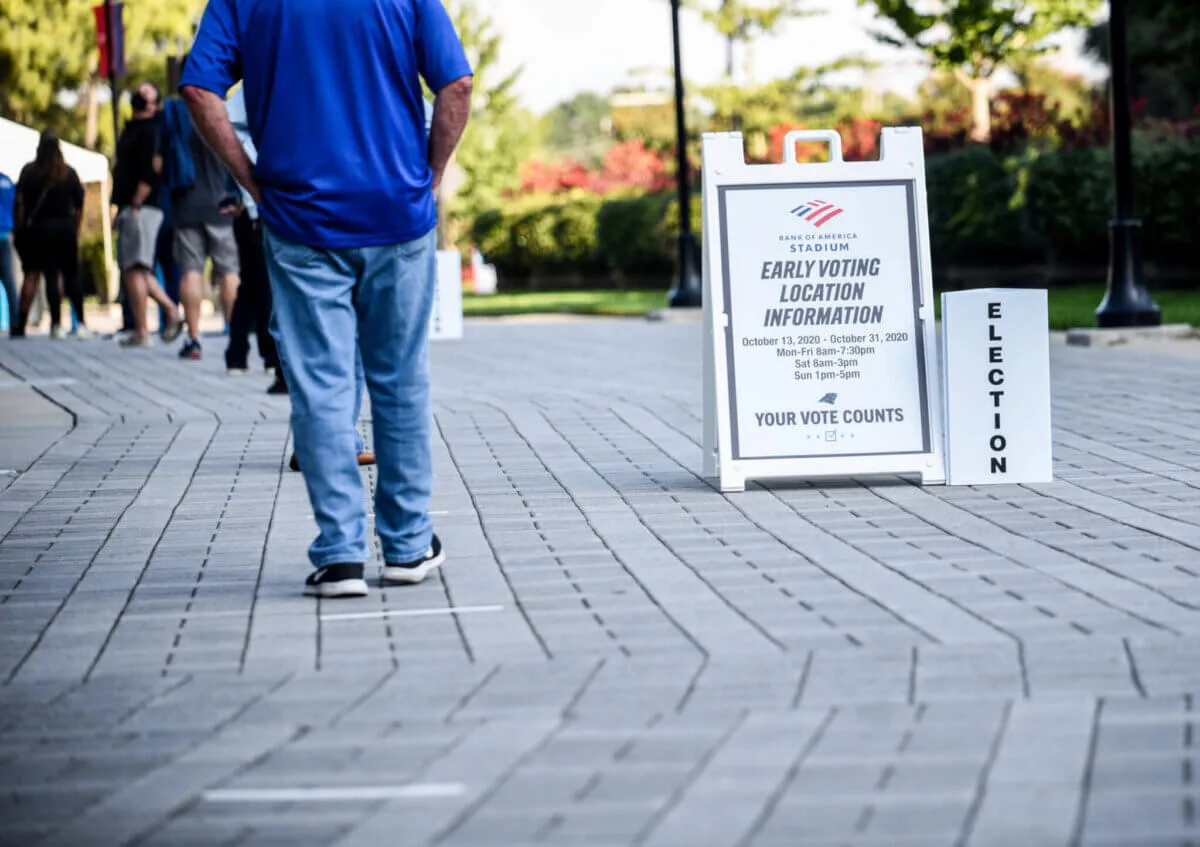
Voters wait in line to cast their ballots at an early voting site located at Bank of America Stadium in Charlotte. (Image for Cardinal & Pine by Alvin Jacobs Jr.)
A state law with racist roots has long barred people on parole from voting or registering to vote. Courts ruled it unconstitutional this year.
As of today, more than 55,000 North Carolinians who have felony convictions but are no longer in prison can vote and register to vote.
They were previously denied the right to do both under a state law, but that law was ruled unconstitutional by a state court this year.
Voting rights advocates point to the law’s racist roots in the Jim Crow era, when white supremacists acted at the turn of the 20th century to disenfranchise Black Southerners. Their efforts were remarkably effective.
We know North Carolina, inside and out. Sign up for our free newsletter.
North Carolina’s Republican legislators appealed this year’s ruling, and it is still before the court. But the Court of Appeals ruled that rights be restored while the case is being decided.
The North Carolina Board of Elections announced on Tuesday that it had updated the system to account.
“As of July 27, the State Board will update its website and voter registration forms and other voting-related documents to reflect this new information on felon eligibility,” the NCBOE said in a news release.
“The agency will update this information upon any further order of the courts.”
To register to vote for the November elections, click here.
Anyone in jail or prison for a felony conviction is still not allowed to register or vote, but if someone is in jail awaiting trial but has not been convicted, they are still able to vote.
“In North Carolina, a person never loses their voting rights for a misdemeanor conviction,” The NCBOE points out.
In 2020, state laws denied the right to vote to 83,837 residents. Of those North Carolinians, 39,989 of them are Black. North Carolina ranks in the middle (26th) of the country on this metric, according to the Sentencing Project, a nonprofit criminal justice reform organization.
Most states have some laws restricting the right to vote for people with felony records, and Black Americans are disproportionately affected, according to the Sentencing Project.
Author

Support Our Cause
Thank you for taking the time to read our work. Before you go, we hope you'll consider supporting our values-driven journalism, which has always strived to make clear what's really at stake for North Carolinians and our future.
Since day one, our goal here at Cardinal & Pine has always been to empower people across the state with fact-based news and information. We believe that when people are armed with knowledge about what's happening in their local, state, and federal governments—including who is working on their behalf and who is actively trying to block efforts aimed at improving the daily lives of North Carolina families—they will be inspired to become civically engaged.

Op-Ed: Studying the Holocaust remains vital to ensuring it never happens again
International Holocaust Day will be observed on January 27, 2024. This day commemorates the liberation of the Auschwitz concentration camp by the...

VIDEO: How Rural Broadband Is Coming to This North Carolina County
More than 1.1 million North Carolinians lack access to high-speed internet, a necessity of the modern economy. In Warren County, help is on the way,...
VIDEO: Sampson County puts Biden’s promise to boost rural infrastructure to the test
Locals in this rural NC county say their water and air is polluted by a PFAS-contaminated landfill, massive hog and poultry farms, and industrial...
VIDEO: Sampson County puts Biden’s promise to boost rural infrastructure to the test
Locals in this rural NC county say their water and air is polluted by a PFAS-contaminated landfill, massive hog and poultry farms, and industrial...

Mold and classes in trailers: Inadequate funding for schools is hurting NC communities
Schools across the state are dealing with dilapidated classrooms and buildings in need of significant repair or a total rebuild due to a lack of...