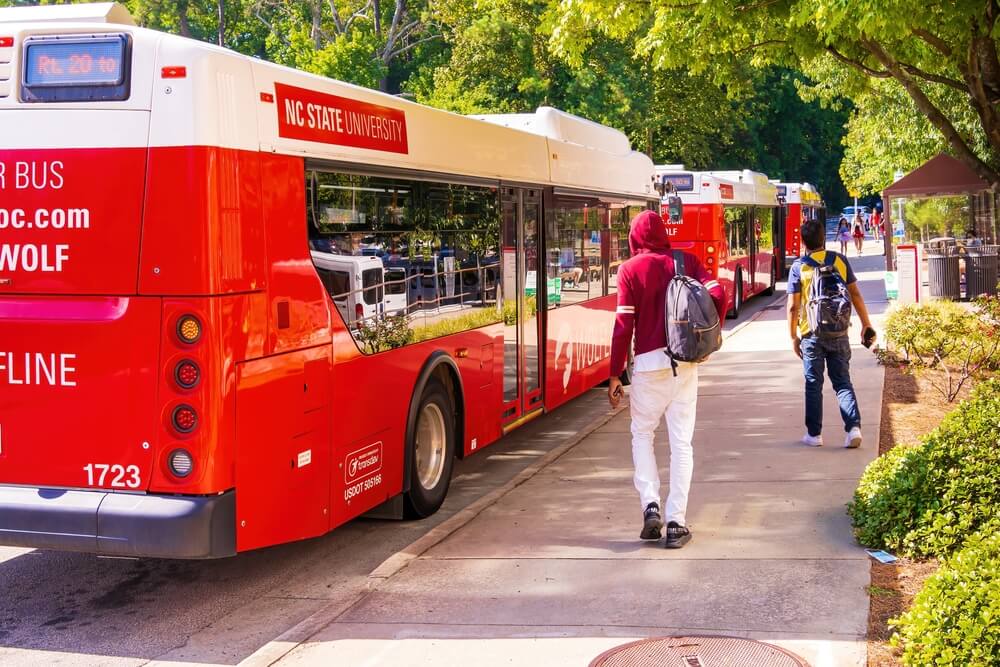
Students at NC State University board buses near the Raleigh campus. (Image via Shutterstock.)
Nearly $177 million is headed to North Carolina to buy energy-efficient buses, update transportation centers, and prop up rural public transportation systems.
There’s a big pot of public transit money coming to North Carolina this year, courtesy of the federal government—not to mention us taxpayers!—to help get more people where they need to go.
Nearly $177 million in funds earmarked for the state over the next year was announced recently by the federal transportation department. The funding is the first set of installments to come out of the 2021 bipartisan infrastructure deal signed into law by President Joe Biden. It’s a 25% uptick from what North Carolina got the year before.
“We are so pleased with the bipartisan effort that has taken place to get us to this point,” said state Transportation Secretary Eric Boyette in a statement. “Public transit is the backbone of so many communities in North Carolina. This funding will go a long way in continuing to support them.”
A big priority will be improving options for public transportation in rural areas, a serious need given the often higher rates of poverty and larger shares of the state’s aging population that leave people with fewer options to get to work, stores, or doctors’ appointments.
Out of this year’s federal funding, a quarter of it, or $45 million, will go to rural and smaller communities including those in Eastern North Carolina to improve their offerings, according to the NC’s transportation department. (Eighty of the state’s 100 counties are considered “rural” based on population density.)
The Biden administration is striving to update the nation’s transit systems, noting that many growing cities are relying on older systems desperately in need of upgrades. Meanwhile, rural areas have too often been left out of the mix. According to a 2019 NC First Commission report, “long distances and sparser populations can make rural transit costly and difficult to provide, leading to limited service in some areas, even as extended work commutes are on the rise.”
The nation’s dependency on gas and oil, as well, can be lessened as more people hop on dependable and affordable public transit options like buses and trains. Longer-range plans include Amtrak bringing more rail lines to our state, so that someone could one day take the train from the mountains of Asheville to Wilmington and the coast.
Expect to see more electric buses and zero-emission vehicles on the state’s roads soon, a move that will improve air quality over time as cleaner vehicles take to the road. The city of Greensboro, for example, is getting $3 million to replace older buses and add four new electric ones to its fleet while Concord is slated to receive $4 million to buy hybrid electrical diesel buses.
And in Durham, $10.8 million will go to update the city’s central bus station, according to the Federal Transit Administration.
Author


Op-Ed: Studying the Holocaust remains vital to ensuring it never happens again
International Holocaust Day will be observed on January 27, 2024. This day commemorates the liberation of the Auschwitz concentration camp by the...

VIDEO: How Rural Broadband Is Coming to This North Carolina County
More than 1.1 million North Carolinians lack access to high-speed internet, a necessity of the modern economy. In Warren County, help is on the way,...

VIDEO: Sampson County puts Biden’s promise to boost rural infrastructure to the test
Locals in this rural NC county say their water and air is polluted by a PFAS-contaminated landfill, massive hog and poultry farms, and industrial...
VIDEO: Sampson County puts Biden’s promise to boost rural infrastructure to the test
Locals in this rural NC county say their water and air is polluted by a PFAS-contaminated landfill, massive hog and poultry farms, and industrial...

Mold and classes in trailers: Inadequate funding for schools is hurting NC communities
Schools across the state are dealing with dilapidated classrooms and buildings in need of significant repair or a total rebuild due to a lack of...