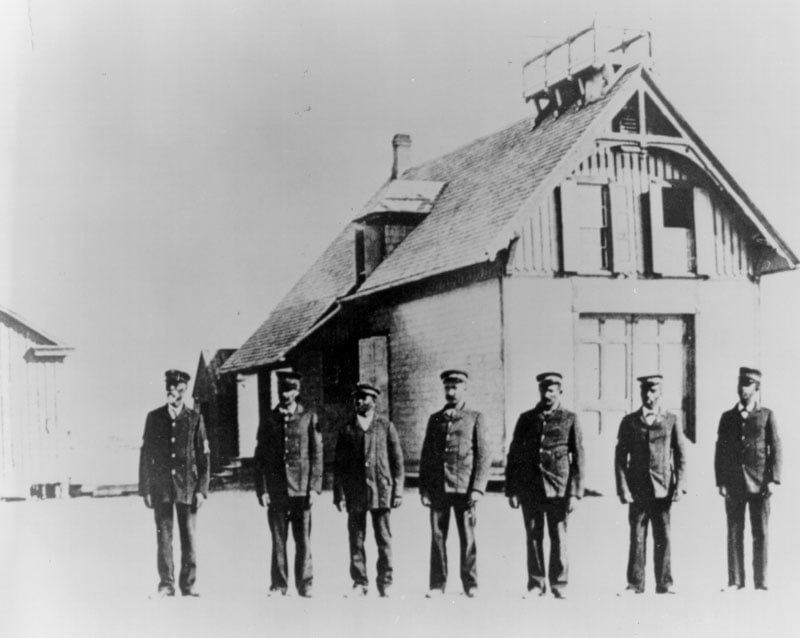
Keeper Richard Etheridge (on left) and the Pea Island Life-Saving crew in front of their station, circa 1896. (Public Domain)
Dive into the legacy of North Carolina’s iconic Pea Island Life Saving Station and its heroic, history-making crew.
Every year, North Carolina’s Outer Banks attract about five million visitors looking to enjoy the area’s beautiful beaches and blue waters. But those same waters that vacationers flock to are notoriously dangerous too: There have been so many shipwrecks in the Outer Banks that the area earned the nickname the Graveyard of the Atlantic.
Out of those rough waters came one of the most remarkable stories in North Carolina history: that of the Pea Island Life-Saving Station, the only all-Black life-saving station in the United States. Keep reading to learn more about how the Pea Island Life-Saving Station made history.
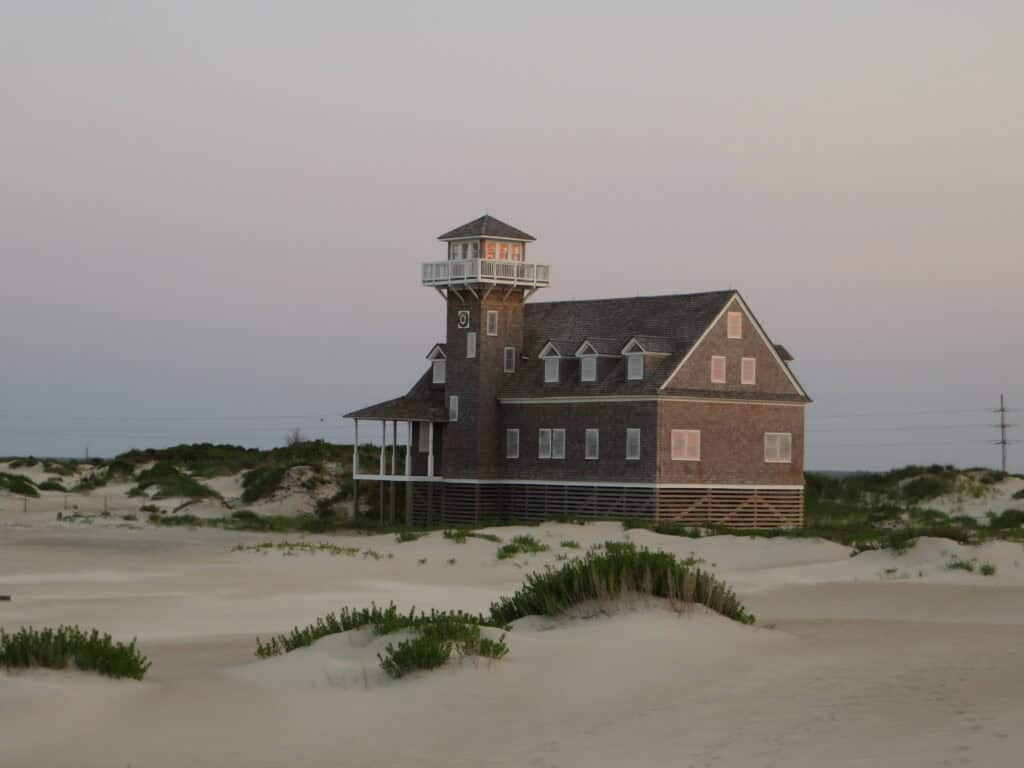
What is a life-saving station?
Life-saving stations were coastal facilities that were constructed to save the lives of people in distress out at sea and were operational between 1848 and 1915 before the formation of the Coast Guard. Before the creation of the modern-day U.S. Coast Guard, these stations and their staff were the only lifeline ship captains and crew members had if they ran into trouble out on the water.
Similar to fire stations, life-saving stations were designed to enable a fast response to disasters: Crew dormitories were housed on the upper floor, and equipment was kept on the main level.
There were three main types of life-saving stations: Complete Life-Saving Stations, Life Boat Stations, and Houses of Refuge. These were manned full-time, either for part of the year or year-round, depending on how likely wrecks were to occur in a particular location. Stations along the Atlantic coastline, such as those in North Carolina, were typically Complete Life-Saving Stations and featured a lookout cupola on top to watch for wrecks.
Pea Island Life-Saving Station
Storms, shifting sandbars, and limited navigation tools made shipwrecks along the Outer Banks quite common in the 1800s. The Pea Island Life-Saving Station, one of 29 stations established in North Carolina, was built during the winter of 1878-79 and initially manned by white staff. However, after an investigation into a failed rescue, the station’s white commander, also known as a keeper, was fired and replaced by Richard Etheridge.
In 1880, Richard Etheridge was named keeper of the Pea Island Life-Saving Station. Etheridge had been born into slavery and served in the Union Army during the Civil War before joining the U.S. Life-Saving Service.
His appointment made him the first Black station keeper in the U.S. Life-Saving Service—and it was met with immediate resistance. White surfmen refused to work under him, so Etheridge recruited an all-Black crew, many of whom were formerly enslaved men from nearby coastal communities.
The only all-Black life-saving station in the country
Under Etheridge’s leadership, the Pea Island Life-Saving Station became the only station in the country staffed entirely by Black surfmen. (For context, there were about 300 life-saving stations in the U.S.)
Knowing that any minor slip-up would result in extra scrutiny due to the color of his crew’s skin, Etheridge was a strict leader and trained his crew relentlessly.
The surfmen at Pea Island are credited with performing about 600 rescues, though one in particular brought the crew into the spotlight and earned them a place in history books.
Heroism during the E.S. Newman rescue
In October 1896, a powerful hurricane struck the Outer Banks, driving the schooner E.S. Newman aground near Pea Island, with the captain, his wife, and their young son on board.
Towering waves and strong winds prevented the Pea Island Life-Saving Station crew from using a surfboard or breeches buoy to perform the rescue mission. Instead, they swam to the boat and heaved a line on board, making nine trips total to save all of the ship’s passengers and crew members.
The crew received little recognition for their efforts at the time; however, the Newman’s captain found the piece of the boat with its name on it and gave it to the crew as a thank you.
Long-overdue recognition
Etheridge passed away in 1900, but the Pea Island Station continued to be manned by Black keepers and crew members until 1947, when it was decommissioned.
In 1996, 100 years after the E.S. Newman rescue, the U.S. Coast Guard posthumously awarded gold life-saving medals to Etheridge and his crew as a symbolic acknowledgment of their heroism.
Preserving the legacy of the Pea Island Life-Saving Station
The area that was once home to the Pea Island Life-Saving Station is now the Pea Island National Wildlife Refuge.
The legacy of the Pea Island Life-Saving Station lives on and is preserved through museums, memorials, and historical markers by organizations such as the Pea Island Preservation Society.
The Pea Island Cookhouse Museum, located in Manteo, helps tell the story of the surfmen’s lives, service, and impact on American maritime history. It houses memorabilia and artifacts, including the signboard for the E.S. Newman and a Lyle gun used by the crew.
There is also a life-size bronze statue of Etheridge in the center of a roundabout on Bideford and Sir Walter Raleigh streets in Manteo.
Author

Greensboro Sit-Ins: Learn about the protest that sparked a movement
The Greensboro Sit-Ins started in North Carolina in 1960 before going nationwide. Here’s everything you need to know about this important series of...
Forgotten North Carolina baseball player was a hero in segregated Negro leagues
One of North Carolina's greatest baseball products ever played in an era of segregation. This is his story. A Wilmington native who played in...
Opinion: Martin Luther King Jr. and the blood that fueled a movement
This Martin Luther King Jr. Day, a look at King and other "forgotten" martyrs of the Civil Rights Movement. (Editor’s note: This column originally...
Opinion: Martin Luther King Jr. and the blood that fueled a movement
This Martin Luther King Jr. Day, a look at King and other "forgotten" martyrs of the Civil Rights Movement. (Editor’s note: This column originally...
How NC’s Howe family, descended from an enslaved man, helped give Wilmington its distinctive look
North Carolina's Howe family traces their lineage back to an enslaved man who was forced to work construction projects. His descendants have helped...