Photo credit: antoniodiaz/Shutterstock
As a national anti-abortion group pours propaganda funds into North Carolina, one canvasser prepares for harder conversations.
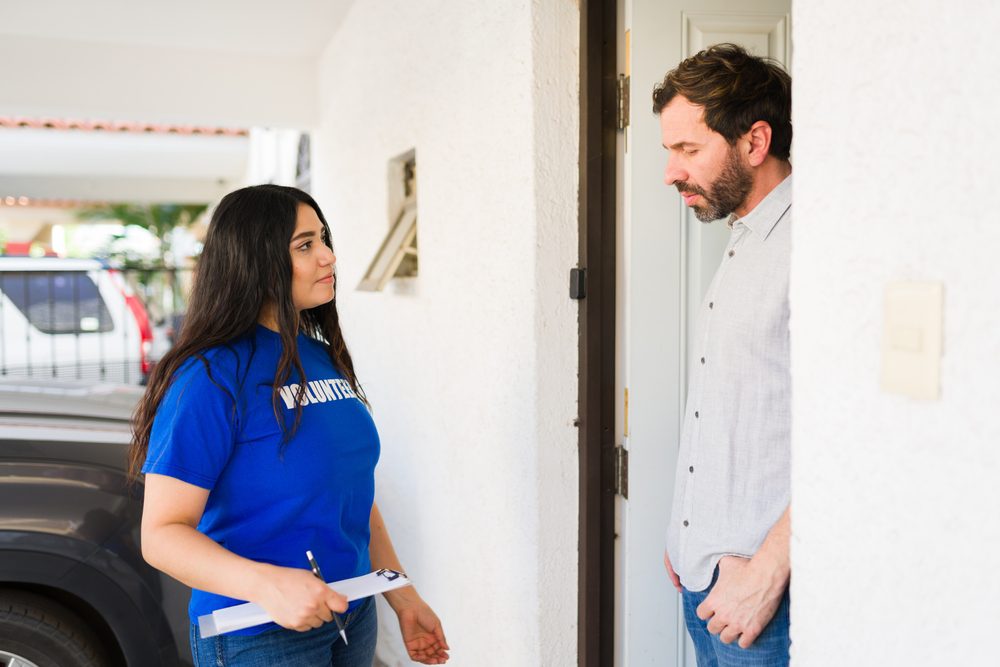
Emma Horst-Martz has learned to take a breath before the door opens.
It’s a mental tactic she uses to clear her mind while canvassing and start each new door-to-door interaction with a clean slate. Sometimes the person who opens the door looks curious. Sometimes annoyed. Sometimes excited. Regardless, the same introduction plays on her lips.
“Hi, I’m Emma. I’m knocking on your door today because the election is coming up,” Hortz-Martz says. “And we need to elect representatives who know how to fight for our rights, including reproductive rights. Do you have your plan to vote?”
After a decade of canvassing about issues such as women’s autonomy, she’s intimately familiar with the moments that come after her initial introduction. It’s the split second when a conversation could become political, personal, or end altogether.
Horstz-Martz is the organizing manager with Planned Parenthood Votes! South Atlantic, a regional nonprofit focused on reproductive rights and voter advocacy.
Much of her work involves going door to door to talk with voters across different states about reproductive rights and upcoming elections. Over the years, Horstz-Martz has knocked on hundreds of doors, encountering support, resistance, and sometimes something more complicated: households where people hold different views from hers, different comfort levels, and different understandings of the issues altogether.
RELATED: They’re not politicians, they’re OB-GYNs—and their podcast might change how you talk about abortion
Those conversations are about to take on a new weight in North Carolina.
Last year, Susan B. Anthony Pro-Life America, a national anti-abortion organization, announced an $80 million national investment to “retain pro-life majorities in the US House and Senate” for the 2026 midterm elections. According to its press release, the group plans to reach 10.5 million voters across battleground states, including North Carolina, with the goal of mobilizing anti-abortion voters. Nearly five million of those voters, SBA says, will be reached through door-canvassing efforts.
PPSAT declined to comment directly on the SBA announcement. But organizers say the influx of national messaging will likely shape the kinds of conversations voters bring to the door—and the questions they ask when someone like Hortz-Martz shows up.
Voters raise questions about real-life abortion access
At doorsteps, voter uncertainty more often shows up in the form of practical questions versus political ones.
Emily Thompson, deputy director of PPSAT, said voters frequently ask about access itself: which reproductive health care services are available, how restrictions work, and what recent policy changes mean in practice for patients.
North Carolina is one of the few Southern states where abortion is legal past six weeks of pregnancy, making it a destination for patients in search of abortion access across the region. According to data from the Guttmacher Institute, clinicians in North Carolina provided more than 47,000 abortions in 2024, with 36% of patients traveling from out of state.
Currently, state law bans most abortions after 12 weeks and 6 days of pregnancy, with limited exceptions including to save a pregnant person’s life, to prevent serious risk to the pregnant person’s health, or when the fetus is not expected to survive the pregnancy.
The state also now legally requires pregnant people to have two appointments prior to an abortion. During the first appointment, a person must visit an abortion provider for “in-person counseling” and to confirm the pregnancy. The second appointment is the abortion procedure itself—which must be at least 72 hours after the first appointment.
READ MORE: ‘They knew I wanted an abortion’: What she got instead at a ‘crisis pregnancy center’ in NC
Thompson said many voters are unsure how legal restrictions translate into real-life access, so it’s up to canvassers to clear up confusion. PPSAT’s electoral program focuses heavily on preparing canvassers for those moments.
According to Thompson, training includes discussions about current abortion laws, stigma-information organizing, and how to respond when voters raise concerns or misinformation they’ve encountered elsewhere.
That’s because the goal, Thompson said, isn’t to argue, but to meet voters where they are.
RELATED: ‘I’m afraid of no access’: Calls flood NC clinics as providers warn of a backdoor abortion ban
“Voters have made it clear that they’ve had enough of the attacks on reproductive health care,” she said. “And I think the results of the 2024 election in North Carolina and what we were able to accomplish illustrates that. We saw it on election night [in 2025]. We’ll see it again [this] year.”
In 2024, North Carolinians elected Democratic Gov. Josh Stein, who has publicly supported abortion access, reproductive rights, and criticized further restrictions. After Gov. Stein’s inauguration, one of his executive orders vowed to protect women’s reproductive freedom and privacy.
And last year, during Virginia’s gubernatorial election, voters elected Gov. Abigail Spanberger as the first woman governor in the state. As an advocate for protecting reproductive rights throughout her campaign, Spanberger supports the Reproductive Freedom Amendment, and vowed to fight for the The Virginia Right to Contraception Act—moves that Thompson sees as a clear sign that voters in the South as a whole are ready to defend reproductive rights.
Thompson said the organization is prioritizing outreach in counties like Wake, Mecklenburg, New Hanover, and Buncombe, where population growth and political stakes make voter education especially important.
“I just think North Carolinians know and agree that each of us should be able to live, work, raise a family, and make decisions of health without interference from the government,” Thompson said. “Because when people can make decisions about their own reproductive health care, they have more control over their health and well-being.”
Why conversations about abortion still matter
For Horst-Martz, the work often comes down to moments that don’t fit neatly into campaign strategy.
She recalled one of her earliest memorable canvassing conversations, a formative one that didn’t unfold as expected.
“My very first deep canvasser conversation that ever happened was that kind of scenario where the person I was looking for was a woman in this house, and then it was her dad, he was the grandfather taking care of the kids that weekend,” Horst-Martz said. “I ended up having a conversation about abortion with him.”
He wasn’t the kind of voter her organization typically targets, she said, but the conversation stayed with her.
READ MORE: ‘This will delay care’: NC doctor warns of harm after Trump’s rollback on emergency abortion rule
“We covered so many different parts of the issue,” Horst-Martz said. “Even though he still gave his same number of support at the end of the conversation, it was one of those examples where I think he may have left thinking about it a little bit differently, or had some more accurate information to work with.”
She said that kind of exchange is what “deep canvassing,” a phrase used in training that encourages canvassers to spend more time with voters on a personal level, is about—not necessarily changing someone’s mind in one sitting, but understanding where they’re coming from.
“I expect that if we do more deep canvassing, no matter what part of the issue or who we’re talking to, I’ll end up having conversations where you really have to understand where the person is coming from, correct some misinformation, address stigmas, and bring it down to a more personal level,” Horst-Martz said. “Every person you talk to sort of has a different approach to the issues and comes to different conclusions.”
Door-knocking their way to Election Day
As national organizations pour millions into voter outreach and door-knocking operations for the election, Horst-Martz expects the volume of conversations in North Carolina neighborhoods to increase.
But her approach won’t change.
She’ll knock. She’ll reset. And she’ll meet each voter with a blank slate.
Early voting in North Carolina ends this Saturday, Feb. 28 at 3 p.m. Election Day is March 3. For organizers like Horst-Martz, the hope is simple: that voters open the door, and stay for the conversation.
RELATED: NC House votes to block Medicaid patients from getting care at Planned Parenthood
Author
Support Our Cause
Thank you for taking the time to read our work. Before you go, we hope you'll consider supporting our values-driven journalism, which has always strived to make clear what's really at stake for North Carolinians and our future.
Since day one, our goal here at Cardinal & Pine has always been to empower people across the state with fact-based news and information. We believe that when people are armed with knowledge about what's happening in their local, state, and federal governments—including who is working on their behalf and who is actively trying to block efforts aimed at improving the daily lives of North Carolina families—they will be inspired to become civically engaged.

NC House votes to block Medicaid patients from getting care at Planned Parenthood
Lawmakers transformed an HOA reform bill into a measure restricting preventative care access for thousands of low-income North Carolinians. For many...

They’re not politicians, they’re OB-GYNs—and their podcast might change how you talk about abortion
At Duke University, two OB-GYNs want to help you start the hard conversations. Before Dr. Beverly A. Gray and Dr. Jonas Swartz slip on their...

‘They knew I wanted an abortion’: What she got instead at a ‘crisis pregnancy center’ in NC
When the clock is ticking on an unwanted pregnancy, many women go to the first search result that looks like it’ll help them get an abortion. That’s...
‘They knew I wanted an abortion’: What she got instead at a ‘crisis pregnancy center’ in NC
When the clock is ticking on an unwanted pregnancy, many women go to the first search result that looks like it’ll help them get an abortion. That’s...

‘I’m afraid of no access’: Calls flood NC clinics as providers warn of a backdoor abortion ban
Cancer screenings, STI tests, and birth control are at stake. At the clinic, questions started almost immediately. The MyChart messages and phone...