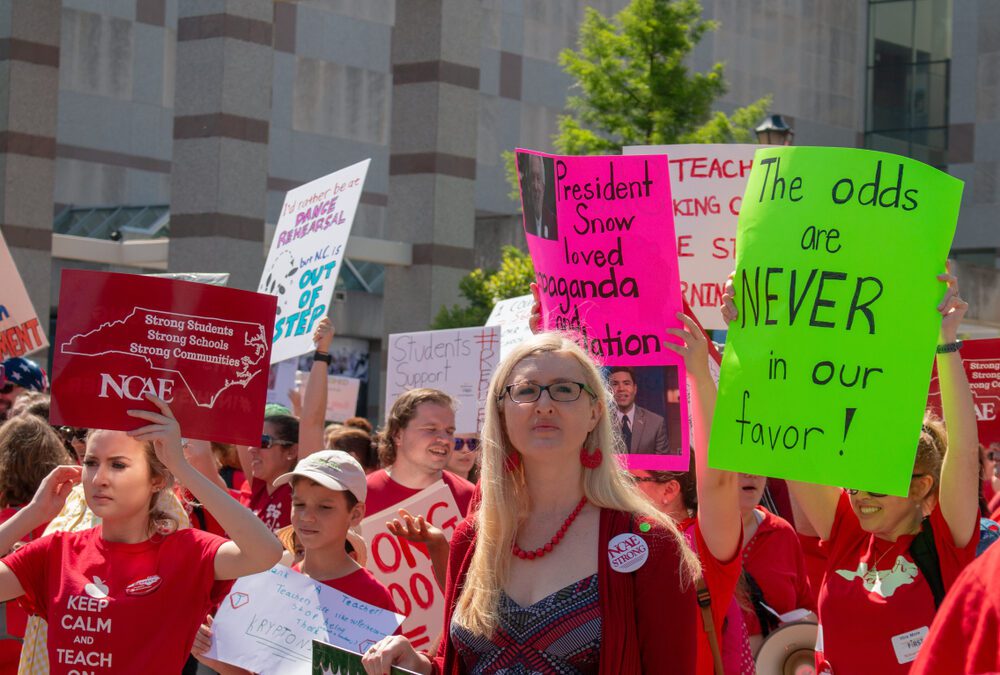
In this May 2019 file photo, teachers march to protest school funding shortfalls in North Carolina. The rising cost of healthcare and mediocre salaries are forcing veteran NC teachers out of the profession. (Shutterstock)
As the NC State Health Plan faces a $507 million deficit, veteran NC teachers say shrinking benefits and rising out-of-pocket costs are driving them out of the classroom.
After nearly three decades in the classroom, Matthew Townsend says he can no longer afford to be healthy.
Townsend, a Durham public school educator of 27 years, said he and his wife Susan, also a teacher, now spend nearly $12,000 a year on medical care, even with insurance through the North Carolina State Health Plan. Susan has chronic kidney disease, and the couple expects to hit their out-of-pocket maximum early each year.
“I feel like I’ve been robbed,” Townsend said. “I feel like I was promised one thing as a teaching fellow years ago, but the rug was pulled out from under me.”
His experience describes a growing reality for many teachers across North Carolina, as rising health care costs and shrinking benefits push them toward a nearly impossible choice: stay in the profession they love, or find work that allows them to afford basic medical care.
On average, teacher pay in North Carolina trails the national average by roughly $14,000, even as the cost of living and health care continues to rise. Benefits that once made public service sustainable have thinned. And year after year, health care—once one of the few dependable perks of teaching—has become a growing financial burden.
RELATED: Report: NC teacher pay and per-pupil funding are in a dismal place
Benefits used to be the benefit of being a NC teacher
When Townsend entered the classroom in the late 1990s, health care was a cornerstone of the profession. Teacher pay was modest—the average salary in 1997 was $31,167, about $7,000 below the nation’s average, according to the National Center for Educational Statistics—but insurance was strong. Townsend said a hospital stay for kidney stones in 2000 cost him just $50.
But the system he joined is not the system he navigates today.
According to fact sheets from the Office of the State Treasurer, the State Health Plan is facing a $507 million deficit, driven by rising medical claims, stagnant state funding, and the end of a seven-year freeze on premium and benefit changes. The documents show the plan is nearing the depletion of its cash reserves after spending more than it has taken in.
Beginning in 2026, family deductibles on the standard plan will reach up to $3,750, and out-of-pocket maximums will climb as high as $16,300. Premiums will also shift to a salary-based structure, a move state officials say will lessen the burden on lower-paid employees.
But educators say the changes point to deep instability.
“When many of our veteran educators started well over 10 years ago, there was very minimal out of pocket costs around health care,” said Tamika Walker Kelly, teacher and president of the North Carolina Association of Educators. “Now we have seen health care premiums go up…and our educators are experiencing more challenges accessing their benefits than they have seen previously before.”
Walker Kelly said upcoming premium increases will effectively reduce take-home pay for teachers.
“When our health care premiums increase to salary based in January of 2026, it will be essentially a pay cut to our educators across the state,” she said. “We are operating in a deficit for educators.”
A good idea backfires
One of the State Health Plan’s most ambitious attempts to control costs, the Clear Pricing Project, was designed to force hospitals and providers to accept more transparent, Medicare-based rates. State Treasurer Dale Folwell argued the program would save money and lower premiums.
But the program backfired, reshaping how teachers across North Carolina approach their own medical care.
Hospitals were slow to participate, provider networks fluctuated, leaving educators unsure whether long-time doctors and specialists would remain covered from one year to the next. For many teachers, that meant delaying care, switching providers mid-treatment, or paying significantly more out of pocket to stay with the doctors they trusted.
“What it resulted in is that some educators had issues with their providers being in the network and then not being in the network,” Walker Kelly said. “If their provider was not in the network, then they had to find another provider. It causes educators to just lose trust in the effectiveness of the system to provide consistent quality health care.”
For teachers like Townsend, the shift became unmistakable when his wife was hospitalized outside the plan’s network.
“When I was a new band director in 2000, I was hospitalized for a kidney stone, and it cost me $50,” Townsend said. “The first time Susan was hospitalized out of network, that was in 2010 and my bill was $16,000.”
“It’s a whole different world,” Townsend added. “Lots of teachers are in medical debt, and lots of teachers are postponing surgeries or not going to see specialists.”
Townsend said even with insurance, many educators now avoid routine care altogether.
“If I hurt myself or I’m sick, I’m staying home, as do a lot of teachers,” he said.
The fallout extended beyond individual households. Project backers acknowledged the program cost far more than expected—nearly $150 million annually, about $50 million above original estimates—deepening the State Health Plan’s financial strain instead of easing it.

NC teachers protest near the General Assembly building in Raleigh in 2018. Education funding was a major point of conflict in the state in the last decade, particularly longstanding funding inequities between urban and rural counties. (Photo by Sara D. Davis/Getty Images)
The shutdown ripple effect
The 42-day federal shutdown of 2025 did not stop teacher paychecks, because public schools are state employees, but it did expose deeper vulnerabilities. Teachers with spouses or children on Medicaid worried about coverage disruptions. Special education teachers feared delays in federally funded therapies. Districts tracked how long meal programs could operate with uncertain federal reimbursements.
The shutdown also collided with congressional debates over expiring Affordable Care Act subsidies (ACA), which help millions afford private insurance. While discourse on the topic continues now, without renewal, families could see their monthly health premiums soar across the country.
RELATED: NC resident faces 1,100% increase in health insurance costs
Getting by takes multiple side hustles
The financial strain has reshaped how Townsend thinks about his future in public education.
He once believed teaching would provide stability for life. Instead, like many other teachers in the state, he said he works multiple jobs to make ends meet: lawn work, IT assistance, driving school buses, “hustling.”
Townsend plans to leave public education once he reaches 30 years of service to secure his pension.
“I’ve been fighting the good fight, but I’ll get to set down my sword,” he said. “It gets harder year after year. You’d think, with more experience, that it gets easier, but no, it gets tougher.”
He said he would never advise anyone in his family to become an educator.
“I just feel incredible sadness for the teaching profession, public schools, for kids, and for families,” he said. “It’s profound. I don’t understand the immorality of the decisions that are being made of all of this so somebody can have a second yacht.”
Still, for now, Townsend stays—marking the days down to retirement. Each morning, he heads to his school, supports his students, and teaches.
Author

Support Our Cause
Thank you for taking the time to read our work. Before you go, we hope you'll consider supporting our values-driven journalism, which has always strived to make clear what's really at stake for North Carolinians and our future.
Since day one, our goal here at Cardinal & Pine has always been to empower people across the state with fact-based news and information. We believe that when people are armed with knowledge about what's happening in their local, state, and federal governments—including who is working on their behalf and who is actively trying to block efforts aimed at improving the daily lives of North Carolina families—they will be inspired to become civically engaged.

NC Supreme Court throws out Leandro school funding orders
The GOP-dominated NC Supreme Court decision vacates a 2023 trial court order requiring the state to transfer hundreds of millions of dollars for...
Video: North Carolina teachers getting hoodwinked on pay raises
Cardinal & Pine spoke with Rep. Lindsay Prather, a former educator, about the pay North Carolina teachers are getting. She says they're being...

Trump says millions are ‘lifted’ off SNAP. A Charlotte nonprofit says hunger hasn’t gone away in NC
More than 1.4 million North Carolinians rely on SNAP benefits to help pay for groceries. Boxes and tractor trailers loaded with donated food move...
Trump says millions are ‘lifted’ off SNAP. A Charlotte nonprofit says hunger hasn’t gone away in NC
More than 1.4 million North Carolinians rely on SNAP benefits to help pay for groceries. Boxes and tractor trailers loaded with donated food move...

Food insecurity is hitting thousands of NC children—and it’s following them into the classroom
More than 580,000 NC children rely on SNAP to help keep food on the table. On school mornings in North Carolina, some children arrive already...