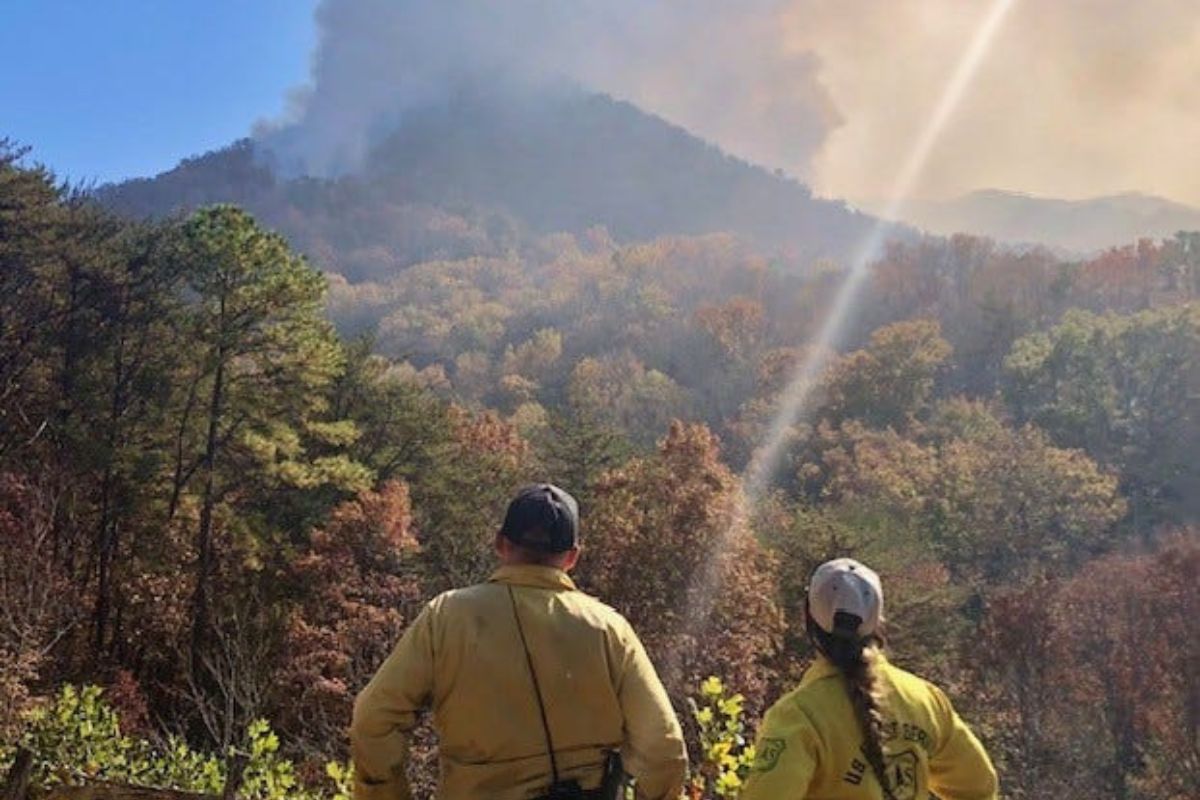
Two crew members watch smoke coming from a November 2023 wildfire, which spans thousands of acres in the Nantahala National Forest. (NC Newsline)
Nearly 18 months after Helene, forestry officials and the state fire marshal warned legislators Thursday that North Carolina needs to be much better prepared to battle wildfires.
by Clayton Henkel, NC Newsline
March 12, 2026
When Hurricane Helene swept through western North Carolina, forestry officials conservatively estimated the storm damaged 822,000 acres of timber. Now satellite imagery showing changes in forest cover suggests the extent of damage was much greater.
Nearly 18 months after Helene, forestry officials and the state fire marshal warned legislators Thursday that North Carolina needs to be much better prepared to battle wildfires.
Deputy Forester Kevin Harvell with the North Carolina Forest Service said from the air, it’s easy to spot areas where complete stands of trees were flattened, making forest roads and logging roads impassable.
Trump says millions are ‘lifted’ off SNAP. A Charlotte nonprofit says hunger hasn’t gone away in NC
“Firefighters quite literally have to cut their way through to the fire,” explained Harvell, adding that a delayed response can put more homes and lives at risk.
When a downed power line sparked the Black Cove fire in Polk County in March 2025, Helene’s remnants fueled the blaze for days.
“We were seeing severe fire behavior at unexpected times because of hurricane damage,” Harvell recounted. “These fires were burning later into the night, more intense, and were jumping control lines consistently.”
Harvell said it took several weeks and crews from 20 states before that fire was under control. More than 3,500 acres burned.
And that’s not an isolated situation.
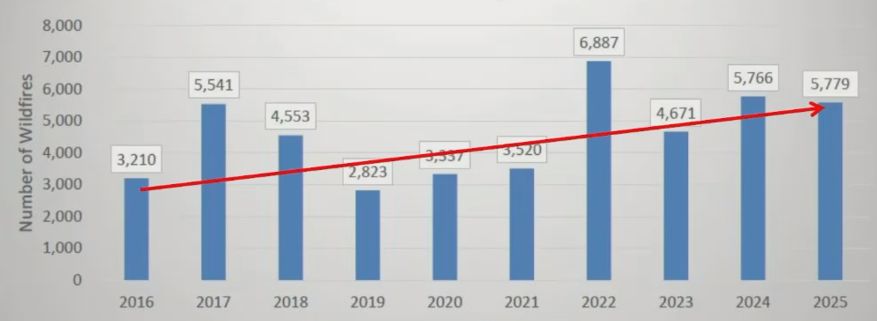
While every year is different, North Carolina has averaged 4,600 wildfires a year for the past 10 years. (Graph: N.C. Forest Service presentation)
More wildfires, fewer people to fight them
State Forester Greg Hicks told members of the Joint Legislative Emergency Management Oversight Committee that North Carolina has averaged 4,600 wildfires a year for the last decade.
“Yesterday alone there were 94 wildfires across the state. It was a fire day — hot, dry and windy — and 434 acres burned,” said Hicks. “It’s a pretty big issue here in North Carolina.”
In many counties, N.C. Forest Service staffing consists of just three people – a county ranger, an assistant ranger, and a heavy equipment operator. That means a local county fire department may be the first responder when a brush or woods fire is reported.
As in many areas of state government, Hicks says low pay is making it increasingly difficult to keep experienced staff. The vacancy rate at the North Carolina Forest Service is between 15% and 20%.
A third of new employees leave before completing a two-year training program, Hicks said. Almost half of the agency’s workforce has less than five years of service.
“We’ve invested a ton of money into these employees getting them trained to be wildland firefighters,” said Hicks, “so keeping and maintaining employees and getting them trained is critical.”
Harvell said the agency is working to mitigate some of the risk by removing or grinding up the downed timber and conducting prescribed burns to reduce accumulated debris.
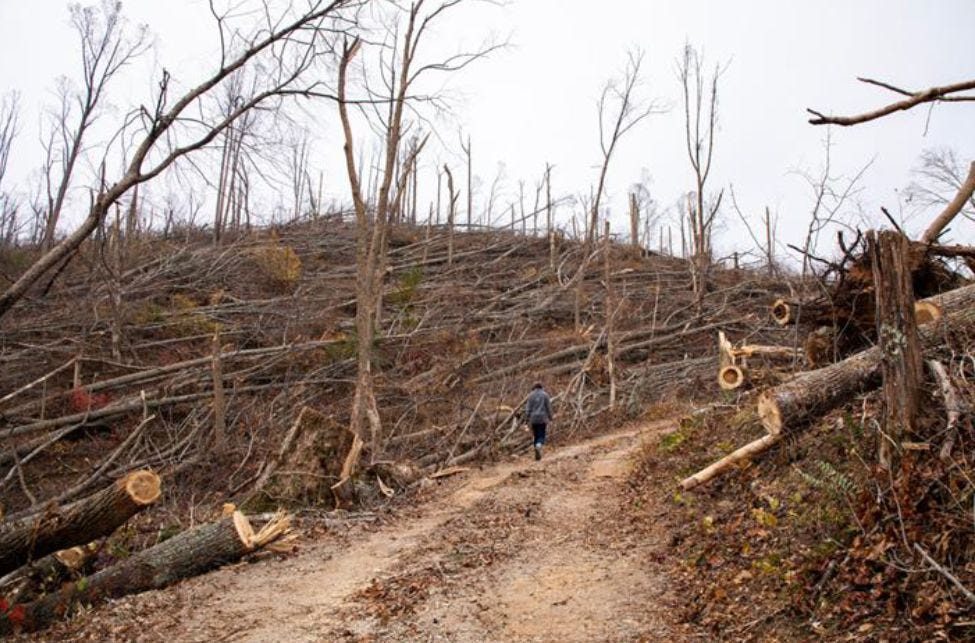
Tropical Storm Helene in 2024 flattened large swaths of trees in western North Carolina. The accumulated debris increases the risk for wildfires and makes forest roads and logging roads impassable.
Rep. Mark Pless (R-Haywood), a former firefighter, asked if the service was also doing any planting in the aftermath of Helene to help with reforestation.
“We lost all of our hardwoods in those areas, and they do a good job of withstanding storms,” said Pless. “But if we’re not starting them back, we have to wait on nature to begin that course again. We’re going to be without any protection for years and years and years.”
Harvell acknowledged replanting would help with forest resiliency, but with limited resources, he said, the forest service is focused on controlling invasive species like kudzu that increase the state’s fire risk.
“[It’s] a very labor-intensive process controlling everything that’s coming up naturally,” said Harvell. “Allowing those oaks, those poplars and those maples to come back naturally is the best and cheapest alternative.”
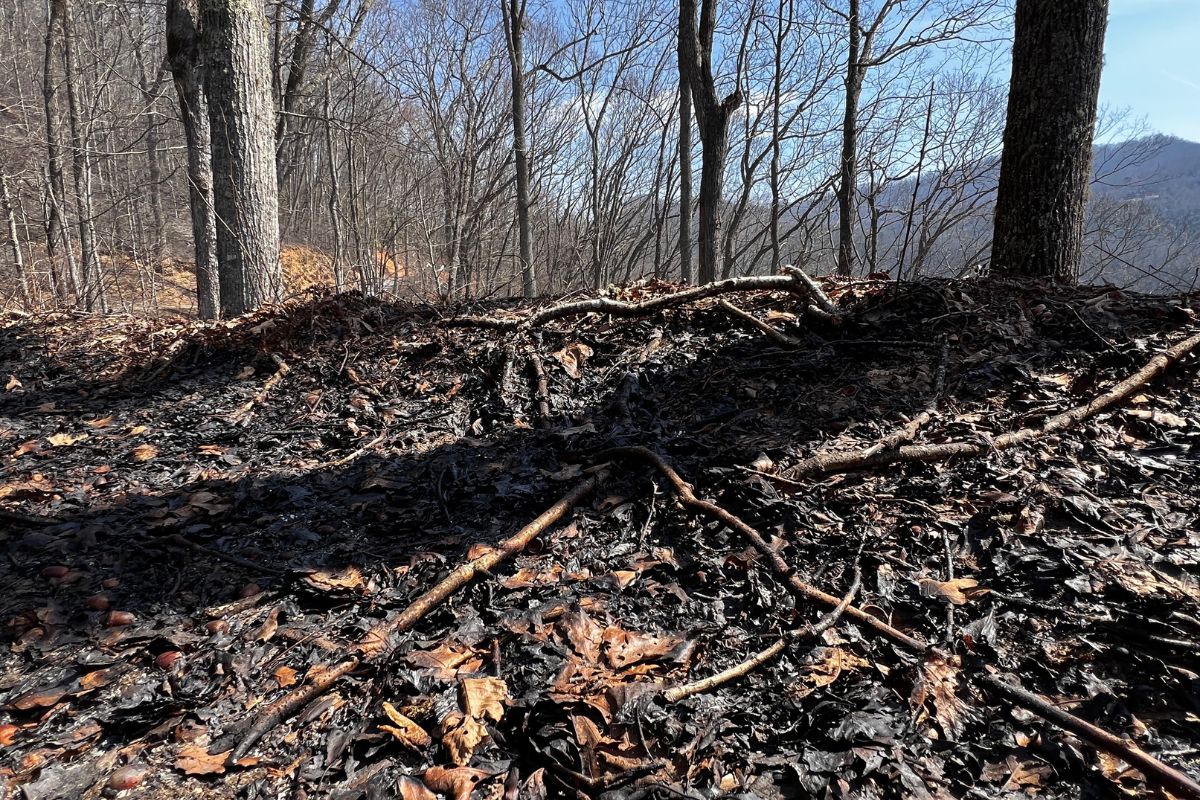
Firefighting efforts on Long Creek Lane in the Alarka Community in Swain County, North Carolina in March, 2025. Wildfires in the area had burned thousands of acres. (USA Today via Reuters)
Hicks said the agency’s top priority for this legislative session is to address its pay structure. Unlike in teaching, which has a step system that increases salary with experience, a forest technician with a starting salary of $39,115 may find themselves at that same salary a decade later, Hicks told the committee.
Pless said failure to pay experienced forest service workers what they are worth is penny-wise but pound-foolish. He said wildfires can grow quickly beyond what a local fire department may be able to handle, requiring the forest service’s expertise.
“You’re going to be there for days and days trying to get it put out,” Pless said. “And that’s not an incident that you need somebody that has three or four years of experience. It needs to be people that have been out there for a long time, saving lives and saving property.”
NC Newsline is part of States Newsroom, a nonprofit news network supported by grants and a coalition of donors as a 501c(3) public charity. NC Newsline maintains editorial independence. Contact Editor Laura Leslie for questions: [email protected].
Author

North Carolina’s drought makes this weekend’s ‘good’ weather into bad news
This weekend's forecast is warm, dry weather. But that's bad news for North Carolina's ongoing drought. The good news: Fayetteville and the Cape...

What to know about the 2026 spring equinox in North Carolina
Will it be a warm spring or a cool one? Here's what to know about spring in North Carolina. Residents of North Carolina ― and most of the rest of...

NC regulators object to Wilmington Harbor deepening project. Here’s why
North Carolina leaders say the Wilmington Harbor deepening project raises environmental concerns, including worries about 'forever chemicals,'...
NC regulators object to Wilmington Harbor deepening project. Here’s why
North Carolina leaders say the Wilmington Harbor deepening project raises environmental concerns, including worries about 'forever chemicals,'...
Controversial Wilmington Harbor deepening project paused by feds
A billion-dollar deepening of Wilmington Harbor is necessary to keep the port competitive, but it comes with economic and environmental concerns for...