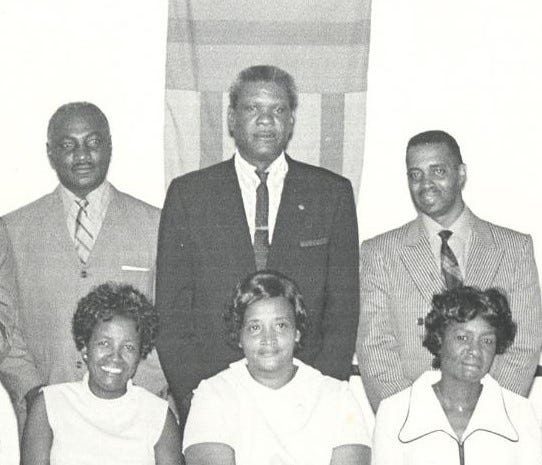
Photo from 1970 shows Wilmington native and former Negro leagues baseball player Marshall Boney, top center. Top left is Melvin Johnson, who played with Boney on the all-Black Winston-Salem Pond Giants baseball team. Front and center is Boney's wife, Annie. (USA Today via Reuters)
One of North Carolina’s greatest baseball products ever played in an era of segregation. This is his story.
A Wilmington native who played in baseball’s segregated Negro leagues could get some long-overdue local recognition after more than 75 years.
Marshall Boney, who attended Wilmington’s segregated Williston Industrial High School, played catcher for several Black and independent league teams in the late 1940s, including a two-year stint in a Canadian league in 1949 and 1950 on a team that included at least one future major leaguer.
Derrick C. Jones, a retired educator and noted researcher into the history of the Negro leagues who is also a Wilmington native, said that Boney, who died in 1975, is arguably one of the best baseball players that Williston, or Wilmington, ever produced.
Williston’s most notable baseball alum is Sam Bowens, who played for two Major League Baseball teams in the 1960s, winning a World Series with the Baltimore Orioles in 1966.
Jones said it’s possible that Boney inspired Bowens, though he’s not been able to establish a definite connection between the two.
The true measure of Boney’s talents, Jones said, will likely never be known “for reasons of race separation during the period (when) he was in his prime. The possibilities of his baseball skills were never fully expressed.”
Jones, whose research into and memorabilia from the Negro leagues was used for an exhibit at the College of William & Mary, Jones’ alma mater, in 2024, said Boney’s story “fell into my lap” after talking with Boney’s son Lionel, who lives in Wilmington.
In doing research for another project, Jones said, he kept coming across Boney’s name, and “his story began to touch me deeply.”
Jones said when he was growing up in Wilmington he actually knew of Boney, not because of his history as a baseball player but because Boney and his wife, Annie, lived near Jones’ grandparents on South Seventh Street.
Boney played football and baseball as a young nan, and Jones found a story from the Wilmington Morning Star, a predecessor of the StarNews, dated Dec. 9, 1940, in which Boney is mentioned as the captain of a local football team called the Castle Street Bears playing at Legion Stadium.
Boney served in the U.S. Army during World War II from 1942-1945, and when he came back to Wilmington he continued playing sports.
Jones said he talked to Oliver A. Boykins of Wilmington, who turned 100 in 2025 and is one of the only living people to have seen Boney play. Jones said Boykins told him that Boney played for a sandlot team called the Wilmington Clippers and was a “home run hitter” whose speed, befitting a catcher, was not his strong suit. “He was so slow that he had to hit a double just to get on first base,” Jones said Boykins told him.
By the late 1940s, according to Jones’ research, Boney and his friend from Wilmington, Melvin Johnson, were playing on the Winston-Salem Pond Giants, a Black semi-pro team. Boney also played with the Danville Stars, also known as the Danville All-Stars, out of Virginia, and toured or “barnstormed” with the Brooklyn Cuban Giants, an independent Black team.
In 1949, the Cuban Giants were touring through Canada when Boney caught the eye of the Elmwood Giants out of the city of Winnipeg, who played in the Manitoba-Dakota League. Boney played with other former Negro league players on the Elmwood Giants in 1950, hitting .237 with 1 home run and a team-leading 28 RBIs in 44 games, according to Baseball-reference.com. One of his teammates, Solly Drake, would go on to play for the Chicago Cubs, Los Angeles Dodgers and Philadelphia Phillies in the 1950s.
Moving back to Wilmington in the early 1950s, Boney worked as a longshoreman, Jones said. When he died in 1975, he was only his early to mid-50s.
Of course, there’s no known video footage of Boney playing baseball, although AtThePlate.com, a website that documents the history of baseball in Canada, has a grainy black and white photo that purports to be Boney wearing catcher’s gear.
Boney didn’t play for the better-known Negro league teams but toiled in what might be called the Negro minor leagues during an exciting time for baseball. Jackie Robinson integrated the major leagues in 1947 with the Brooklyn Dodgers, paving the way for other Black players.
Boney came along at a time when the Negro leagues were largely on their way out, but he must certainly have been inspired by Robinson’s story while harboring big-league dreams of his own.
Jones, who lives in Virginia Beach, Virginia, said he’d like to see Boney get some kind of permanent recognition in Wilmington, with perhaps an area field named after him, much like a field at Robert Strange Park in Wilmington was named for Bowens in 2025.
Reporting by John Staton, Wilmington StarNews / Wilmington StarNews
USA TODAY Network via Reuters Connect
Author

Opinion: Martin Luther King Jr. and the blood that fueled a movement
This Martin Luther King Jr. Day, a look at King and other "forgotten" martyrs of the Civil Rights Movement. (Editor’s note: This column originally...
How NC’s Howe family, descended from an enslaved man, helped give Wilmington its distinctive look
North Carolina's Howe family traces their lineage back to an enslaved man who was forced to work construction projects. His descendants have helped...
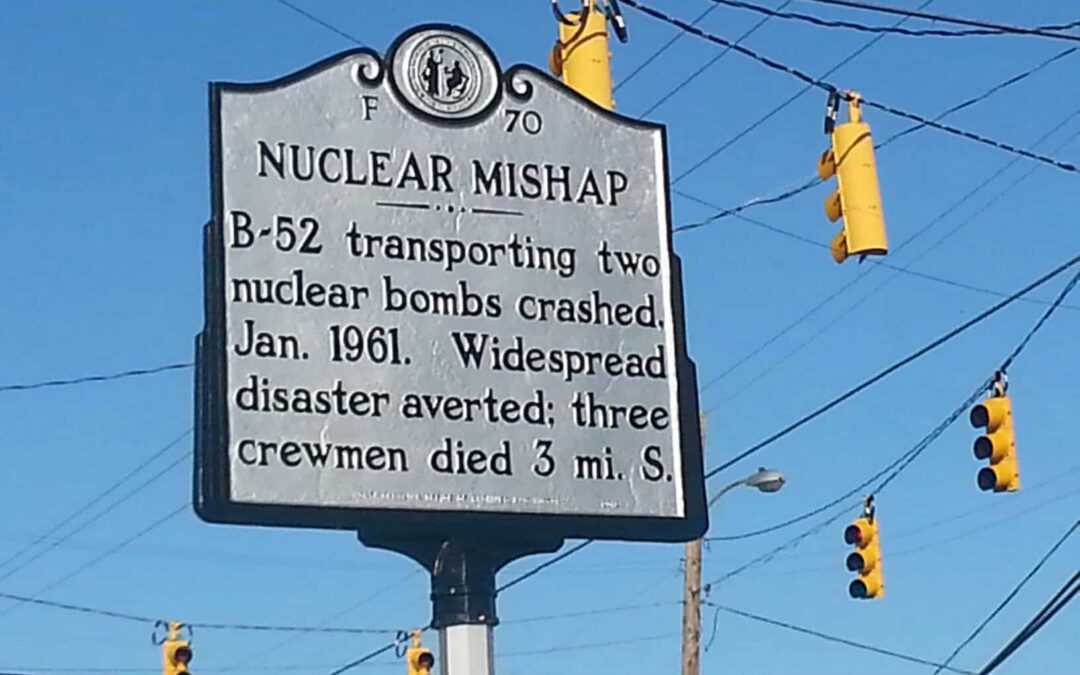
5 creepy things you never knew about North Carolina
These lesser-known facts and stories about North Carolina will make your hair stand on end. Learning more about the state you live in is never a...
5 creepy things you never knew about North Carolina
These lesser-known facts and stories about North Carolina will make your hair stand on end. Learning more about the state you live in is never a...
The real ballad of Frankie Silver, one of the first women executed in North Carolina
Frankie Silver is believed to be the first white woman executed in North Carolina. Here’s the real story of what happened to her back in the 1830s....