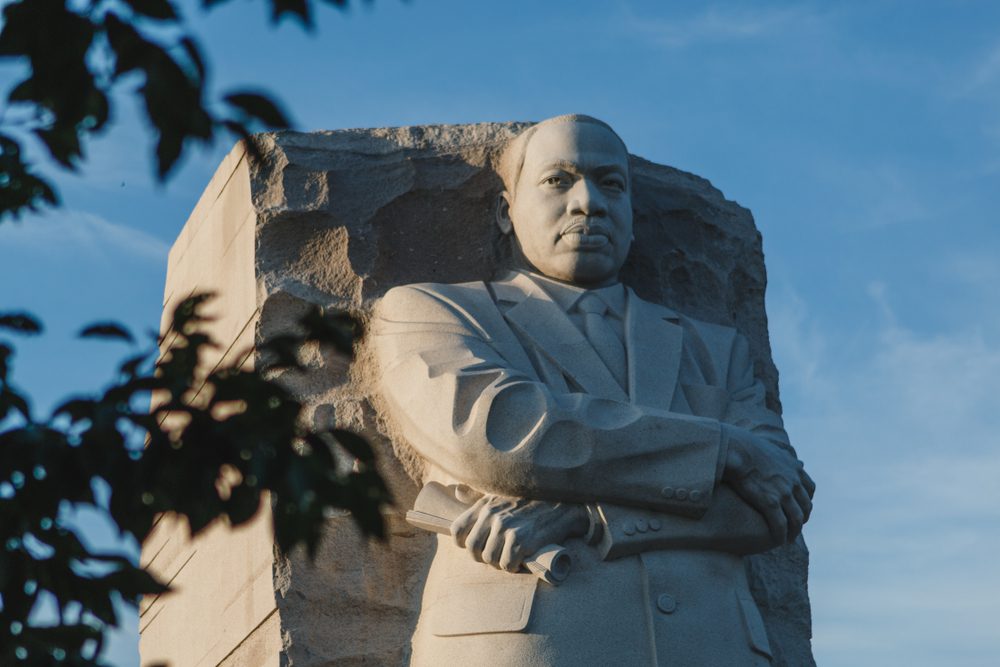
The Martin Luther King Jr. monument in Washington, D.C. (Xavier Lorenzo via Shutterstock)
This Martin Luther King Jr. Day, a look at King and other “forgotten” martyrs of the Civil Rights Movement.
(Editor’s note: This column originally published in January 2018. Stephon Ferguson, who was quoted, is currently a Fayetteville resident and member of the City Council.)
Sculptor Maya Lin, best known for the Vietnam Veterans Memorial in Washington, D.C., created another memorial to heroes, the Civil Rights Memorial in Montgomery, Alabama.
It is a fountain that honors 41 people, Black and white, who were killed during the fight for equal rights for African Americans, including Dr. Martin Luther King Jr.
Etched in the side of the memorial is the King’s words “… until justice rolls down like waters and righteousness like a mighty stream” from his speech, “I Have a Dream.”
Martin Luther King Jr. visited NC often. Here are 5 times to remember.
The Southern Poverty Law Center, which sponsors the memorial, says at its website that 74 additional, “forgotten” people likely died for the cause between 1952 and 1968.
Lessons from Albany: The pernicious effects of casual racism.
Remembering the blood of the civil rights movement reminds us what a struggle it was.
Though these days nearly everyone at least claims they agreed with King.
That was not the case then, and events suggest it is not the case now. The side that lost did not change their minds — they just lost. The demise of formal segregation, and adoption of the Voting Rights Act, did not stop some people from believing African Americans were lesser. They told their kids so, who grew up to tell their kids so.
King’s legacy includes not only unity and nonviolence, but faith, strength, courage, steadfastness and smarts.
He first tried in Albany, Georgia, the nonviolent tactics that would eventually change history. The Albany police chief, Laurie Pritchett, arrested protesters but largely with no violence. The nightly news was not able to show police swinging clubs or turning fire hoses and snarling dogs on protesters — images that came to define the clash between protesters and Birmingham, Alabama chief Bull Connor.
The end result in Albany was no change. The town remained firmly segregated when King pulled up stakes in 1962.
The episode is an historical reminder that casual acceptance and non-reaction to racism — which Pritchett’s “soft” response help facilitate — can be more harmful than open bigotry. The latter demands a response, and eventually, change.
Martin Luther King Jr.’s humanity: Humor, faith and sweet potato pie
But King had experienced early successes, such as the 1950s effort to desegregate buses in Montgomery, Alabama, which showed his great organizational skills, says Stephon Ferguson.
Ferguson, formerly of Fayetteville, is an Atlanta resident immersed in all things King. He is working on two books. He is a licensed impersonator of King who delivers dead-on versions of his sermons. Ferguson works for the National Parks Service at the Martin Luther King Jr. National Historic Park. He lives across from the house where King was born.
“It’s just an honor,” he says.
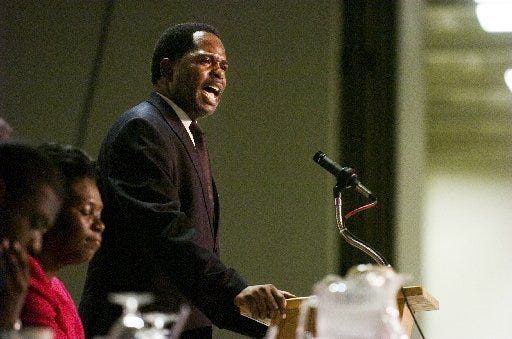
In this file photo from June 18, 2008, Stephon Ferguson delivers a portion of the “I Have a Dream” speech at the annual Martin Luther King, Jr. prayer breakfast at the Crown Expo Center Monday morning. (USA Today via Reuters)
He says under-appreciated aspects of King include his religious devotion and sense of humor.
Ferguson says King’s sister-in-law, Naomi King, told him that when King was stabbed in New York, while signing copies of his first book, she called him in the hospital to ask if he needed anything. He said he would get out of his bed right then for a slice of her sweet potato pie. She sent him one.
Ferguson said the first known instance of King using “I Have a Dream,” was in a speech he gave in Rocky Mount, eight months before the March on Washington.
He believes King’s message of peace and nonviolence is more relevant than ever — and broadly applicable.
“I believe it would really work if people would get a grasp of it,” he says. “And understanding it would work in marriage, it works with children. It is about conflict resolution.”
Reporting by Myron B. Pitts, Fayetteville Observer / The Fayetteville Observer
USA TODAY Network via Reuters Connect
Author

What to know about each of NC’s historically Black colleges
Discover key stats and dive into the history of each of North Carolina’s 10 historically Black colleges and universities. North Carolina is home to...
Discover the Pea Island Life Saving Station, the only all-Black station of its kind in the US
Dive into the legacy of North Carolina’s iconic Pea Island Life Saving Station and its heroic, history-making crew. Every year, North Carolina’s...
Greensboro Sit-Ins: Learn about the protest that sparked a movement
The Greensboro Sit-Ins started in North Carolina in 1960 before going nationwide. Here’s everything you need to know about this important series of...
Greensboro Sit-Ins: Learn about the protest that sparked a movement
The Greensboro Sit-Ins started in North Carolina in 1960 before going nationwide. Here’s everything you need to know about this important series of...
Forgotten North Carolina baseball player was a hero in segregated Negro leagues
One of North Carolina's greatest baseball products ever played in an era of segregation. This is his story. A Wilmington native who played in...