Geraldine Alshamy, a social justice minister, said the failure of the General Assembly to pass a comprehensive budget hurts poor children the hardest. (Photo: Clayton Henkel/NC Newsline)
NC faith leaders and advocacy groups outlined a policy agenda focused on education funding, health care access, and more as lawmakers prepare for the 2026 legislative session.
by Clayton Henkel, NC Newsline
January 5, 2026
North Carolina faith leaders gathered at the General Assembly in Raleigh Monday to advocate for policies they believe will improve the lives of all North Carolinians in the new year.
The legislature was not in session Monday. They’re scheduled to begin a short session in March and may not address many of the issues advocates highlighted. But Reverend Dr. Floyd Wicker of the People’s Fellowship of North Carolina said the group wanted to speak out in the face of voter suppression, chronic underfunding of public schools, and a health care system which has become unaffordable for far too many.
“To the lawmakers in the General Assembly who wish to suppress our voices and erase all of the gains our dear ancestors fought so hard for us to attain, let it be known we will do all that is in our Holy Ghost power to organize to a better, more equitable North Carolina,” said Wicker.
Geraldine Alshamy, a 72-year-old social justice minister and founder of Mary Magdalene Ministries, braved Monday’s chilly temperatures to advocate for disadvantaged students.
“When lawmakers fail to pass a state budget, it hits not only Black, brown and poor children hardest. It hits all children everywhere,” said Alshamy.
Alshamy grew up in rural Wilson County during the early days of integration. She sees similarities between those days and how schools are being funded now.
“Access to education was promised, but never delivered. We are still at those same times. Support and resources were withheld, and communities were told to make do,” she said.
Alshamy said without appropriate funding, more students in North Carolina struggle with behavioral health problems, and teachers who are not trauma-informed are able to provide little support.
“Every time early intervention is denied, the cost is simply shifted to the courts, law enforcement, prison, and broken families,” said Alshamy.
Republican state legislative leaders have often pointed out that the state’s spending on education has grown every year for the past decade. But the increases have not kept pace with inflation or need, and North Carolina now ranks 48th among all states for per-pupil spending.
Kate Daley with the nonprofit Down Home NC joined the group to advocate for health care funding.
“North Carolina state budget is the last of all 50 states to be passed, still tabled after our legislators left unfinished business,” said Daley. “It remains to be seen how our lawmakers will respond to the billions of dollars missing in federal spending for Medicaid and the Supplemental Nutrition Assistance Program.”
Daley said North Carolina will be challenged this year to fill the gap left by federal budget cuts and the state’s shrinking tax revenue.
“Affordable health care, SNAP, and public education are on the line for North Carolina more than ever before, and the time has come to end our state’s corporate tax cuts,” said Daley.
Whether to pause scheduled cuts to state personal and corporate income taxes is one of the sticking points that led to a budget impasse between state House and Senate Republicans in 2025. There’s no indication they’re any closer to an agreement yet.
Tyler Daye, Common Cause N.C.’s policy and civic engagement coordinator, said he was frustrated legislators did not have time to finish a state budget in 2025, but did have time to redraw congressional district maps giving Republicans an advantage in the first congressional district.
“They made the decision to manipulate our voting districts to protect themselves and their friends in power. And legislators went after the only truly competitive congressional districts in the state,” said Daye.
Daye said by ignoring historical voting patterns, legislators have made it more difficult for Black voters in the state to have their voice heard.
“This is cheating,” he said. “It is disgraceful, shameful, and it should be illegal.”
Daye said his organization would again make the case this year for an independent redistricting commission.
“This gerrymandering, or a better word for it, election fraud, election manipulation, must be stopped,” Daye said. “It is disintegrating the integrity of North Carolina’s elections.”
Alshamy knows lawmakers may not choose to address many of the group’s issues this spring. But she remained hopeful – and offered elected officials a stern reminder.
“Leadership is not measured by how much power you hold, but how you protect the citizens of this state,” she said. “I urge you to choose wisely. Choose courage over convenience. Choose children over ideology.”
Author

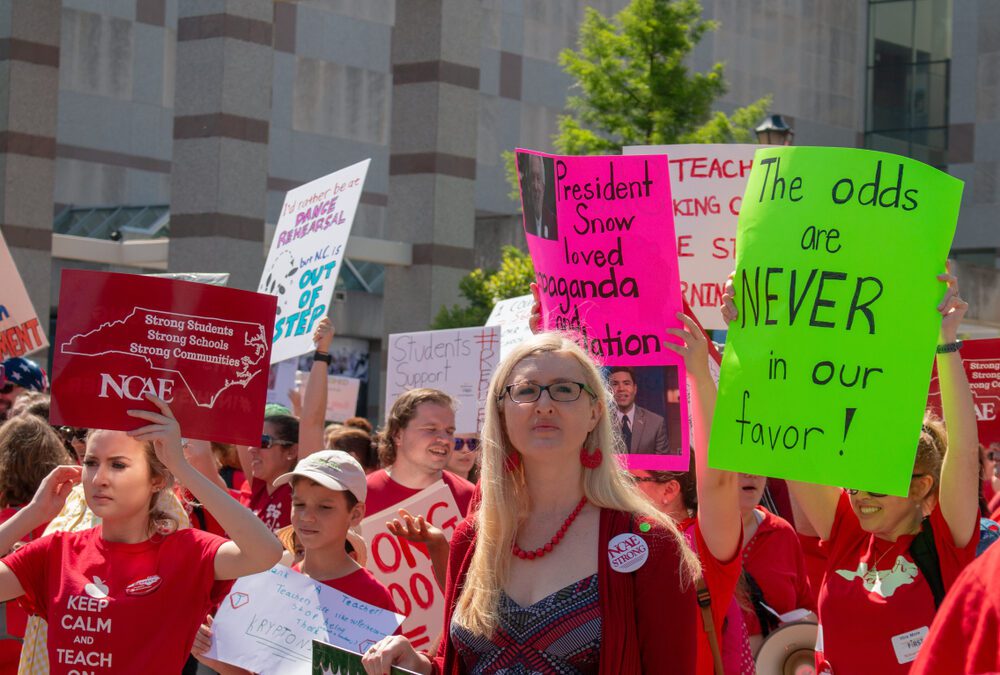
NC Supreme Court throws out Leandro school funding orders
The GOP-dominated NC Supreme Court decision vacates a 2023 trial court order requiring the state to transfer hundreds of millions of dollars for...
Video: North Carolina teachers getting hoodwinked on pay raises
Cardinal & Pine spoke with Rep. Lindsay Prather, a former educator, about the pay North Carolina teachers are getting. She says they're being...

Trump says millions are ‘lifted’ off SNAP. A Charlotte nonprofit says hunger hasn’t gone away in NC
More than 1.4 million North Carolinians rely on SNAP benefits to help pay for groceries. Boxes and tractor trailers loaded with donated food move...
Trump says millions are ‘lifted’ off SNAP. A Charlotte nonprofit says hunger hasn’t gone away in NC
More than 1.4 million North Carolinians rely on SNAP benefits to help pay for groceries. Boxes and tractor trailers loaded with donated food move...

Food insecurity is hitting thousands of NC children—and it’s following them into the classroom
More than 580,000 NC children rely on SNAP to help keep food on the table. On school mornings in North Carolina, some children arrive already...