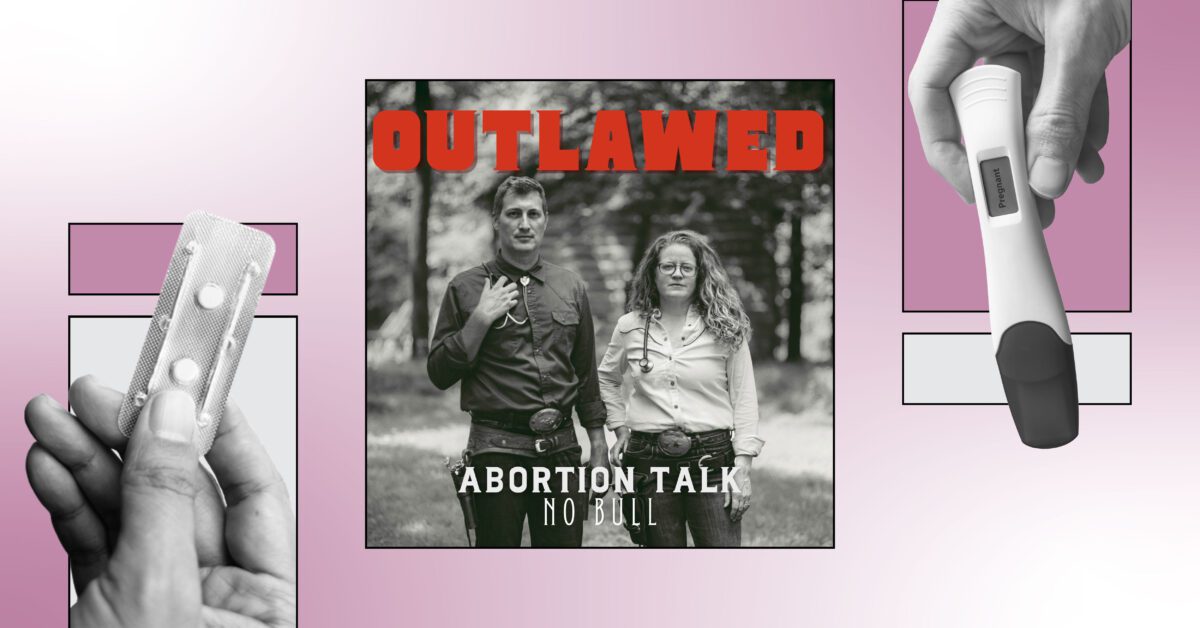
Courtesy Photo/Outlawed Podcast. COURIER Illustration.
At Duke University, two OB-GYNs want to help you start the hard conversations.
Before Dr. Beverly A. Gray and Dr. Jonas Swartz slip on their headphones and mic up, the two podcasters can be found in clinics or research meetings at Duke University. As associate professors of obstetrics and gynecology, they transform into content creators during a walk across campus to the recording studio, talking as they go about what they want to cover depending on their next guest—a reproductive activist, an economist, or even a patient.
During their lunch break, they co-host “Outlawed,” the biweekly North Carolina-based podcast where the two OB-GYNs try to make sense of abortion bans, misinformation on reproductive health, and the everyday lives caught in-between.
Through candid conversations and storytelling, they aim to make abortion care something people can talk about—not argue about.
A podcast born in the Dobbs era
The idea for “Outlawed” started in 2024, two years after the Dobbs decision. Gray and Swartz were collecting oral histories from abortion providers across the country, working with a group of graduate and undergraduate students, as well as an oral historian. Both had grown frustrated that so many stories about abortion care, especially the quiet, human ones, never reached the public.
“There are a lot of nuances to the care we provide,” Gray said. “There are a lot of ways that people are harmed that aren’t flashy to make the news, but still impact people’s lives. And so we wanted to convey what we were seeing, convey the humanity of the patients, the humanity of the providers, in a way that people could listen to.”
After going through a list of potential names, the title for the show came as a reflection of the changing times, Swartz said.
“We wanted one or two words that captured how our work and access to health care were changing,” Swartz said. “‘Outlawed’ worked as it evokes abortion bans but also the tongue-in-cheek notion that two ho-hum, normal doctors were suddenly outlaws for doing their job.”
Their guests range from clergy members to researchers, from economists to abortion storytellers. During their conversations, the two started to notice a theme: while abortion care was increasingly restricted, public dialogue around it was shrinking. Many Americans who supported access still felt uneasy talking about it.
Swartz said this group is called “the mushy middle,” meaning people who support abortion access but don’t know how to explain why. “Outlawed,” he said, is meant to give them language, facts, and confidence to have those difficult conversations, “even with Uncle Bob.”
The podcast, produced by Jane Marie’s Little Everywhere studio—the same team behind “This American Life” and “The Dream,” is free and ad-free on Apple Podcasts, Spotify, iHeart, YouTube, BuzzSpout, Substack, and other platforms.
Now in its newest second season, the two hosts have turned their attention to the data behind the Dobbs decision’s ripple effect. In their most recent episode, they speak with Caitlin Myers, an economist and professor at Middlebury College, and creator of the Abortion Access Dashboard, whose research maps how far patients now travel for care. According to the Guttmacher Institute, in 2024 alone, roughly 155,000 people crossed state lines for abortion procedures, despite growing restrictions.
Using applied microeconomics, Myers helped listeners understand how abortion bans influence access to care, travel burdens, and the broader economic ripple effects across the United States.
“What’s been so dismaying to me is how glib some of the political conversations seem to be—as though life isn’t incredibly complex, as though human bodies aren’t incredibly complex,” Myers said in the episode. “I understand how reasonable people can disagree. But reasonable people should be able to have a conversation about the evidence.”
‘We’re not political. We’re doctors.’
Both Gray and Swartz insist that “Outlawed” isn’t political. The hosts see the podcast as an extension of their daily work: caring for patients in a state where abortion access remains legal but increasingly limited.
RELATED: North Carolina Republicans introduce bill to ban nearly all abortions statewide
In North Carolina, abortion remains legal through 12 weeks of pregnancy, but a law passed by the Republican-led legislature in 2023 added new barriers, including a 72-hour waiting period, two in-person visits, and detailed state-mandated counseling.
Clinics have reported a rise in patients traveling from nearby states with stricter bans, while providers warn that the new rules still delay time-sensitive care for North Carolinians.
READ MORE: ‘They knew I wanted an abortion’: What she got instead at a ‘crisis pregnancy center’ in NC
“I’m not political, I’m just a doctor who’s trying to provide care, and that is really how I want to convey any message,” Gray said. “As OB-GYNs provide this care, we absolutely know what is safe for patients and know what is important. But when laws are written without counsel of OB-GYNs, without input from them, then the laws are really not meant to keep patients safe when they’re not talking to the expert.”
Beyond southern lines
Although both hosts live and practice in North Carolina, their episodes span the country. One featured anonymous patient voices from Texas, where abortion restrictions remain among the harshest in the nation. Another explored how misinformation spreads through social media and political campaigns.
“Our goal is for anyone who wants to learn more about abortion and about the science and stories of abortion that they could listen to no matter where they are,” Gray said. “I think many of these issues apply to both in restricted states across the country, but there are a lot of topics that are interesting for people even if you live in an access state. We want it to be approachable for everyone.”
The hosts say the podcast isn’t about persuasion, it’s about empathy. Listeners have written in to share that the show helped them talk with family members who disagreed with them. Others said it made them realize how limited their own knowledge had been.
“I’ve heard from medical students, residents, my colleagues, and I think that’s the most surprising thing,” Swartz said. “I have many brilliant colleagues, but many of them will say, ‘I really learned something. I love listening to this. You taught me so much about something.’ And it tells you about the fragmentation of knowledge in medicine. So it gives an opportunity to share that.”
And after the red recording light finally clicks off and they finalize their narrations, the doctors hang up their headphones and microphones, trade a few last thoughts about the episode, and step out of the studio. They cross campus together towards the undergraduate class they co-teach, ready to keep another kind of conversation going.
Author
Support Our Cause
Thank you for taking the time to read our work. Before you go, we hope you'll consider supporting our values-driven journalism, which has always strived to make clear what's really at stake for North Carolinians and our future.
Since day one, our goal here at Cardinal & Pine has always been to empower people across the state with fact-based news and information. We believe that when people are armed with knowledge about what's happening in their local, state, and federal governments—including who is working on their behalf and who is actively trying to block efforts aimed at improving the daily lives of North Carolina families—they will be inspired to become civically engaged.


NC canvassers brace for flood of anti-abortion messaging ahead of 2026 midterms
As a national anti-abortion group pours propaganda funds into North Carolina, one canvasser prepares for harder conversations. Emma Horst-Martz has...
NC House votes to block Medicaid patients from getting care at Planned Parenthood
Lawmakers transformed an HOA reform bill into a measure restricting preventative care access for thousands of low-income North Carolinians. For many...
‘They knew I wanted an abortion’: What she got instead at a ‘crisis pregnancy center’ in NC
When the clock is ticking on an unwanted pregnancy, many women go to the first search result that looks like it’ll help them get an abortion. That’s...
‘They knew I wanted an abortion’: What she got instead at a ‘crisis pregnancy center’ in NC
When the clock is ticking on an unwanted pregnancy, many women go to the first search result that looks like it’ll help them get an abortion. That’s...

‘I’m afraid of no access’: Calls flood NC clinics as providers warn of a backdoor abortion ban
Cancer screenings, STI tests, and birth control are at stake. At the clinic, questions started almost immediately. The MyChart messages and phone...