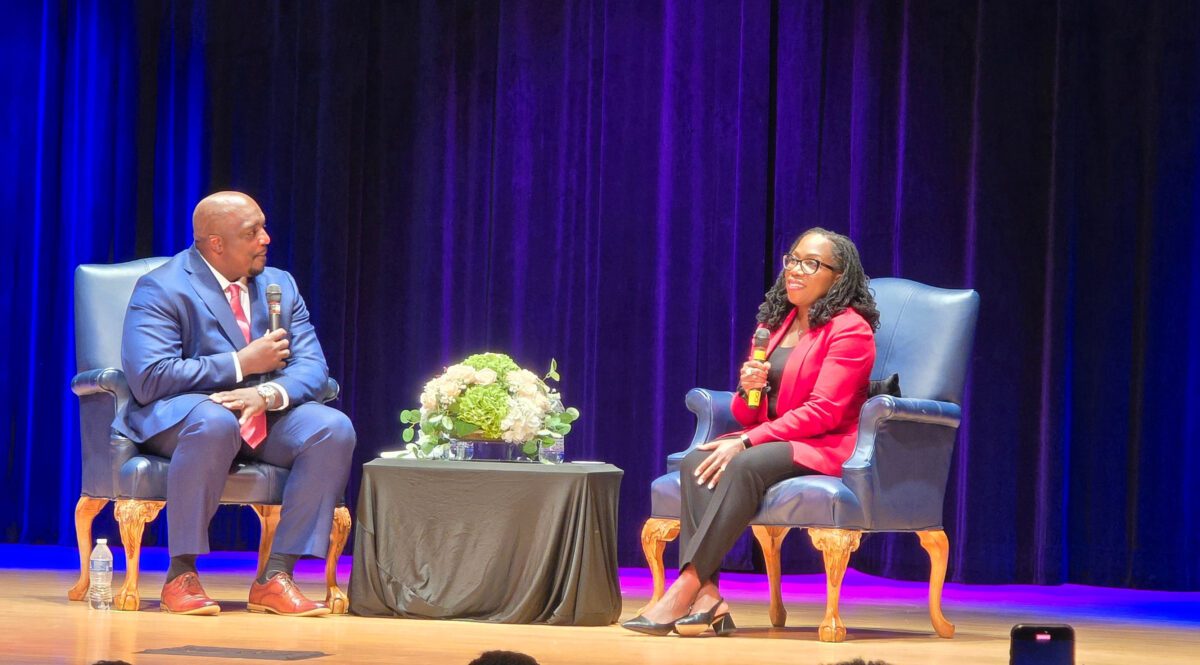
U.S. Supreme Court Justice Ketanji Brown Jackson is interviewed by Brandon Price, CEO of Fayetteville Area Habitat For Humanity, in an event in Seabrook Auditorium at Fayetteville State University Thursday, Sept. 4, 2025. (USA Today via Reuters)
Ketanji Brown Jackson, the first Black woman on the US Supreme Court, told her story at Fayetteville State University. Here’s what she had to say.
U.S. Supreme Court Justice Ketanji Brown Jackson shared a personal story from shortly into her freshman year at Harvard University. Jackson spoke around noon Sept. 4 at Fayetteville State University.
Back then, Jackson, a Floridian, had reached her 18th birthday — alone — and was having a tough time adjusting to the unfamiliar, New England environment; it was the first time she’d been away from her family on her birthday.
“I just remember going to the main campus library and sitting on the steps and sobbing on my birthday,” she said.
READ MORE: Opinion: Trump accused Biden of abandoning NC after Helene. Now, he’s doing just that
A couple of things turned it around for her. The first is that she was walking on a path on the yard and a Black woman whom she did not know was approaching from the other direction.
“As we crossed on the path, she leaned over and said, ‘persevere,’” Jackson said. That was all the woman said and kept walking. “That stuck with me. She had seen something in my face, in my demeanor, and she just wanted to give me a word.”
The second occurrence was that Jackson received a birthday letter from an aunt working abroad in the Peace Corps. Her aunt wrote: “I want you to remember that the Lord has put angels all around you to guide you and light your path.”
Jackson wondered if the woman she met along the way had been such an angel. “I started to change my mindset about feeling alone and feeling out of place.”
The story was one of several shared by Jackson in a highly personal interview conducted by Brandon Price, CEO of Fayetteville Area Habitat for Humanity, which sponsored Jackson’s appearance in Seabrook Auditorium. Jackson, appointed by President Joe Biden in April 2022, is the first Black woman to serve on the U.S. Supreme Court in the institution’s 233 years. She is on tour promoting her autobiography, “Lovely One,” which is the English translation of her West African name, Ketanji Onyika.
READ MORE: What’s new with Fayetteville restaurants? Here are 20 updates.
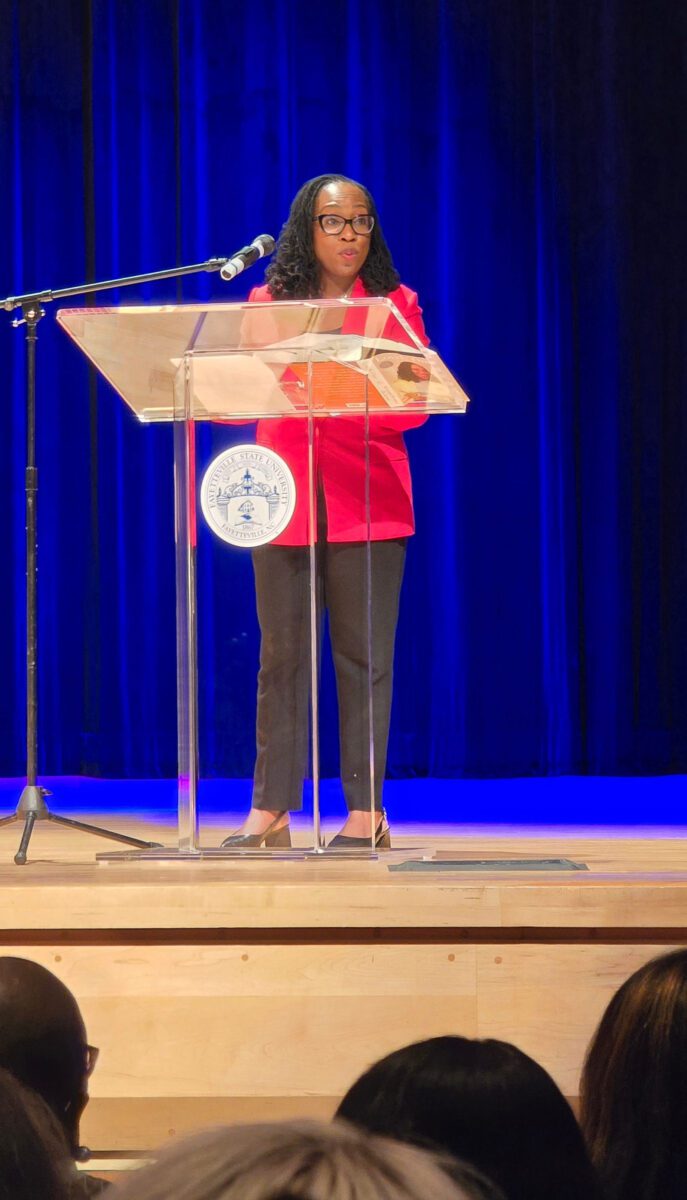
U.S. Supreme Court Justice Ketanji Brown Jackson speaks in Seabrook Auditorium at Fayetteville State University Thursday, Sept. 4, 2025.
Supreme Court Justice Ketanji Brown Jackson’s story is that of Black America
That word: “Persevere.”
Sitting in the full auditorium on Thursday, I thought about how the word can be applied not just to Jackson’s life but to the lives of Black people in the United States, her story being a significant milestone on a long journey.
FSU Chancellor Darrell T. Allison, in his opening remarks, said the historically Black school was the perfect destination for this moment, which was Jackson’s first visit to North Carolina.
Fayetteville State, founded in 1867 by seven enterprising men who invested $136, is the second-oldest public school in the state, Allison said.
The university is also a product of the Reconstruction, the incomplete attempt by the U.S. government to grant deserved rights to the formerly enslaved after the American Civil War; it was an ambitious project brought to a halt through Southern violence and intimidation and a feckless federal government. Someone like Jackson, Black and a woman, in her high position, would have been an unimaginable prospect for anyone living back then.
But there we all were.
“She hears us,” the chancellor said of Jackson, who was backstage at the time. “The SUPREME Court justice!”
The audience cheered.
Justice Jackson’s parents stressed education and achievement
Jackson appeared on a stage to applause and cheers and read from the preface of her book, in which she recounted the heady moment just before she was sworn in as the 116th justice on the nation’s highest court. “My heart was hammering so loudly that I wondered if the two black-robed men standing on either side of me, Chief Justice John G. Roberts Jr. and retiring Associate Justice Stephen G. Bryer, could hear it, too,” she said.
During her sit-down interview with Price, Jackson sketched out her life story. She was born in Washington, D.C., and raised in Miami by a father who was a history teacher turned lawyer and a mother who was an educator. She talked of the time when her family lived on campus at the University of Miami, when her father was a law student there.
“I will never forget that my earliest memories are of my dad sitting at a kitchen table in the apartment on campus,” she said. “He has his books and I have my coloring books.”
She believes that those times with her dad was her parents’ modeling the importance of education, early on. Later, her parents would press her to excel in academics and extracurricular activities — in any endeavor she tried. She got the message.
She recounted how she missed commencement at her high school, where she was class president, because it conflicted with a national forensics competition.
“I won,” she said, “So it was worth it.”
At Harvard, she fought against a rebel flag, and distractions
Jackson had an attentive audience in Seabrook, as she shared flashpoints from her life story, some from her autobiography. They included when someone at Harvard unfurled a huge rebel flag, “and they put a light behind it, to make sure everybody can see it.” Jackson and her girlfriends, who were fellow members of the Black Student Association, circulated flyers and campaigned to the university to get the flag taken down — to the point where their efforts were beginning to affect their studies.
Jackson said she was at a Black Student Association meeting and recalling a then-recent quote by Toni Morrison, a Nobel Prize-winning Black author, who said: “The very real function of racism is distraction.”
Jackson thought, “That’s kind of like what’s happening here, we need to make sure that we are continuing to do the work so that we don’t flunk out, which is precisely what this person would want.”
Supreme Court justice shares stories of humor, hairstyles and a conversation with her daughters
Justice Jackson shared other stories:
— How, before she started dating her future husband, Patrick, she was frustrated that he seemed to be two different people in two different classes they shared at Harvard. In one class, they talked and flirted. In another class, he looked at her as if he didn’t know her. She finally confronted him. He said, “You must be talking about my identical twin.” He had a twin at the university.
— How she settled on her hairstyle, sisterlocks, after seeing a woman crossing the street with her hair in that style. The new style saves Jackson from the hours she said she once spent on her perm and relaxer, but which she no longer had time for. She had enjoyed doing her hair, she said, but “you just get to the point where you have so many other responsibilities.” She has had the same sisterlocks stylist, whom the woman on the street had recommended, for 18 years. “I needed to find something that was going to be true to who I was, and then I could just keep going.”
— How she and Patrick sought their daughters’ approval before entering the process of vetting for the Supreme Court. They were particularly concerned for their older daughter, who is diagnosed with autism, and who may not have wanted attention brought to that. But both girls were encouraging, Jackson said. The older daughter said, “This is who I am. There’s nothing wrong with me. This is the way I navigate the world.”
Attendee at Fayetteville State event: Jackson was ‘amazing’
After the event, a line queued up to purchase signed copies of “Lovely One.”
Christal Carmichael, a psychology professor at N.C. Central University and a licensed therapist who drove down Thursday from Raleigh, said Jackson’s visit was “amazing.”
She said: “I thought that it was the perfect time for a strong, professional and Black woman to get on stage and share such vulnerability and passion for where she is and what she’s doing.”
Carmichael, whose parents have been married for 50 years, said she liked how Jackson highlighted her strong foundation and family. Carmichael is a Fayetteville native and graduate of FSU, whose parents are also alumni. Two younger brothers attended as well, one of whom played football, and an older sister graduated from a master’s program at FSU and is a pharmacist, Carmichael said.
“Even though she continued her career while building a family, she showed that was possible,” continued Carmichael, the mother of three. “That’s so very much needed for Black women today.”
Jackson’s was a message we all could appreciate, and it is a major chapter in the story of a people.
This article originally appeared on The Fayetteville Observer: The first Black woman on the Supreme Court wows Fayetteville State, a perfect venue | Opinion
Reporting by Myron B. Pitts, Fayetteville Observer / The Fayetteville Observer
USA TODAY Network via Reuters Connect
Author


NC commission advances PFAS testing rule for public review
Proposed rules that would require hundreds of industrial manufacturers and public sewer plants across the state to test the wastewater they...

Good New Friday: NC tops the country in workforce development, report says
State leaders tout new magazine ranking of states with the best workforce development, a Charlotte museum announces major AI grant funding, and a...

Opinion: The big problem with the plans for a Fayetteville data center
Why a proposed data center in Fayetteville poses a risk to the environment, to neighbors, and to locals' pocketbooks. In our city, Energy Storage...
Opinion: The big problem with the plans for a Fayetteville data center
Why a proposed data center in Fayetteville poses a risk to the environment, to neighbors, and to locals' pocketbooks. In our city, Energy Storage...

Good News Friday: Welcome the first NC babies of 2026
The first NC babies of 2026 are here. Plus, rural health upgrades and college football players give back in this week's "Good News Friday." If...