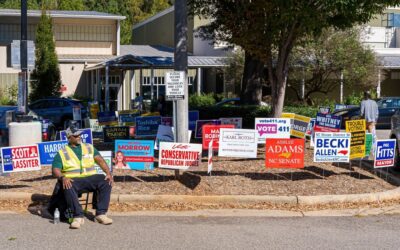
NC Supreme Court candidate Jefferson Griffin is asking the state's high court to overturn his 2024 election loss. (Photo via @officialjudgegriffin on Instagram)
Republican judge Jefferson Griffin’s controversial plea to throw out 60,000 votes—and make him the winner of the NC Supreme Court election—is sent back to state courts by a federal judge. Here’s what that means.
North Carolina’s state Supreme Court appears poised to decide if Republican judge Jefferson Griffin lost his election or not—even though multiple recounts have shown Griffin to have lost to Democrat Allison Riggs by more than 700 votes.
Read More: Opinion: Jefferson Griffin proves he isn’t fit to be on the NC Supreme Court
Multiple outlets reported Monday night that a Trump-appointed federal judge has passed the case back to the state courts. The state elections board could certify Griffin’s loss as soon as this week, though, meaning Griffin is hoping for the state Supreme Court to issue an injunction and quickly take up his case.
[UPDATE: The NC Supreme Court blocked certification of the election Tuesday afternoon and has agreed to hear Griffin’s protest in late January, according to NC journalist Bryan Anderson.
However, following an outcry from the public Tuesday, the court submitted a revised order, which appeared to show at least two Republican members of the Supreme Court are reluctant to throw out 60,000 votes. The order, among other things, included an uncommon dissent from conservative Justice Richard Dietz, who worried about the “incredible mischief” that Griffin’s case might invite if the court goes along with it. Dietz also called Griffin’s claims “almost certainly meritless.”]
View this post on Instagram
Griffin is asking the court he wants to join—which is also dominated by his political party—to throw out 60,000 votes, even though Griffin and Republicans haven’t proven that any of those voters are ineligible.
Advocates are pointing to this case as a major test for North Carolina democracy and judicial independence.
An N&O analysis of Griffin’s case found that Black voters were twice as likely as white voters to have their ballot challenged. He is challenging those voters for a number of reasons, but mostly because the voters’ registrations were missing some information in a state database, such as a Social Security number or a driver’s license number.
However, that doesn’t mean those voters, who had to show a voter ID before casting a ballot, aren’t eligible. The vast majority of these contested voters are likely eligible voters, and there are many valid reasons the information might be missing from the database, election officials say.
Stay tuned to Cardinal & Pine for updates.
View this post on Instagram
Author

Good News Friday: Signs of life abound in North Carolina film industry
North Carolina film leaders are bullish about the state's prospects for movie and TV productions, a decade after state leaders launched a grant...
Army considers Fort Bragg for massive data center project
The Army has selected Fort Bragg as one of four sites where commercial data center development is being considered. The growth of data centers in NC...

Asheville won’t be getting a CostCo after all—at least for now
Asheville residents have been eagerly awaiting a CostCo, but a proposed plan to build one in the western NC city has been withdrawn. After multiple...
Asheville won’t be getting a CostCo after all—at least for now
Asheville residents have been eagerly awaiting a CostCo, but a proposed plan to build one in the western NC city has been withdrawn. After multiple...

Former NC hog-feeding operation pollutes nearby waterways – again
By Eric TegethoffA North Carolina farm with a troubled history is once again being accused of polluting nearby waterways. The most recent round of...