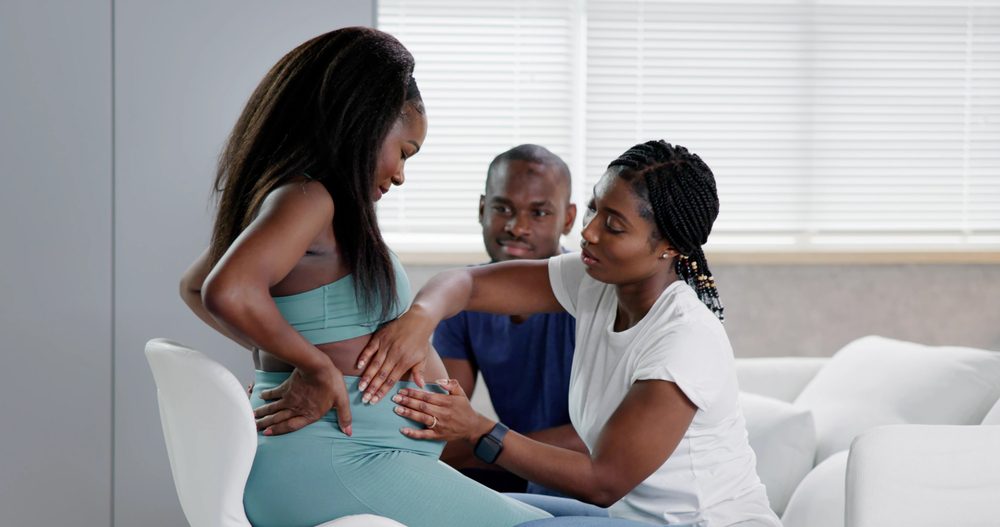
A North Carolina child fatality task force wants to make doula care more affordable by having it covered by Medicaid. It's an attempt to increase services in parts of the state that lack caregivers. (Shutterstock)
Doulas are non-medical aides who provide information and support to parents before, during, and shortly after the birth of their babies. Supporters say the state should make doulas in NC more affordable.
[Editor’s Note: This story was originally reported by NC Newsline.]
Members of a group seeking to improve the health of pregnant North Carolina residents before and after they give birth want to continue to advocate for state support to make doula services available to people on Medicaid.
Doulas are non-medical aides who provide information and support to parents before, during, and shortly after the birth of their babies.
‘You don’t know what you don’t know’: A Q&A with a NC doula on making maternal care affordable and accessible
A committee of the North Carolina Child Fatality Task Force discussed the potential for having the Medicaid program pay for doula services at its meeting Thursday.
About 120,000 babies were born to North Carolina residents in 2023, according to the CDC, and more than half were covered by Medicaid.
National groups such as the Institute for Medicaid Innovation and the National Law Health Program promote including doula services in Medicaid plans.
A 2022 study found that doula support decreases the likelihood of cesarean sections and postpartum depression among women who used Medicaid. A 2013 study found that mothers with low-incomes were more likely to have healthy babies, less likely to have birth complications and more likely to initiate breastfeeding when they had doula assistance before giving birth.
North Carolina has been thinking for years about making doula services available to people who use Medicaid.
In the last few years, the state Department of Health and Human Services has used grants to help support a handful of local doula programs run by county health departments.
It held a doula summit in 2022 to consider what Medicaid-supported doula services would look like, NC Newsline reported. It created a Doula Action Team this year to consider best practices.
Gov. Roy Cooper included Medicaid reimbursement in his recommended 2022-23 budget, but the General Assembly has not funded it.
Sen. Jim Burgin, a Harnett County Republican and chairman of the Senate Health and Human Services budget committee, said he’s been doing his own research on doulas and considered they may be an avenue to ensuring more women receive prenatal care.
“I’m going to work this next year to try to fund a bunch of this stuff,” said Burgin, who is also a member of the Child Fatality Task Force committee.
Interest around the country in Medicaid-supported doula services is accelerating.
The Child Fatality Task Force’s committee on Perinatal Health decided to recommend to the full committee that it keep asking that Medicaid pay for doula services. It would cost about $1.5 million a year for the reimbursements and $550,000 a year for training, promotion, and doula engagement. One of the concerns doulas have raised is how they will be integrated into the Medicaid payment system.
“Reimbursement is step one,” said Belinda Pettiford, a DHHS section chief. “You can’t do reimbursement if you don’t have the support system in place for the workforce.”
The committee also considered a request to support licensure for Certified Professional Midwives.
Certified Nurse Midwives are licensed to practice in North Carolina. License qualifications include a master’s degree or higher in nurse midwifery. The bill limiting abortions that the legislature passed last year included a provision that allows experienced nurse midwives to practice without doctors’ supervision.
Certified Professional Midwives are not licensed in the state, but families hire them for home births.
Nicole Havelka, president of the state chapter of the Association of Certified Professional Midwives, said CPMs could help address the lack of maternity care in rural and underserved areas.
Thirty-six states and Washington DC license Certified Professional Midwives, according to the national association.
The NC Medical Society has historically opposed CPM licensure.
The committee did not make a final decision whether to support CPM licensing, with members saying they needed to talk with more people interested in the issue.
NC Newsline is part of States Newsroom, a nonprofit news network supported by grants and a coalition of donors as a 501c(3) public charity. NC Newsline maintains editorial independence. Contact Editor Rob Schofield for questions: [email protected]. Follow NC Newsline on Facebook and X.
Author
Stein reverses Medicaid cuts, but warns of ‘devastating’ consequences if Republicans fail to fund the program
The governor cited court rulings that blocked some of the cuts, but said the state’s Medicaid fund would still run out of money in the spring if...

North Carolina continues to fail new moms and their babies, annual report shows
For the third year in a row, the March of Dimes gave the state a D+ for its record of ensuring healthy pregnancies and providing adequate access to...

What North Carolina Medicare enrollees should expect in 202
Medicare Advantage and traditional Medicare enrollees could see increases in premiums, deductibles and out-of-pocket expenses in 2026. by Ashley...
What North Carolina Medicare enrollees should expect in 202
Medicare Advantage and traditional Medicare enrollees could see increases in premiums, deductibles and out-of-pocket expenses in 2026. by Ashley...
NC program to support people with severe mental illness leaving prison
More than half of the people in the criminal justice system have a mental illness. A state program in NC wants to help them re-enter society. by...