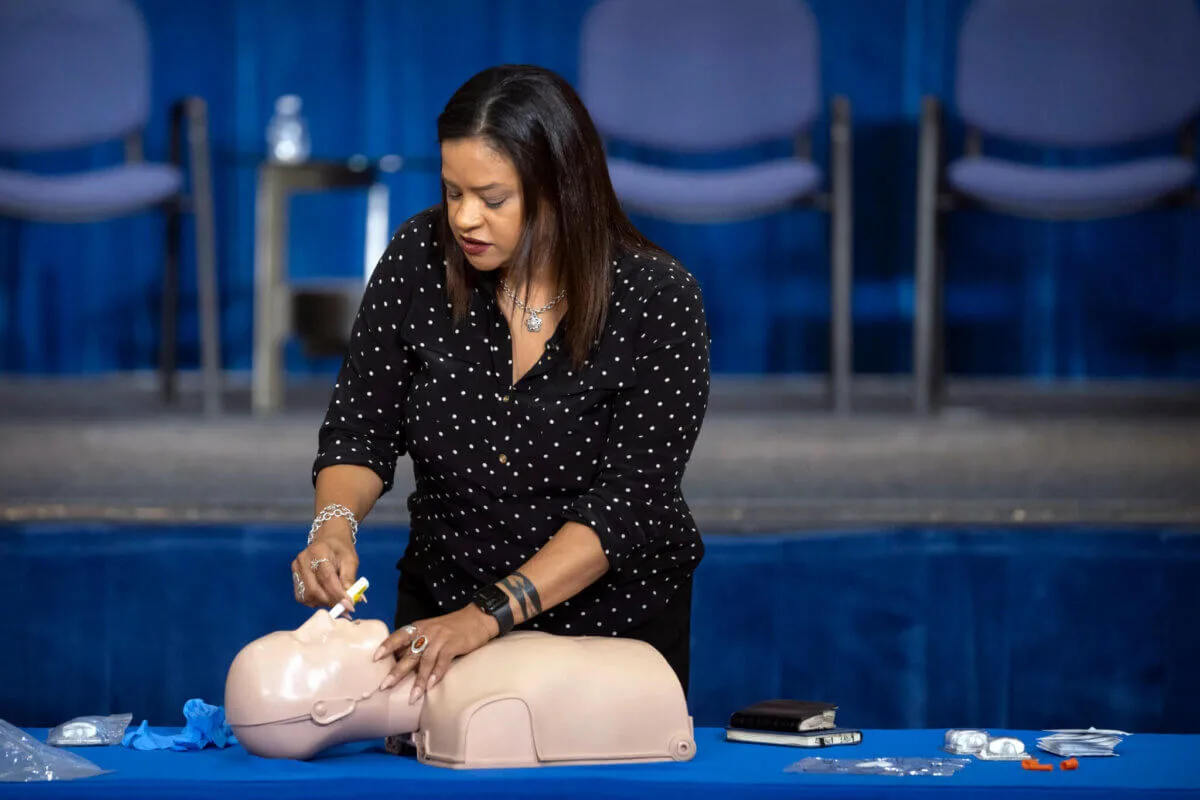
Rosalind Pichardo, the founder of the Philadelphia organization Operation Save Our City, demonstrates how to administer Narcan at the Health and Human Services Humphrey Building on Friday, Sept. 8, 2023, in Washington. Health officials held an event on Friday to mark the availability of the opioid overdose-reversal drug naloxone without a prescription. (AP Photo/Mark Schiefelbein)
This eastern NC County is using the cash to buy more Narcan, an emergency overdose treatment. They’re also partnering with local orgs to reach more people. Share this with someone in Wilson.
[Editor’s Note: If you or a loved one are struggling with addiction, and need help, check out these resources. No judgment. Just treatment.]
North Carolina is set to receive $1.5 billion in opioid settlement money from big pharma companies and their distributors for their role in the opioid crisis.
The first payments were made in May 2022 and the full settlement will be paid out over the next 18 years. Most of the money—85%—will go directly to North Carolina’s 100 counties and 17 municipalities, while the remaining 15% will be distributed at the state level.
We know Tar Heels. Sign up for our free, award-winning newsletter on everything NC.
More than 36,000 North Carolinians died from overdoses between 2000 and 2022, according to state health officials. And deaths have been trending upward, spiking during the pandemic.

NC opioid data (Graphs via the NC Department of Health and Human Services)
Local leaders are hoping the opioid settlement money will make a dent in these troubling figures.
Here’s how one NC county is using their money:
Wilson County in eastern NC is primed to implement its share with its well-established community resources and partners, including families and individuals who have experienced the ramifications of substance abuse.
In 2022, the Wilson County Opioid Multidisciplinary Team (OMDT), for example, won an award from the NC Association of County Commissioners for their strategies to prevent substance misuse, increase access to treatment, and fortify the recovery community.
Wilson has dedicated $575,000 of their settlement payment to support 8 strategies in 2023-2024:
- Expand equitable treatment for substance abuse
- Expand the availability of Naxalon (Narcan)
- Expand medication-assisted treatment for those with Opioid Use Disorder (OUD)
- Expand trauma-informed programming in the public school system
- Sustain Localized Syringe Services Programming
- Provide stipends to expand housing access for people in recovery
- Create and sustain an OUD data dashboard
- Supplement local non-profits, faith organizations, and other organizations actively involved in OUD prevention, treatment, harm reduction, and recovery
To learn more about Wilson County’s community partners and programming, visit the OMDT services page.
Author


Op-Ed: Studying the Holocaust remains vital to ensuring it never happens again
International Holocaust Day will be observed on January 27, 2024. This day commemorates the liberation of the Auschwitz concentration camp by the...

VIDEO: How Rural Broadband Is Coming to This North Carolina County
More than 1.1 million North Carolinians lack access to high-speed internet, a necessity of the modern economy. In Warren County, help is on the way,...
VIDEO: Sampson County puts Biden’s promise to boost rural infrastructure to the test
Locals in this rural NC county say their water and air is polluted by a PFAS-contaminated landfill, massive hog and poultry farms, and industrial...
VIDEO: Sampson County puts Biden’s promise to boost rural infrastructure to the test
Locals in this rural NC county say their water and air is polluted by a PFAS-contaminated landfill, massive hog and poultry farms, and industrial...

Mold and classes in trailers: Inadequate funding for schools is hurting NC communities
Schools across the state are dealing with dilapidated classrooms and buildings in need of significant repair or a total rebuild due to a lack of...