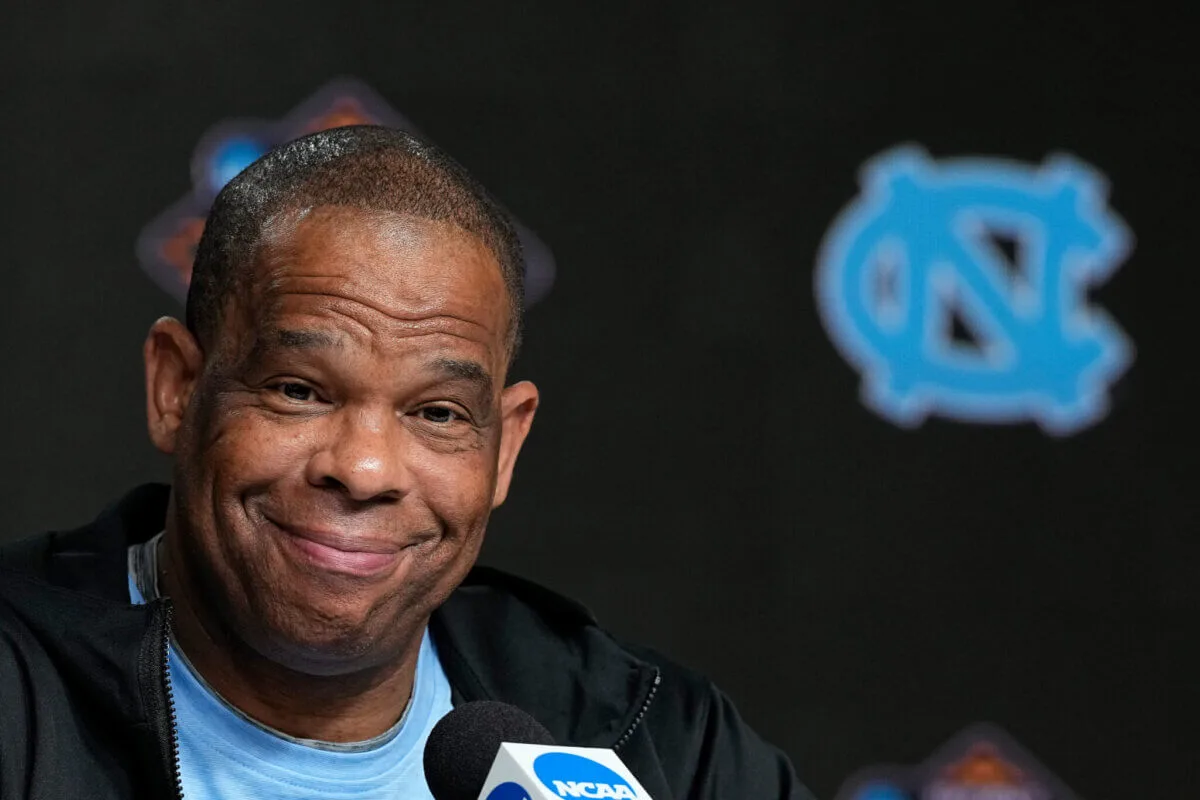
North Carolina head coach Hubert Davis speaks during a news conference about the Men's Final Four NCAA basketball tournament, Sunday, April 3, 2022, in New Orleans. North Carolina will face Kansas in the final game on Monday. (AP Photo/Brynn Anderson)
Unpacking an extraordinary first season for the first Black coach to lead the legendary basketball program at the University of North Carolina at Chapel Hill.
“Carolina didn’t get [Hubert Davis] because he was the best Black guy they could get,” legendary UNC basketball player Charlie Scott said to the News & Observer in 2021. “He was the best coach for Carolina. That’s why he got the job. I think that’s very important to understand.”
And so he was the best coach. Last week, he was named the winner of the John McClendon Award, given annually to the nation’s top college basketball coach. His team plays for a national championship Monday night in New Orleans.
But we’d miss a big part of the story if we didn’t talk about the history he’s making. Scott, the first Black scholarship player for UNC’s basketball team and a star for North Carolina in the peak of the 1960s Civil Rights Movement, knows that history well.
We know North Carolina. Subscribe to the free Cardinal & Pine newsletter.
When Davis was hired a year ago, he became the first Black coach to head the prestigious men’s basketball program more than a century into its history. If he wins tonight, Davis would be the first person ever to win a national championship in his first full season as head coach.
As the N&O noted last April, Davis also became just the fourth Black head coach in any sport in the university’s 133 years of athletic competition.
He is, clearly, more than good at coaching basketball. (Davis was good at playing basketball too. His shooting stroke — deployed at UNC from 1988 to 1992, and in the NBA from 1992 to 2004— was like a beautiful piece of architecture.)
Brick By Brick
There have been, without question, excellent Black basketball coaches in the last 133 years who never got the chance to coach at predominantly white institutions like UNC.
Without question.
North Carolina’s flagship public university is tied to the state’s history of racial oppression. Until 2018, the school’s football stadium was named for William Rand Kenan Sr.. Kenan played a pivotal role in the white supremacist takeover of Wilmington in 1898 and, subsequently, the white supremacist takeover of state government with the ascendance of Jim Crow laws.
“Brick by brick, that university is built on the premise of white supremacy and racism,” Geeta Kapur, the author of “To Drink From the Well: The Struggle for Racial Equality at the Nation’s Oldest Public University,” told Cardinal & Pine last year.
As Kapur explained, 30 of the university’s 40 original trustees owned enslaved people. And its leadership, for decades, was held by some of North Carolina’s most powerful white supremacists. The school’s first building – coincidentally the first public university building in the nation — was built by enslaved hands.
It wasn’t until 2020 that the school removed the name of Julian Carr from a building on campus. Carr was a Chapel Hill merchant whose advocacy and support for the Ku Klux Klan, the Wilmington Massacre, and white supremacy is well documented by this point, even if it is still not known by most North Carolinians.
It’s not just decades-old history.
Last year when the UNC system’s Board of Governors pressured UNC’s journalism school to rescind its offer of a tenured teaching position to the Pulitzer Prize-winning journalist and UNC alum Nikole Hannah Jones, it had nothing to do with Jones’ impeccable credentials and everything to do with her work documenting the history of racial oppression in this country.
None of these things will be talked about during tonight’s national championship. And that makes sense.
Tonight, win or lose, is a celebration of excellence in the sport, and a celebration of Davis’ extraordinary success in his first year.
But we cannot forget the historic significance of Davis. People who are the “first” at anything are honored, but also put under an unfair amount of scrutiny.
Those people who are “first” also open doors for those who come behind them.
Davis, regardless of tonight’s game, has opened countless doors.
Author

Support Our Cause
Thank you for taking the time to read our work. Before you go, we hope you'll consider supporting our values-driven journalism, which has always strived to make clear what's really at stake for North Carolinians and our future.
Since day one, our goal here at Cardinal & Pine has always been to empower people across the state with fact-based news and information. We believe that when people are armed with knowledge about what's happening in their local, state, and federal governments—including who is working on their behalf and who is actively trying to block efforts aimed at improving the daily lives of North Carolina families—they will be inspired to become civically engaged.

Op-Ed: Studying the Holocaust remains vital to ensuring it never happens again
International Holocaust Day will be observed on January 27, 2024. This day commemorates the liberation of the Auschwitz concentration camp by the...

VIDEO: How Rural Broadband Is Coming to This North Carolina County
More than 1.1 million North Carolinians lack access to high-speed internet, a necessity of the modern economy. In Warren County, help is on the way,...
VIDEO: Sampson County puts Biden’s promise to boost rural infrastructure to the test
Locals in this rural NC county say their water and air is polluted by a PFAS-contaminated landfill, massive hog and poultry farms, and industrial...
VIDEO: Sampson County puts Biden’s promise to boost rural infrastructure to the test
Locals in this rural NC county say their water and air is polluted by a PFAS-contaminated landfill, massive hog and poultry farms, and industrial...

Mold and classes in trailers: Inadequate funding for schools is hurting NC communities
Schools across the state are dealing with dilapidated classrooms and buildings in need of significant repair or a total rebuild due to a lack of...