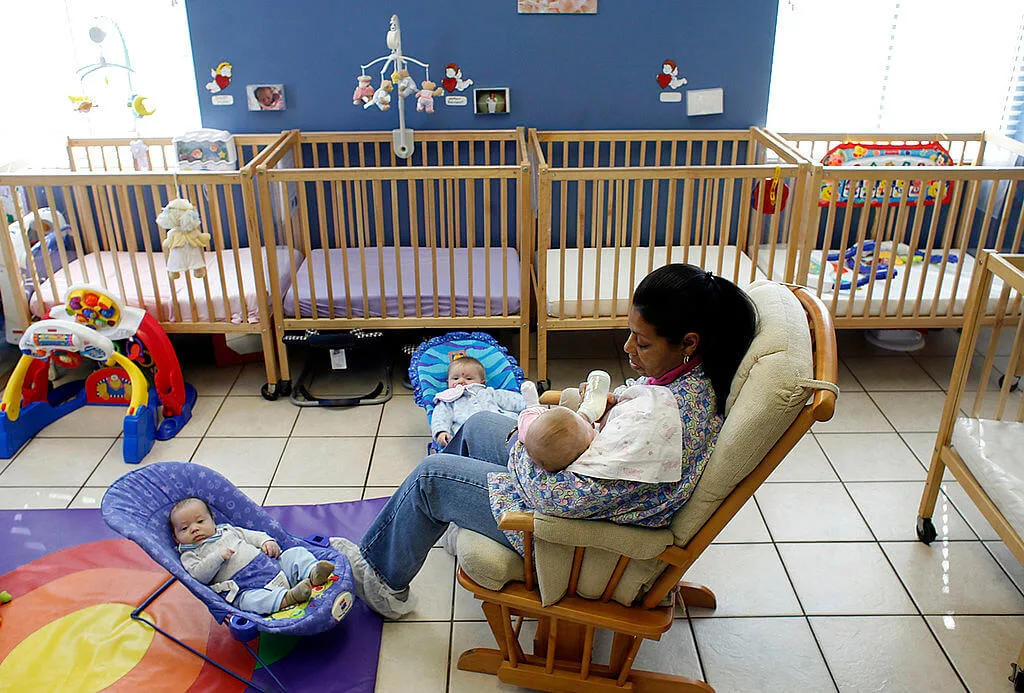
Daycare employee Remontia Greene tends to three infants in a preschool in Clayton, NC, in 2009. (Photo by Ted Richardson/Raleigh News & Observer/Tribune News Service via Getty Images)
Infrastructure isn’t just roads and bridges. Local leaders in North Carolina talk about how federal proposals could impact child care, internet service, and more.
The wait continues for Congress to pass the $1.2 trillion bipartisan infrastructure package that—according to its bipartisan supporters—is expected to improve roads, highways, broadband, clean water, and bring jobs to North Carolina.
Known as the “Bipartisan Infrastructure Investment and Jobs Act,” this critical funding backed by Democrats passed the US Senate last month key Republicans like Sen. Thom Tillis and Sen. Richard Burr on board, but is awaiting action in the US House of Representatives.
We put facts first, always. Subscribe to the free Cardinal & Pine newsletter.
In the last week, North Carolina state and local leaders, including US Rep. Deborah Ross (NC-02), Greensboro and Kinston Mayors Nancy Vaughan and Don Hardy, and North Carolina Democratic Party Chair Bobbie Richardson have publicly called on Congress to pass the bipartisan infrastructure bill.
“In Kinston, across eastern North Carolina, the bipartisan infrastructure deals historic investment in broadband will make a significant difference in our lives,” Hardy said in a video this week.
According to Broadband Now, a nonpartisan group that advocates for broadband access, large portions of rural North Carolina, particularly in eastern parts of the state, lack access to affordable broadband internet. Those gaps can have significant impacts on the local economy and education. The federal infrastructure bills include a $65 billion investment nationally to guarantee low-cost broadband, the largest broadband investment in decades in the US.
Democrats are also touting a second bill called the “Build Back Better Act,” a key priority for President Joe biden’s administration, that focuses on human infrastructure. This $3.5 trillion bill is expected to help with childcare costs for families that need it, strengthen family and medical leave policies. It also has a pair of significant education proposals, guaranteeing preschool for all kids and free community college.
US House progressives like Rep. Alexandria Ocasio-Cortez have threatened to vote “no” on the $1.2 trillion infrastructure package if it’s not linked to the larger budget human infrastructure bill.
House Democrats are still crafting the $3.5 trillion proposal, but House Speaker Nancy Pelosi has committed to a Sept. 27 deadline to vote on the bipartisan infrastructure package, in an effort to appease centrist lawmakers.
Watch C&P’s Max Millington break down the federal infrastructure plans and what they mean for North Carolina in the video below:
Author


Op-Ed: Studying the Holocaust remains vital to ensuring it never happens again
International Holocaust Day will be observed on January 27, 2024. This day commemorates the liberation of the Auschwitz concentration camp by the...

VIDEO: How Rural Broadband Is Coming to This North Carolina County
More than 1.1 million North Carolinians lack access to high-speed internet, a necessity of the modern economy. In Warren County, help is on the way,...
VIDEO: Sampson County puts Biden’s promise to boost rural infrastructure to the test
Locals in this rural NC county say their water and air is polluted by a PFAS-contaminated landfill, massive hog and poultry farms, and industrial...
VIDEO: Sampson County puts Biden’s promise to boost rural infrastructure to the test
Locals in this rural NC county say their water and air is polluted by a PFAS-contaminated landfill, massive hog and poultry farms, and industrial...

Mold and classes in trailers: Inadequate funding for schools is hurting NC communities
Schools across the state are dealing with dilapidated classrooms and buildings in need of significant repair or a total rebuild due to a lack of...