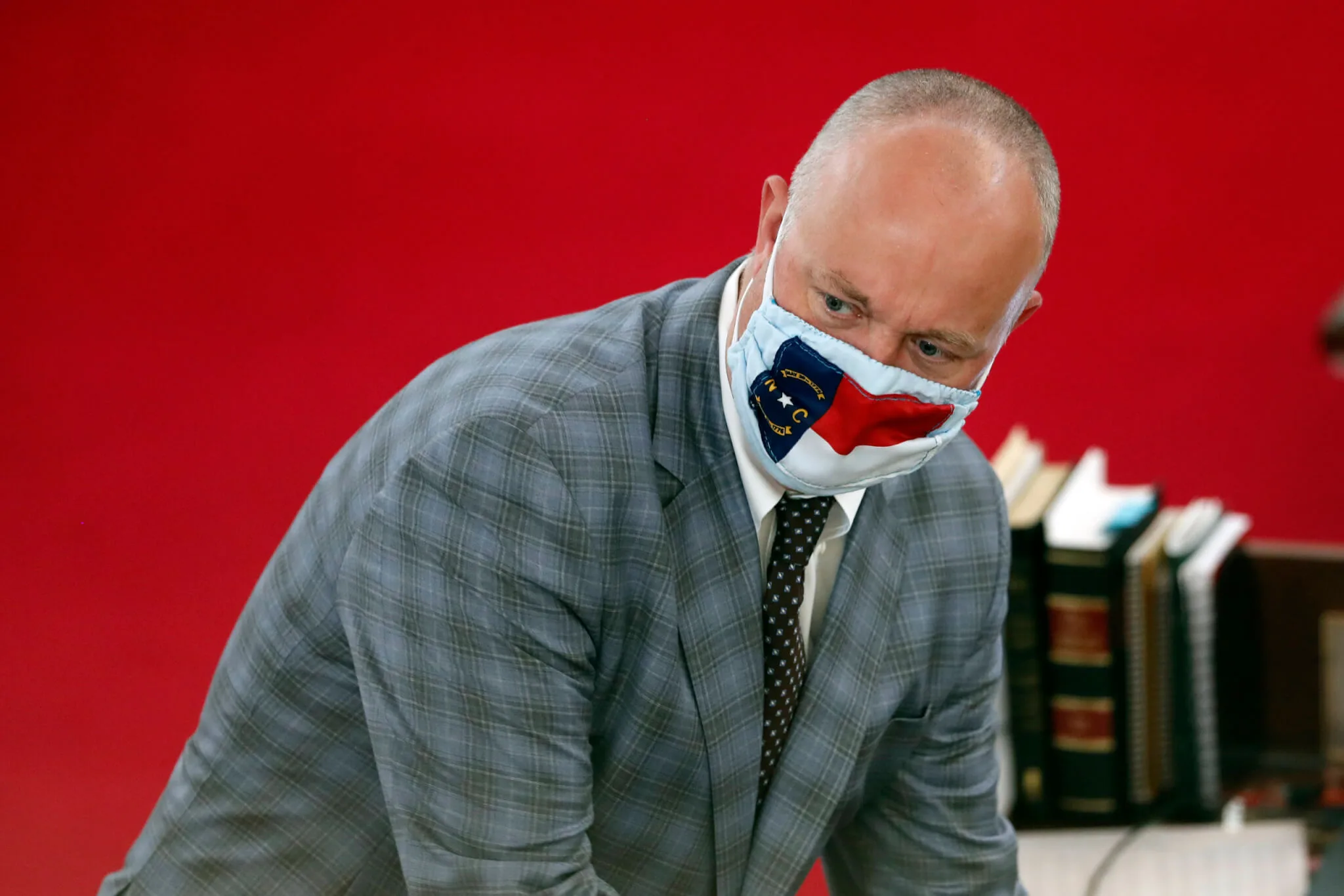
House minority leader Darren Jackson, D-Wake, wears a mask at the legislature in this April 28 file photo. (AP Photo/Gerry Broome)
With 1.5 million public school children relying on remote learning, dueling proposals would fund grants for local governments to build and lease Internet infrastructure.
Last year’s NC Fiber Act would have helped rural counties and municipalities build and lease broadband in areas without high-speed Internet access, a need cast in sharp relief during the coronavirus pandemic.
But the legislation, which had support from 70 Republican and Democratic lawmakers in the NC House of Representatives, more than half of the chamber, never got a vote despite a lack of Internet access in many of the state’s rural reaches.
Lawmakers from both parties are hoping to change that this year.
RELATED: What’s It Like Being A Seventh Grader In Quarantine? It’s A Little Bit Hilarious and Heartbreaking.
House Democrats have filed a broadband bill authorizing $85 million in spending over two years. A bipartisan group of Republicans and Democrats have their own proposal that would spend about $60 million on broadband grants, which have been under the microscope with many NC school systems relying on remote learning and online classes to reach students.
“How can we claim to be providing every child’s constitutional right to a ‘sound, basic education’ without access to the Internet in every home?”
Rep. Rachel Hunt, D-Mecklenburg
In addition to funding broadband expansion, Democrats’ legislation would encourage local governments to build public-private partnerships with providers and incentivize providers to expand their offerings, Democrats said.
Representatives for House Speaker Tim Moore’s office hadn’t responded to questions about the bills at press time, but Democrats on Thursday morning urged the chamber to take action expediently.
“How can we claim to be providing every child’s constitutional right to a ‘sound, basic education’ without access to the Internet in every home?” said Rep. Rachel Hunt, a Mecklenburg County Democrat who co-sponsored Democrats’ version. “We can’t. It’s time to fix that and value our children.”
Last month, Gov. Roy Cooper agreed with Moore and Senate President Phil Berger to a plan for spending federal COVID-19 relief money that included $9 million on rural broadband.
But lawmakers emphasized that the state needs much more to fill the gaps in North Carolina, particularly in rural counties outside of the state’s urban and suburban centers.
State Superintendent Mark Johnson reportedly told officials this week that he expects some students will be asked to continue remote learning in the fall as the pandemic lingers.

“It is not an optional infrastructure. It is like the telephone used to be,” said Rep. Ray Russell, a western NC Democrat who co-sponsored the bill. In Russell’s district, which includes Ashe and Watauga counties, 20 to 30% of residents are without broadband Internet, according to the U.S. Census bureau.
“Internet is now the basic tool for all of our students,” added Hunt. “It is used just like the pencil, paper, and textbook was in the past. These are basic needs and must be available and affordable.”
Access is even spottier in Rep. Joe Sam Queen’s district. The Democrat, who also co-sponsored his party’s bill, represents Swain, Jackson and Haywood counties in western NC, areas where about 30 to 50% of residents are without broadband.
“We all need affordable high-speed Internet to succeed,” Queen said Thursday.
Lynda Sossaman, mayor of the Jackson County town of Sylva, said broadband is “desperately needed” in her town. She talked about students studying in cars parked near temporary Internet signals, part of an emergency state initiative deploying school buses as Wi-Fi hotspots in remote locales.
“These are not the best conditions for learning,” said Sossaman.
RELATED: ‘Not All of Them Can Do Zoom’: NC Students Face Huge Inequalities as Coronavirus Closes Schools
Queen said Democrats’ proposal goes farther than Republicans by requiring that the state meet at least the minimum broadband standards set by the US Federal Communications Commission (FCC).
“We know what our students need,” said Rep. Hunt. “Now we must have the will to provide it.”
Author

Politics

Opinion: My aunt died of an illegal abortion. We can’t go back.
When I was growing up, I was always closer to my mom. She was easier to talk to. Whenever I had a problem or was concerned about something, the...

Trump says he would allow red states to track pregnancies, prosecute abortion ban violators
In an interview published by Time magazine this week, former president Donald Trump detailed his plans for a potential second term and said he would...
Local News

Does NC have more serial women poisoners than anywhere else? Getting to know NC true crime writer Cathy Pickens
Charlotte's Cathy Pickens is the NC author of the Blue Ridge Mountain Mysteries, a local true crime series. We had some burning questions for her....

NASA astronaut Christina Koch receives highest NC honor
Gov. Cooper honored NASA astronaut and North Carolina native Christina Koch while highlighting the state’s strong public schools. At a recent event,...