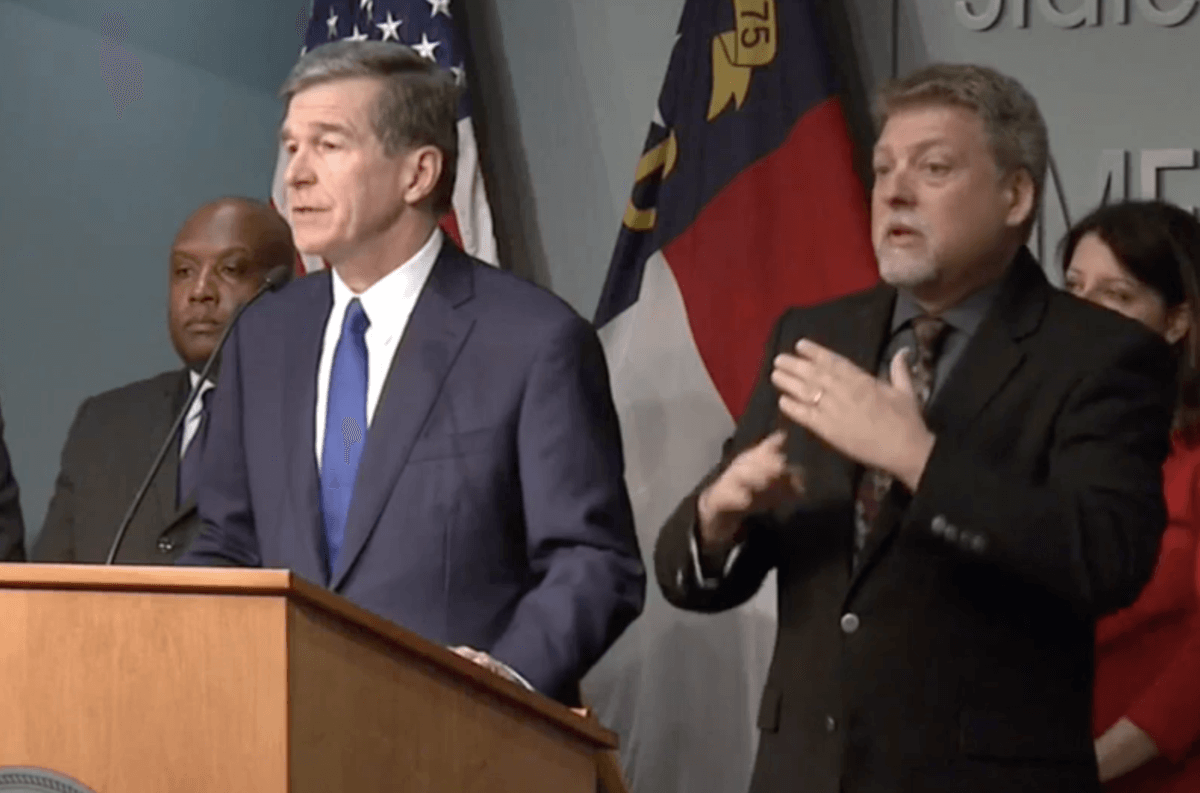
NC Gov. Roy Cooper. (Image via screenshot)
The declaration has also triggered anti-price gouging laws, which prevents retailers from overcharging in a crisis.
Gov. Roy Cooper declared North Carolina in a state of emergency Tuesday, as health and government officials scramble to contain coronavirus infections. Cooper requested testing supplies from the Centers for Disease Control and Prevention, but didn’t get as many as needed.
“I’ve talked with other governors; I’ve talked with the vice president. Every state is having this issue right now,” Cooper said.
The state has seven confirmed cases in the research triangle of Wake, Durham, and Orange counties. Government and private sector workers are being encouraged to work remotely, and Duke University will teach classes online. Schools that offer pre-K through 12th grade will remain open for now.
The emergency declaration “is an appropriate next step with the number of cases that have been identified,” said Dr. Wesley Burks, CEO of UNC Health Care, which operates 11 hospitals in the state.
Researchers say that every infected person spreads the virus to an estimated three more people. To prevent hospital staff and resources from being overwhelmed, Burks said all UNC hospitals will set up testing sites in unused office space this week, to screen people for COVID-19 and determine whether they should be admitted or if they can recuperate at home.
The state of emergency declaration has also triggered anti-price gouging laws, which prevents retailers from overcharging in a crisis. The Food and Drug Administration sent warning letters to seven companies advertising treatments for COVID-19, despite there being no federally approved drugs for treating novel coronavirus.
“There are bad people with bad intentions who try and exploit people to make a buck,” North Carolina Attorney General Josh Stein said. “If folks are seeing products that they need being offered at outrageous prices file a complaint with my office.”
Author


Op-Ed: Studying the Holocaust remains vital to ensuring it never happens again
International Holocaust Day will be observed on January 27, 2024. This day commemorates the liberation of the Auschwitz concentration camp by the...

VIDEO: How Rural Broadband Is Coming to This North Carolina County
More than 1.1 million North Carolinians lack access to high-speed internet, a necessity of the modern economy. In Warren County, help is on the way,...
VIDEO: Sampson County puts Biden’s promise to boost rural infrastructure to the test
Locals in this rural NC county say their water and air is polluted by a PFAS-contaminated landfill, massive hog and poultry farms, and industrial...
VIDEO: Sampson County puts Biden’s promise to boost rural infrastructure to the test
Locals in this rural NC county say their water and air is polluted by a PFAS-contaminated landfill, massive hog and poultry farms, and industrial...

Mold and classes in trailers: Inadequate funding for schools is hurting NC communities
Schools across the state are dealing with dilapidated classrooms and buildings in need of significant repair or a total rebuild due to a lack of...